During the Indian Freedom Struggle, why did Rowlatt Act arouse popular indignation?

- AIt curtailed the freedom of religion
- BIt suppressed the Indian traditional education
- CIt authorized the government to imprison people without trialCorrect
- DIt curbed the trade union activities
Explanation
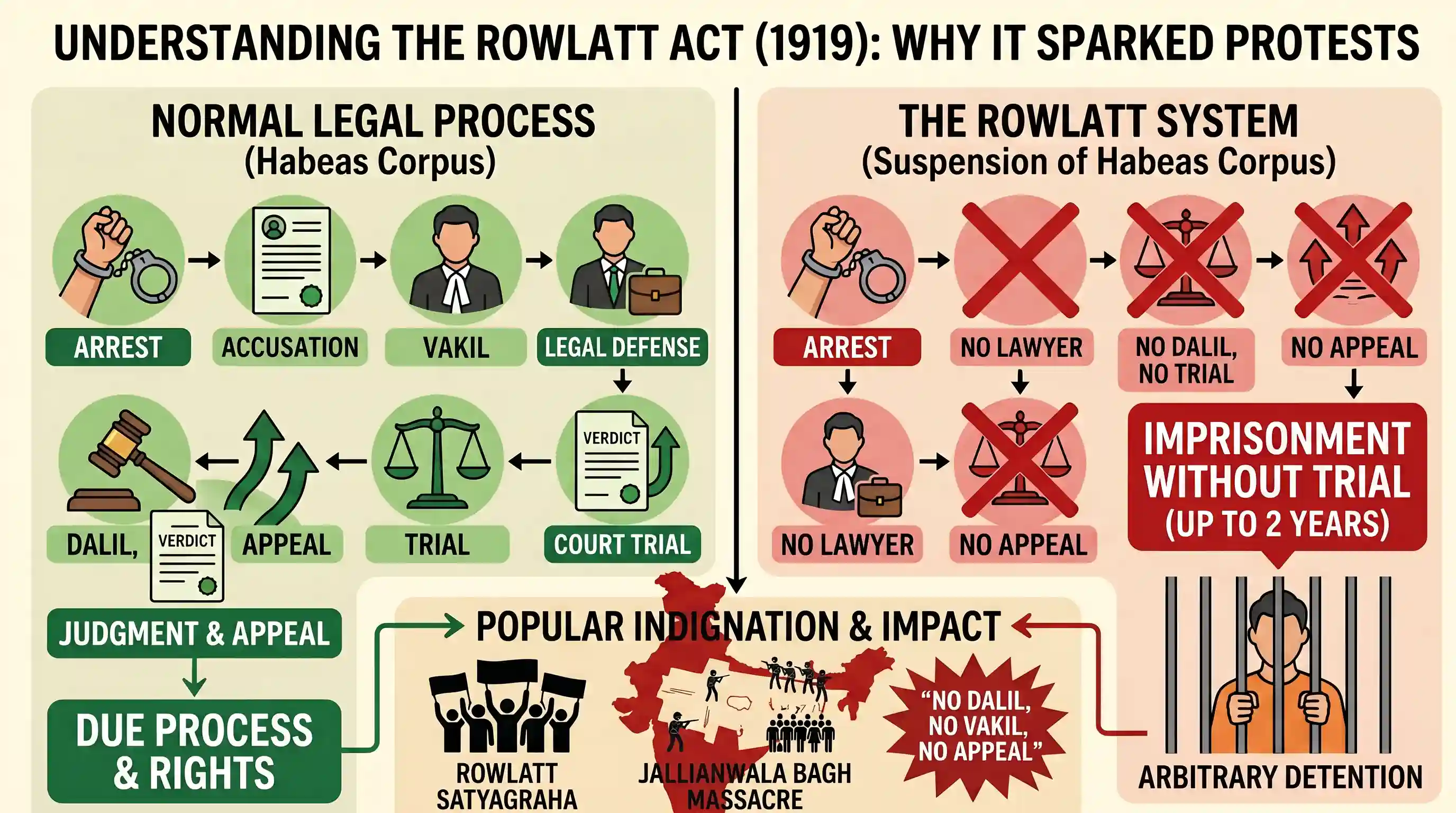
The Rowlatt Act of 1919 officially known as the Anarchical and Revolutionary Crimes Act allowed the British government to detain political activists and suspects without trial for up to two years. This suspension of the right to habeas corpus and the denial of legal defense led to the famous slogan No Dalil No Vakil No Appeal. Because it violated fundamental civil liberties and allowed for arbitrary imprisonment it triggered widespread protests and indignation across India eventually leading to the Jallianwala Bagh massacre.
Related questions
More UPSC Prelims practice from the same subject and topic.
- Prelims 2009GS1history
In the ‘Individual Satyagraha’, Vinoba Bhave was chosen as the first Satyagrahi. Who was the second?
- Prelims 2009GS1history
Consider the following statements: The Cripps Proposals include the provision for 1. Full independence for India. 2. Creation of Constitution-making body. Which of the statements given above is/are co…
- Prelims 2009GS1history
During which Five Year Plan was the Emergency clamped, new elections took place and the Janata Party was elected?
- Prelims 2009GS1history
In collaboration with David Hare and Alexander Duff, who of the following established Hindu College at Calcutta?
- Prelims 2009GS1history
Who of the following Prime Ministers sent Cripps Mission to India?
- Prelims 2009GS1history
Which one of the following began with the Dandi March?