A question paper had ten questions. Each question could only be answered as True (T) or False (F). Each candidate answered all the questions. Yet, no two candidates wrote the answers in an identical sequence. How many different sequences of answers are possible?

- A20
- B40
- C512
- D1024Correct
Explanation
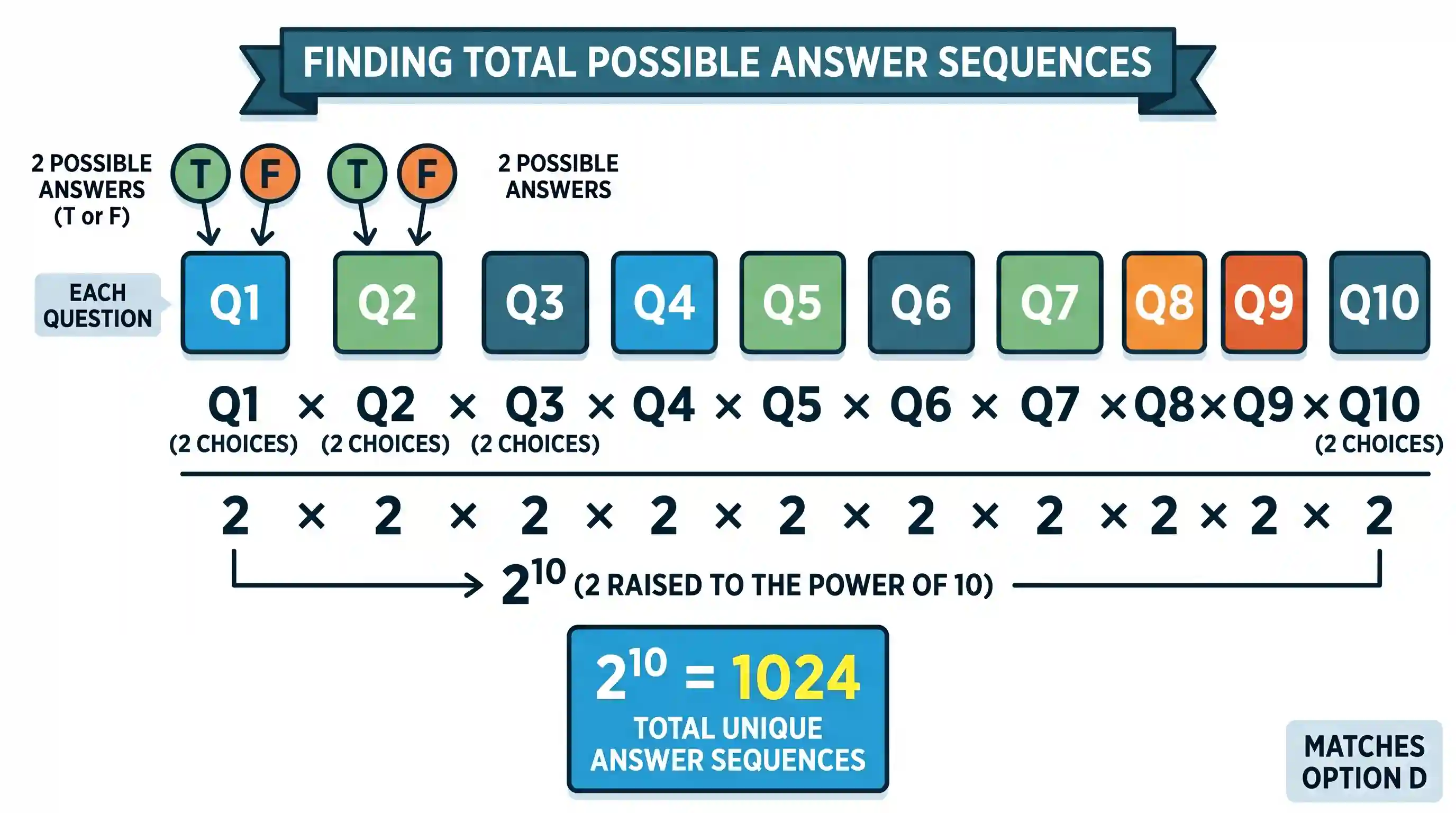
The problem asks for the total number of possible sequences for ten questions, where each question has two choices, True or False.
This is a fundamental principle of counting. For each individual question, there are 2 possible outcomes. Since there are 10 questions and each is independent of the others, we multiply the number of choices for each question together.
The calculation is 2 multiplied by itself 10 times, which is 2 raised to the power of 10.
2 x 2 x 2 x 2 x 2 x 2 x 2 x 2 x 2 x 2 equals 1024.
Therefore, there are 1024 different possible sequences of answers. Since no two candidates wrote identical sequences, this is the maximum number of unique answer keys possible.
The correct option is D.
Related questions
More UPSC Prelims practice from the same subject and topic.
- Prelims 2010GS1science-and-technology
If a potato is placed on a pure paper plate which is white and unprinted and put in a microwave oven, the potato heats up but the paper plate does not. This is because
- Prelims 2010GS1science-and-technology
A cuboid has six sides of different colours. The red side is opposite to black. The blue side is adjacent to white. The brown side is adjacent to blue. The red side is face down. Which one of the foll…
- Prelims 2010GS1science-and-technology
Chlorination is a process used for water purification. The disinfecting action of chlorine is mainly due to
- Prelims 2010GS1science-and-technology
Widespread resistance of malarial parasite to drugs like chloroquine has prompted attempts to develop a malarial vaccine to combat malaria. Why is it difficult to develop an effective malaria vaccine?
- Prelims 2010GS1science-and-technology
India-based Neutrino Observatory is included by the Planning Commission as a mega science project under the 11th Five-Year Plan. In this context, consider the following statements: 1. Neutrinos are ch…
- Prelims 2010GS1science-and-technology
Hydrogen fuel cell vehicles produce one of the following as “exhaust”