In the context of governance, consider the following: 1. Encouraging Foreign Direct Investment inflows 2. Privatization of higher educational Institutions 3. Down-sizing of bureaucracy 4. Selling/offloading the shares of Public Sector Undertakings Which of the above can be used as measures to control the fiscal deficit in India?

- A1, 2 and 3
- B2, 3 and 4
- C1, 2 and 4
- D3 and 4 onlyCorrect
Explanation
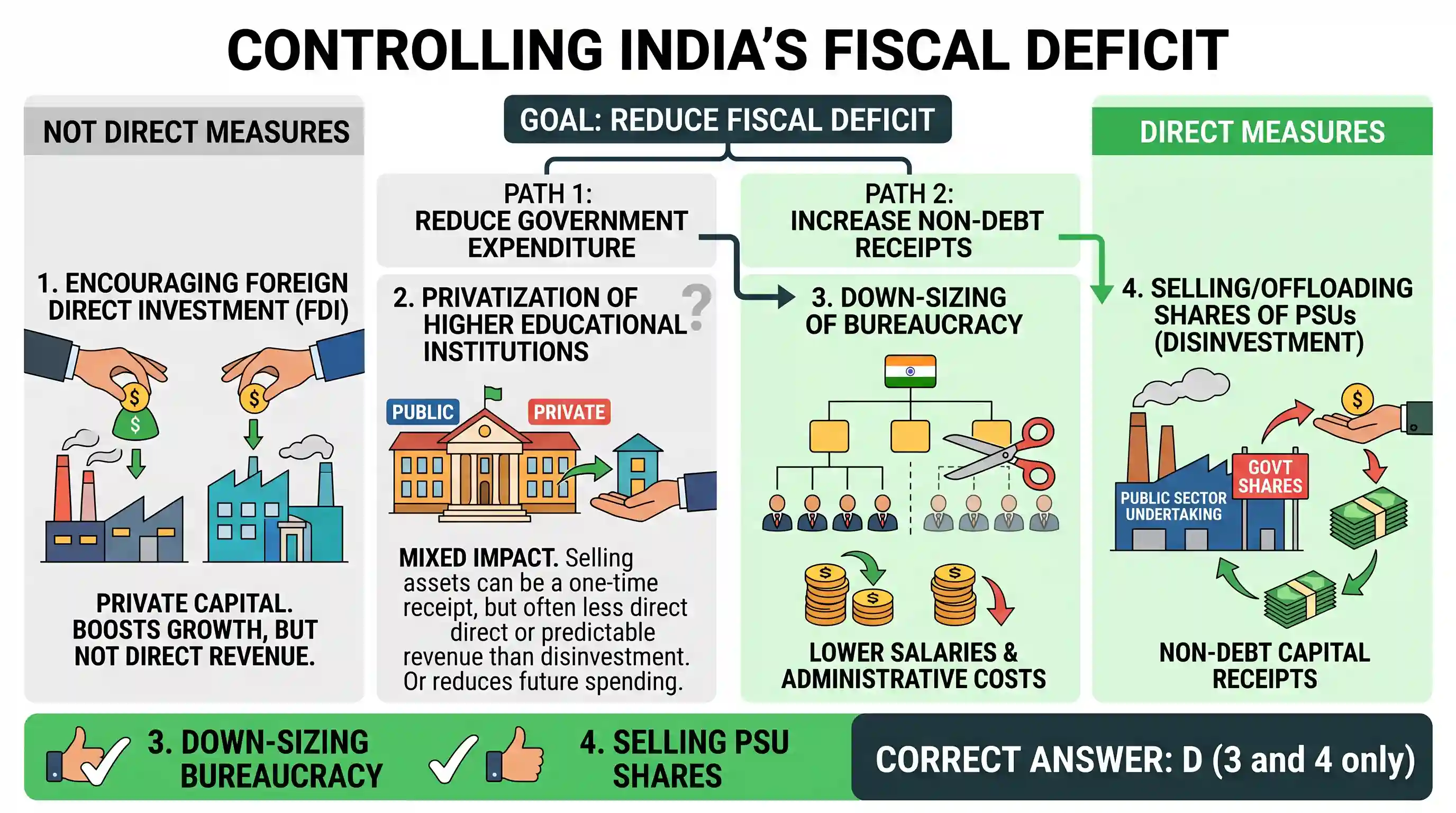
The fiscal deficit is the difference between the government's total expenditure and its total receipts (excluding borrowings). To control it, the government can either reduce its expenditure or increase its non-debt receipts.
Let's analyze each statement:
-
Encouraging Foreign Direct Investment (FDI) inflows: FDI is private capital flowing into the country. It is not a direct source of revenue for the government, nor does it directly reduce government expenditure. While it can boost economic growth and potentially lead to higher tax revenues in the long run, it is not a direct measure to control the current fiscal deficit.
-
Privatization of higher educational Institutions: If this implies selling existing public educational institutions, it would generate one-time capital receipts for the government, thus reducing the fiscal deficit. However, if it refers to encouraging private players to set up new institutions, it would reduce the government's future expenditure burden but not directly impact the current fiscal deficit through revenue generation. Compared to disinvestment of PSUs, it might be a less frequent or significant measure. Given that 3 and 4 are more direct and unambiguous, this statement's impact is less certain or direct in the context of primary deficit control measures.
-
Down-sizing of bureaucracy: This involves reducing the number of government employees and associated administrative costs. This directly leads to a reduction in government expenditure (salaries, pensions, operational costs), which in turn helps control the fiscal deficit.
-
Selling/offloading the shares of Public Sector Undertakings (PSUs): This is known as disinvestment. The proceeds from selling government shares in PSUs are classified as non-debt capital receipts. An increase in these receipts directly reduces the fiscal deficit.
Statements 3 and 4 are direct and unambiguous measures to control the fiscal deficit by reducing expenditure and increasing non-debt receipts, respectively. Statement 1 is not a direct measure. Statement 2, while potentially generating revenue if it means selling existing assets, is less direct or significant as a general control measure compared to 3 and 4, and its interpretation can be ambiguous.
Therefore, the most direct and effective measures listed are 3 and 4.
The final answer is D
Related questions
More UPSC Prelims practice from the same subject and topic.
- Prelims 2010GS1economy
Which one of the following was not stipulated in the Fiscal Responsibility and Budget Management Act, 2003?
- Prelims 2010GS1economy
Consider the following actions by the Government: 1. Cutting the tax rates 2. Increasing the government spending 3. Abolishing the subsidies In the context of economic recession, which of the above ac…
- Prelims 2010GS1economy
With reference to the National Investment Fund to which the disinvestment proceeds are routed, consider the following statements: 1. The assets in the National Investment Fund are managed by the Union…
- Prelims 2010GS1economy
In India, the tax proceeds of which one of the following as a percentage of gross tax revenue has significantly declined in the last five years?
- Prelims 2010GS1economy
In the context of the affairs of which of the following is the phrase “Special Safeguard Mechanisms” mentioned in the news frequently?
- Prelims 2010GS1economy
Which of the following terms indicates a mechanism used by commercial banks for providing credit to the government?