With reference to the National Investment Fund to which the disinvestment proceeds are routed, consider the following statements: 1. The assets in the National Investment Fund are managed by the Union Ministry of Finance. 2. The National Investment Fund is to be maintained within the Consolidated Fund of India. 3. Certain Asset Management Companies are appointed as the fund managers. 4. A certain proportion of annual income is used for financing select social sectors. Which of the statements given above is/are correct?

- A1 and 2
- B2 only
- C3 and 4Correct
- D3 only
Explanation
The National Investment Fund (NIF) was set up in November 2005 to manage the proceeds from the disinvestment of Central Public Sector Enterprises.
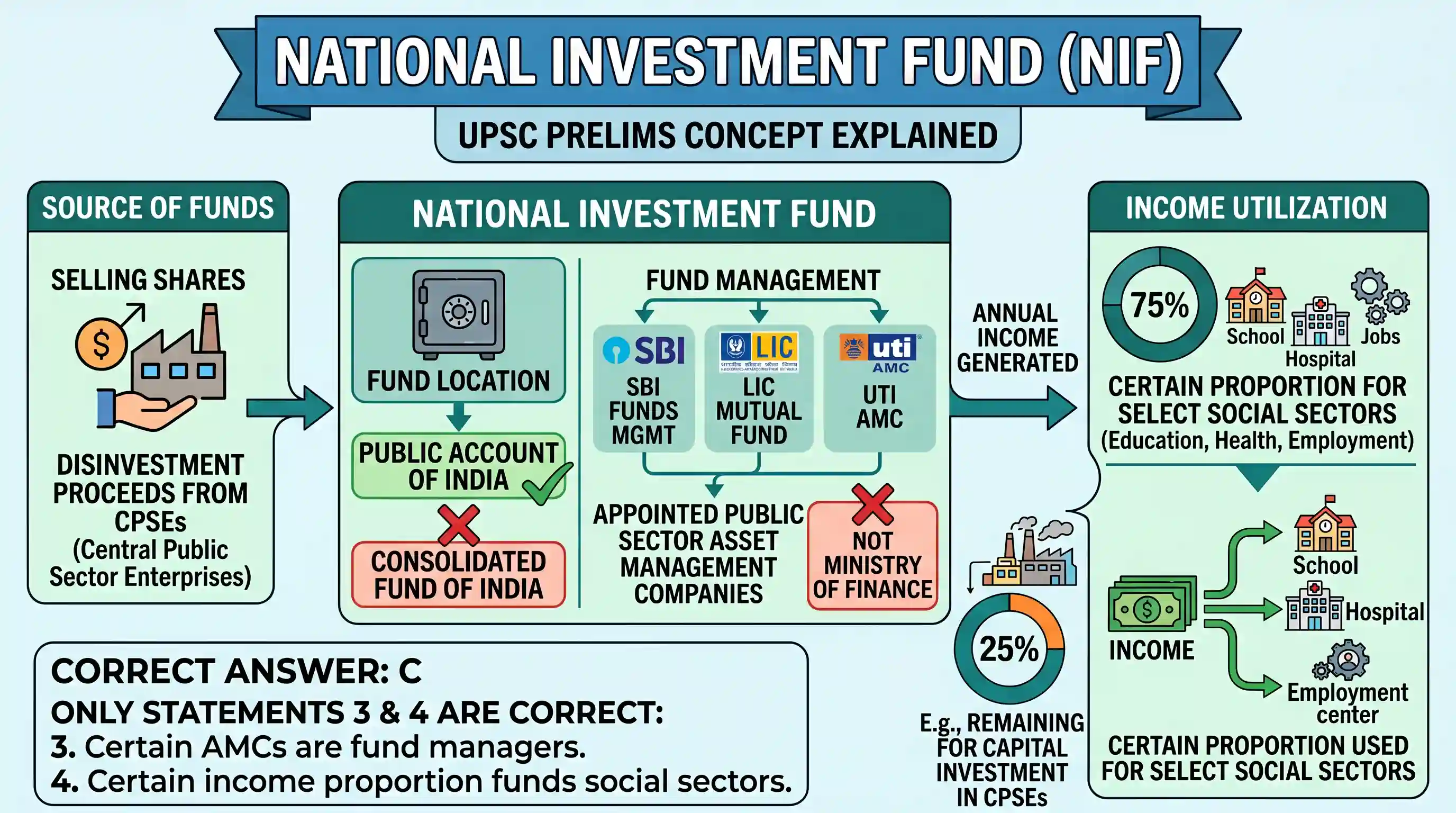
Statement 1 is incorrect. The NIF is not managed directly by the Union Ministry of Finance. Its assets are managed by professional fund managers — public sector Asset Management Companies (initially UTI AMC, SBI Funds Management and LIC Mutual Fund AMC).
Statement 2 is incorrect. NIF proceeds are not kept within the Consolidated Fund of India; they are maintained in the Public Account of India, outside the Consolidated Fund.
Statement 3 is correct. As noted above, designated public sector Asset Management Companies are appointed as the fund managers of NIF.
Statement 4 is correct. As per the original 2005 NIF guidelines, 75% of the annual income generated by the fund was earmarked for select social sector schemes (education, health and employment), so a certain proportion of the annual income is indeed used to finance select social sectors.
Therefore, only statements 3 and 4 are correct, and the answer is option C.
Related questions
More UPSC Prelims practice from the same subject and topic.
- Prelims 2010GS1economy
Which one of the following was not stipulated in the Fiscal Responsibility and Budget Management Act, 2003?
- Prelims 2010GS1economy
In the context of governance, consider the following: 1. Encouraging Foreign Direct Investment inflows 2. Privatization of higher educational Institutions 3. Down-sizing of bureaucracy 4. Selling/offl…
- Prelims 2010GS1economy
Consider the following actions by the Government: 1. Cutting the tax rates 2. Increasing the government spending 3. Abolishing the subsidies In the context of economic recession, which of the above ac…
- Prelims 2010GS1economy
In India, the tax proceeds of which one of the following as a percentage of gross tax revenue has significantly declined in the last five years?
- Prelims 2010GS1economy
In the context of the affairs of which of the following is the phrase “Special Safeguard Mechanisms” mentioned in the news frequently?
- Prelims 2010GS1economy
Which of the following terms indicates a mechanism used by commercial banks for providing credit to the government?