Consider the following statements: 1. Dr. Rajendra Prasad persuaded Mahatma Gandhi to come to Champaran to investigate the problem of peasants. 2. Acharya J. B. Kriplani was one of Mahatma Gandhi’s colleagues in his Champaran investigation. Which of the statements given above is/are correct?

- A1 only
- B2 onlyCorrect
- CBoth 1 and 2
- DNeither 1 nor 2
Explanation
The correct answer is B because of the following reasons:
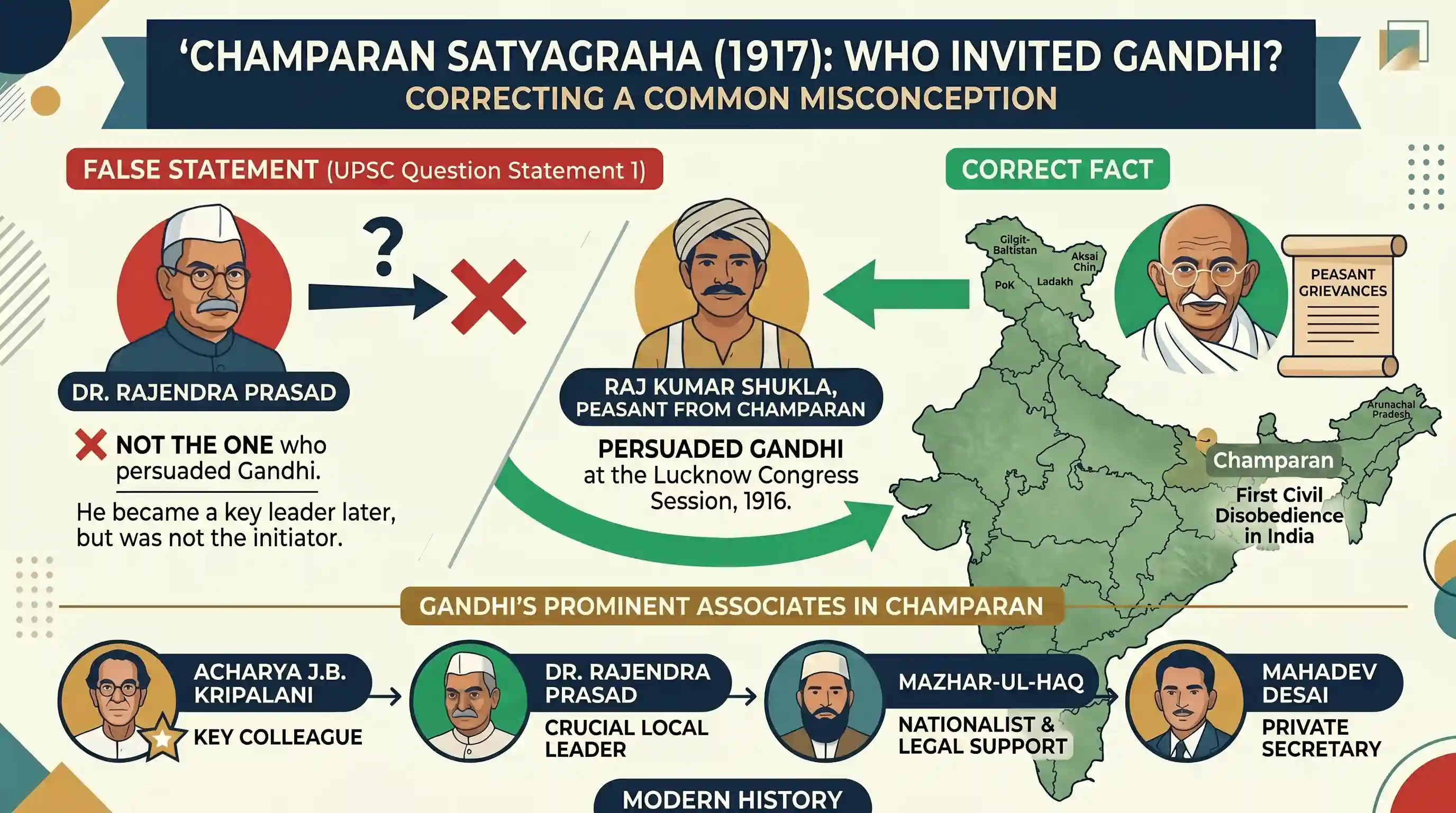
Statement 1 is incorrect. It was Raj Kumar Shukla, a local cultivator from Champaran, who met Mahatma Gandhi at the Lucknow session of the Indian National Congress in 1916 and persuaded him to visit Champaran to investigate the grievances of the indigo farmers. While Dr. Rajendra Prasad later became a key associate of Gandhi during the movement, he was not the one who invited him.
Statement 2 is correct. Acharya J. B. Kripalani was indeed one of the prominent colleagues who assisted Mahatma Gandhi during the Champaran investigation. Other notable associates included Dr. Rajendra Prasad, Mazhar-ul-Haq, Mahadev Desai, and Narhari Parikh.
Therefore, only the second statement is accurate.
Related questions
More UPSC Prelims practice from the same subject and topic.
- Prelims 2010GS1history
With reference to Simon Commission’s recommendations, which one of the following statements is correct?
- Prelims 2010GS1history
Four resolutions were passed at the famous Calcutta session of Indian National Congress in 1906. The question of either retention OR of rejection of these four resolutions became the cause of a split …
- Prelims 2010GS1history
After Quit India Movement, C. Rajagopalachari issued a pamphlet entitled “The Way Out”. Which one of the following was a proposal in this pamphlet?
- Prelims 2010GS1history
Who among the following Governor Generals created the Covenanted Civil Service of India which later came to be known as the Indian Civil Service?
- Prelims 2010GS1history
What was the immediate cause for the launch of the Swadeshi movement?
- Prelims 2010GS1history
By a regulation in 1793, the District Collector was deprived of his judicial powers and made the collecting agent only. What was the reason for such regulation?