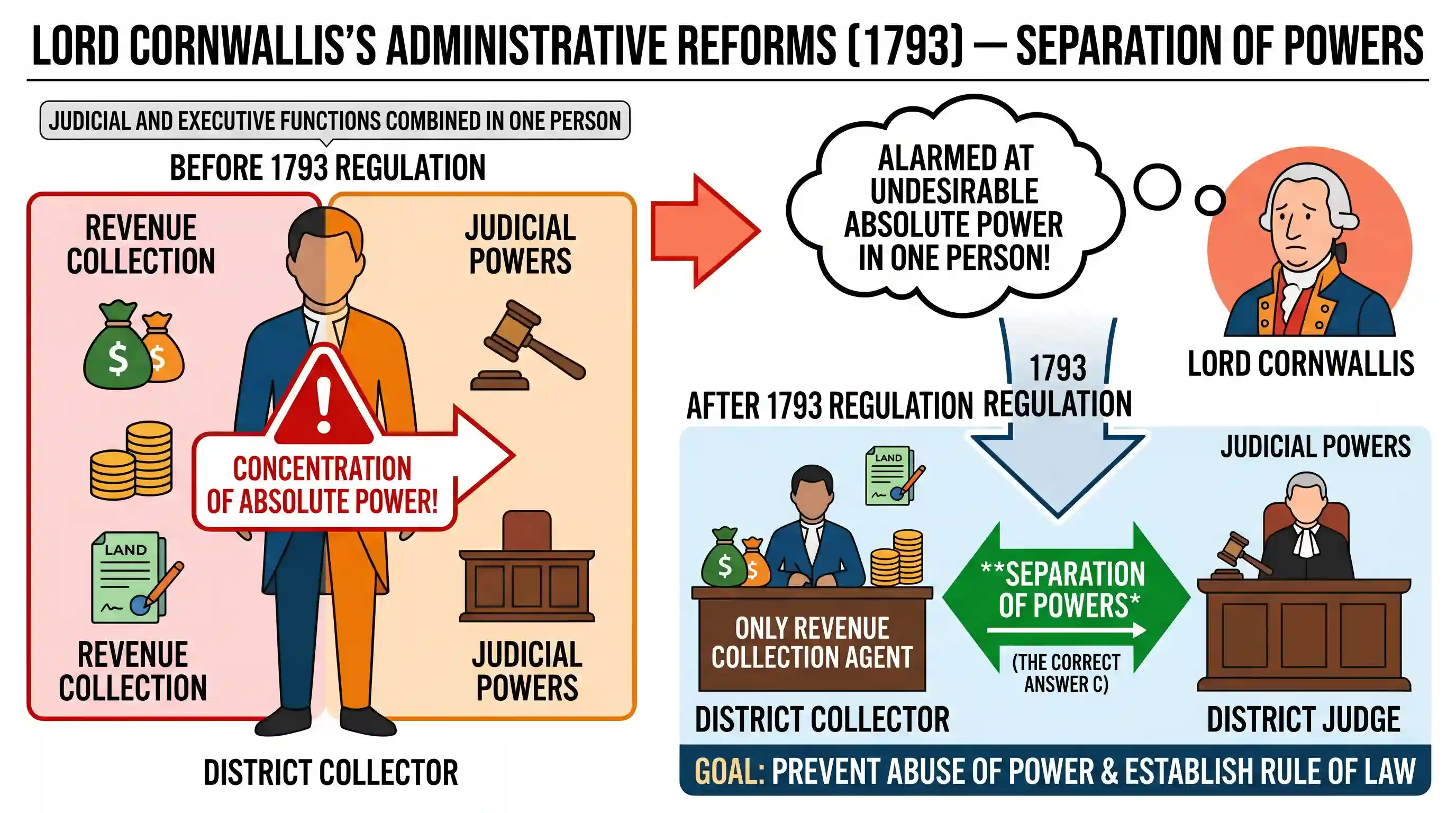
By a regulation in 1793, the District Collector was deprived of his judicial powers and made the collecting agent only. What was the reason for such regulation?

- ALord Cornwallis felt that the District Collector’s efficiency of revenue collection would enormously increase without the burden of other work
- BLord Cornwallis felt that Judicial power should compulsorily be in the hands of Europeans while Indians can be given the job of revenue collection in the districts
- CLord Cornwallis was alarmed at the extent of power concentrated in the District Collector and felt that such absolute power was undesirable in one personCorrect
- DThe judicial work demanded a deep knowledge of India and a good training in law and Lord Cornwallis felt that District Collector should be only a revenue collector
Explanation
The correct answer is C.
Explanation: C) Lord Cornwallis was alarmed at the extent of power concentrated in the District Collector and felt that such absolute power was undesirable in one person. This is the primary reason. Cornwallis was a strong proponent of the separation of powers, influenced by Enlightenment ideals. He believed that combining executive (revenue collection) and judicial functions in one individual could lead to arbitrary rule, abuse of power, and injustice. His reforms aimed to establish a system based on the rule of law, where these powers were distinct.
A) While increased efficiency might have been a secondary benefit, it was not the main reason for the separation. Cornwallis's reforms were driven more by principles of governance and preventing abuse of power than by mere administrative efficiency in revenue collection.
B) While it is true that judicial power was increasingly concentrated in European hands and Indians were largely excluded from higher posts, the reason for depriving the Collector of judicial power was not primarily to create roles for Indians in revenue collection, but to separate the functions themselves based on a principle of governance.
D) While judicial work did require specific knowledge and training, the fundamental reason for the separation was not the Collector's perceived inability to acquire this knowledge, but the inherent undesirability of combining executive and judicial authority in one person, regardless of their individual capabilities. Cornwallis's solution was to create a separate, specialized judicial service.
Related questions
More UPSC Prelims practice from the same subject and topic.
- Prelims 2010GS1history
With reference to Simon Commission’s recommendations, which one of the following statements is correct?
- Prelims 2010GS1history
Four resolutions were passed at the famous Calcutta session of Indian National Congress in 1906. The question of either retention OR of rejection of these four resolutions became the cause of a split …
- Prelims 2010GS1history
After Quit India Movement, C. Rajagopalachari issued a pamphlet entitled “The Way Out”. Which one of the following was a proposal in this pamphlet?
- Prelims 2010GS1history
Who among the following Governor Generals created the Covenanted Civil Service of India which later came to be known as the Indian Civil Service?
- Prelims 2010GS1history
What was the immediate cause for the launch of the Swadeshi movement?
- Prelims 2010GS1history
Consider the following statements: 1. Dr. Rajendra Prasad persuaded Mahatma Gandhi to come to Champaran to investigate the problem of peasants. 2. Acharya J. B. Kriplani was one of Mahatma Gandhi’s co…