In the context of India’s Five Year Plans, a shift in the pattern of industrialization, with lower emphasis on heavy industries and more on infrastructure begins in

- AFourth Plan
- BSixth Plan
- CEighth PlanCorrect
- DTenth Plan
Explanation
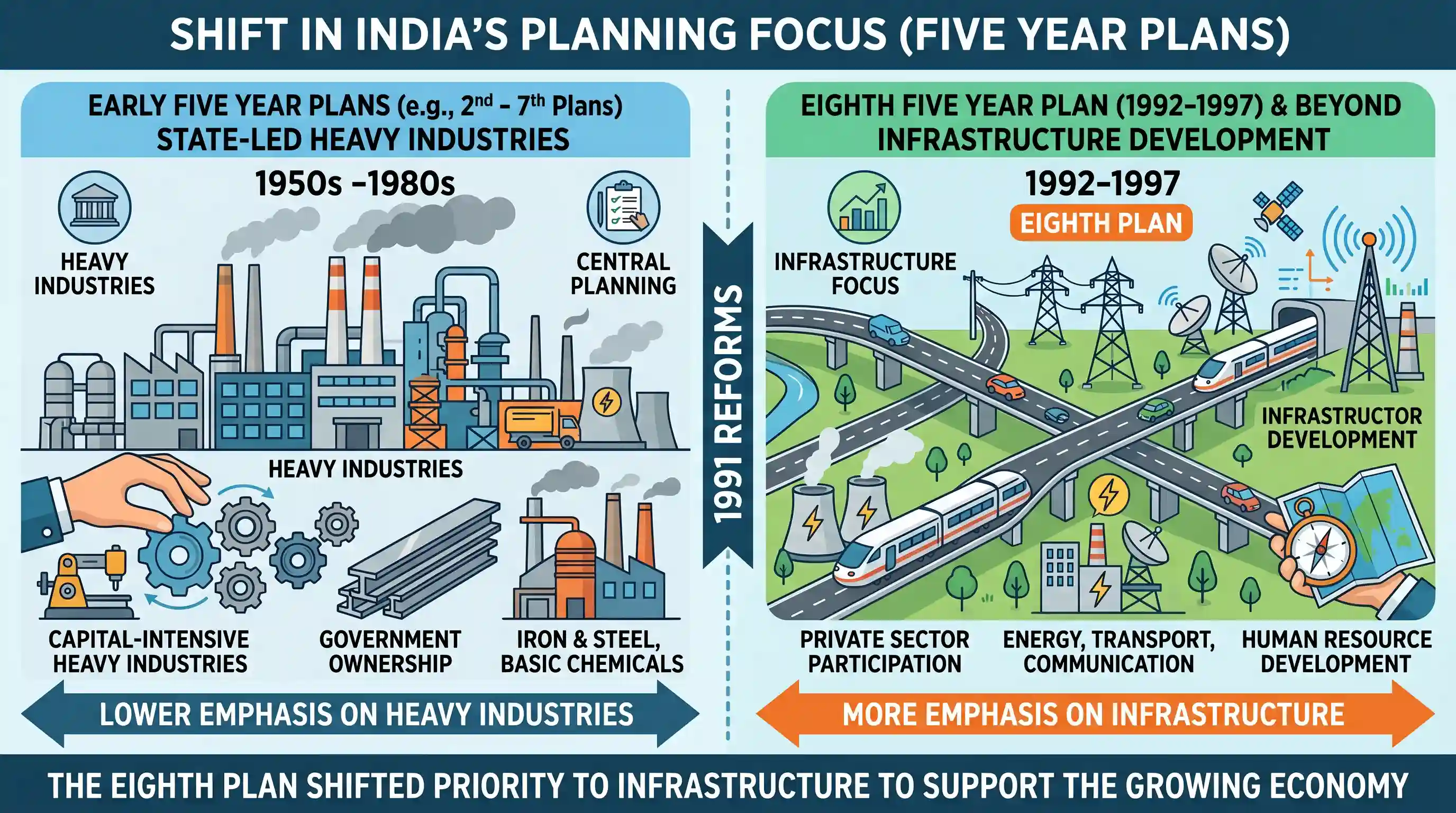
The Eighth Five Year Plan 1992 to 1997 marked a significant turning point in India's economic strategy following the 1991 Liberalization, Privatization, and Globalization reforms. During the earlier plans, especially starting from the Second Plan, the focus was heavily on state led development of basic and heavy industries.
However, the Eighth Plan shifted this focus towards infrastructure development, such as energy, transport, and communication, to support a growing market economy. It moved away from centralized industrial planning and gave more space to the private sector, emphasizing that the government's role should be to create a supportive environment through infrastructure rather than just managing heavy industries. This plan is also known for prioritizing human resource development.
Related questions
More UPSC Prelims practice from the same subject and topic.
- Prelims 2010GS1economy
Inclusive growth as enunciated in the Eleventh Five Year Plan does not include one of the following:
- Prelims 2010GS1economy
In the context of the affairs of which of the following is the phrase “Special Safeguard Mechanisms” mentioned in the news frequently?
- Prelims 2010GS1economy
Which of the following terms indicates a mechanism used by commercial banks for providing credit to the government?
- Prelims 2010GS1economy
The SEZ Act, 2005 which came into effect in February 2006 has certain objectives. In this context, consider the following: 1. Development of infrastructure facilities. 2. Promotion of investment from …
- Prelims 2010GS1economy
Which one of the following statements is an appropriate description of deflation?
- Prelims 2010GS1economy
With reference to the Non-banking Financial Companies (NBFCs) in India, consider the following statements: