Two of the schemes launched by the Government of India for Women’s development are Swadhar and Swayam Siddha. As regards the difference between them, consider the following statements: 1. Swayam Siddha is meant for those in difficult circumstances such as women survivors of natural disasters or terrorism, women prisoners released from jails, mentally challenged women etc. whereas Swadhar is meant for holistic empowerment of women through Self Help Groups. 2. Swayam Siddha is implemented through Local Self Government bodies or reputed Voluntary Organizations whereas Swadhar is implemented through the ICDS units set up in the states. Which of the statements given above is/are correct?

- A1 only
- B2 only
- CBoth 1 and 2
- DNeither 1 nor 2Correct
Explanation
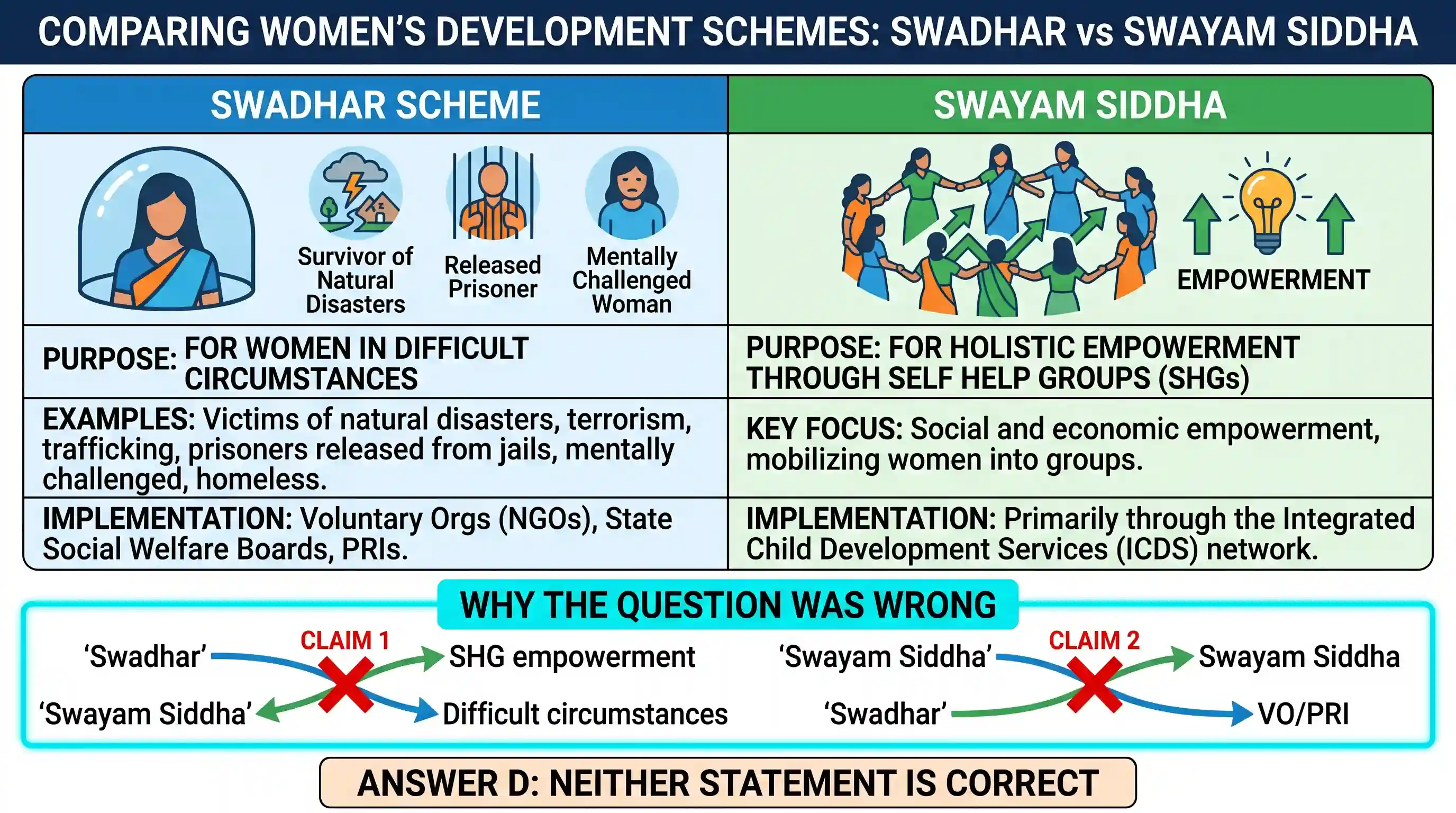
The correct answer is D because both statements are incorrect as they swap the definitions and implementation mechanisms of the two schemes.
Statement 1 is incorrect because it is Swadhar that is designed for women in difficult circumstances such as survivors of disasters, released prisoners, and the homeless. Conversely, Swayam Siddha is the scheme focused on the holistic empowerment of women through the formation of Self Help Groups.
Statement 2 is incorrect because the implementation roles are also reversed. Swayam Siddha was primarily implemented through the Integrated Child Development Services ICDS network and state departments. Swadhar is implemented through various agencies including Voluntary Organizations, Social Welfare Boards, and Panchayati Raj Institutions.
Since both statements incorrectly attribute the characteristics of one scheme to the other, neither 1 nor 2 is correct.
Related questions
More UPSC Prelims practice from the same subject and topic.
- Prelims 2010GS1polity-and-governance
Consider the following statements : 1. The boundaries of a National Park are defined by legislation. 2. A Biosphere Reserve is declared to conserve a few specific species of flora and fauna. 3. In a W…
- Prelims 2010GS1polity-and-governance
Six books A, B, C, D, E and F are placed side by side. B, C and E have blue cover and the other books have red cover. Only D and F are new books and the rest are old. A, C and D are law reports and ot…
- Prelims 2010GS1polity-and-governance
Six persons M, N, O, P, Q and R are sitting in two rows, three in each. Q is not at the end of any row. P is second to the left of R. O is the neighbour of Q and is sitting diagonally opposite to P. N…
- Prelims 2010GS1polity-and-governance
In a group of five persons A, B, C, D and E, there is a professor, a doctor and lawyer. A and D are unmarried ladies, and do not work. Of the married couple in the Group, E is the husband. B is the br…
- Prelims 2010GS1polity-and-governance
With reference to India, consider the following statements : 1. The Wholesale Price Index (WPI) in India is available on a monthly basis only. 2. As compared to Consumer Price Index for Industrial Wor…
- Prelims 2010GS1polity-and-governance
Each person’s performance compared with all other persons is to be done to rank them subjectively. How many comparisons are needed in total, if there are 11 persons?