Six persons M, N, O, P, Q and R are sitting in two rows, three in each. Q is not at the end of any row. P is second to the left of R. O is the neighbour of Q and is sitting diagonally opposite to P. N is the neighbour of R. On the basis of above information, who is facing N?

- AR
- BQCorrect
- CP
- DM
Explanation
Here is the step by step breakdown of the arrangement to determine who faces N.
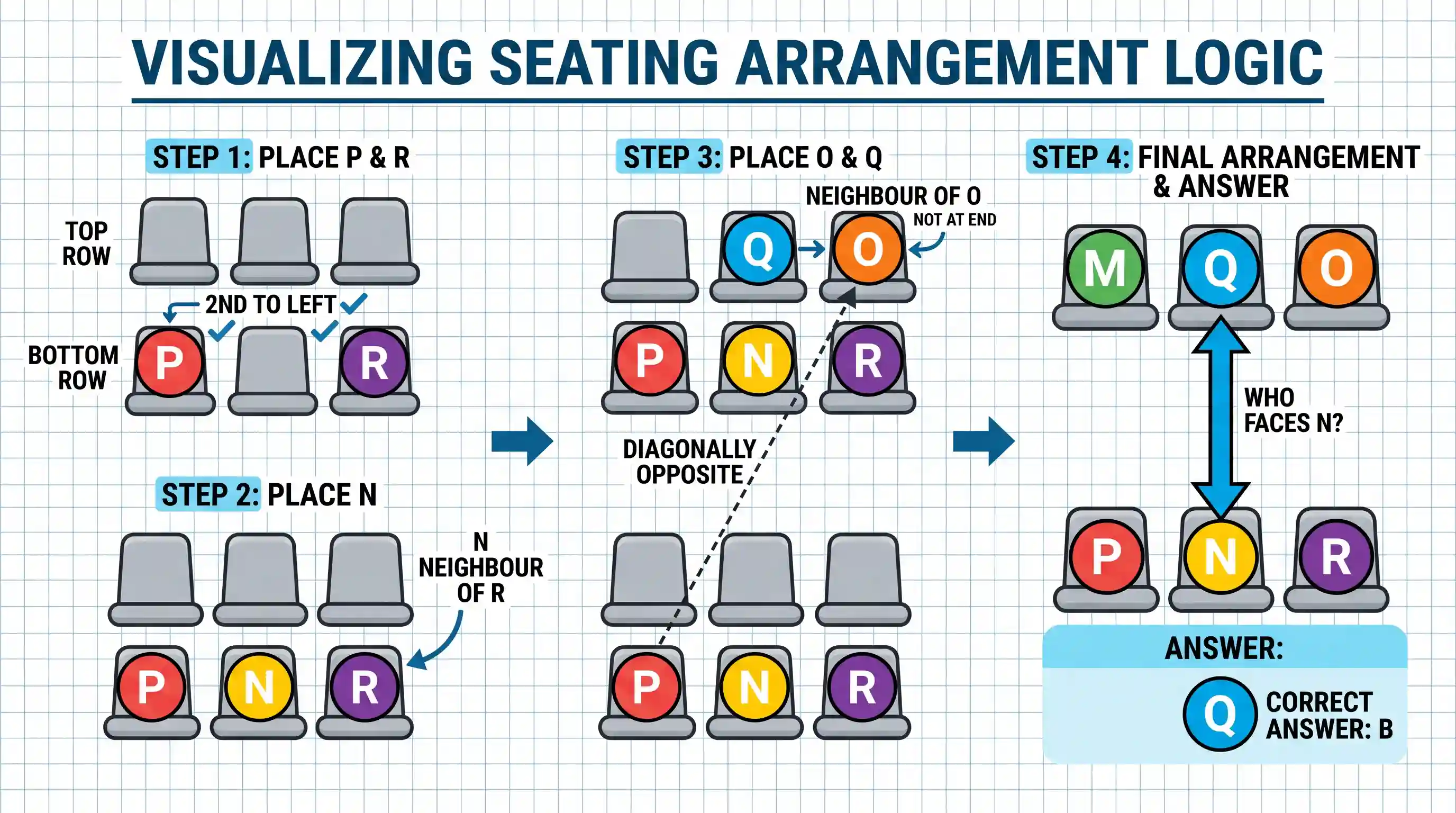
First, identify the positions in the two rows. Since P is second to the left of R, they must be in the same row at the two ends. This leaves the middle seat open. Let us place them in the bottom row as P, Middle, R.
Second, the information states N is the neighbour of R. This means N must occupy the middle seat in the bottom row between P and R. So, the bottom row is P, N, R.
Third, O is sitting diagonally opposite to P. Since P is at the bottom left end, O must be at the top right end.
Fourth, Q is not at the end of any row and is a neighbour of O. This means Q must be in the middle seat of the top row.
Fifth, the only remaining person, M, must occupy the last remaining seat at the top left end.
The final arrangement looks like this: Top Row: M, Q, O Bottom Row: P, N, R
By looking at the middle column, we can see that Q is positioned directly across from N. Therefore, Q is facing N. The correct answer is B.
Related questions
More UPSC Prelims practice from the same subject and topic.
- Prelims 2010GS1polity-and-governance
Consider the following statements : 1. The boundaries of a National Park are defined by legislation. 2. A Biosphere Reserve is declared to conserve a few specific species of flora and fauna. 3. In a W…
- Prelims 2010GS1polity-and-governance
Six books A, B, C, D, E and F are placed side by side. B, C and E have blue cover and the other books have red cover. Only D and F are new books and the rest are old. A, C and D are law reports and ot…
- Prelims 2010GS1polity-and-governance
In a group of five persons A, B, C, D and E, there is a professor, a doctor and lawyer. A and D are unmarried ladies, and do not work. Of the married couple in the Group, E is the husband. B is the br…
- Prelims 2010GS1polity-and-governance
With reference to India, consider the following statements : 1. The Wholesale Price Index (WPI) in India is available on a monthly basis only. 2. As compared to Consumer Price Index for Industrial Wor…
- Prelims 2010GS1polity-and-governance
Each person’s performance compared with all other persons is to be done to rank them subjectively. How many comparisons are needed in total, if there are 11 persons?
- Prelims 2010GS1polity-and-governance
Two of the schemes launched by the Government of India for Women’s development are Swadhar and Swayam Siddha. As regards the difference between them, consider the following statements: 1. Swayam Siddh…