A person X has four notes of Rupee 1, 2, 5 and 10 denomination. The number of different sums of money she can form from them is

- A16
- B15Correct
- C12
- D8
Explanation
To find the number of different sums of money person X can form, we need to consider all possible combinations of the four notes.
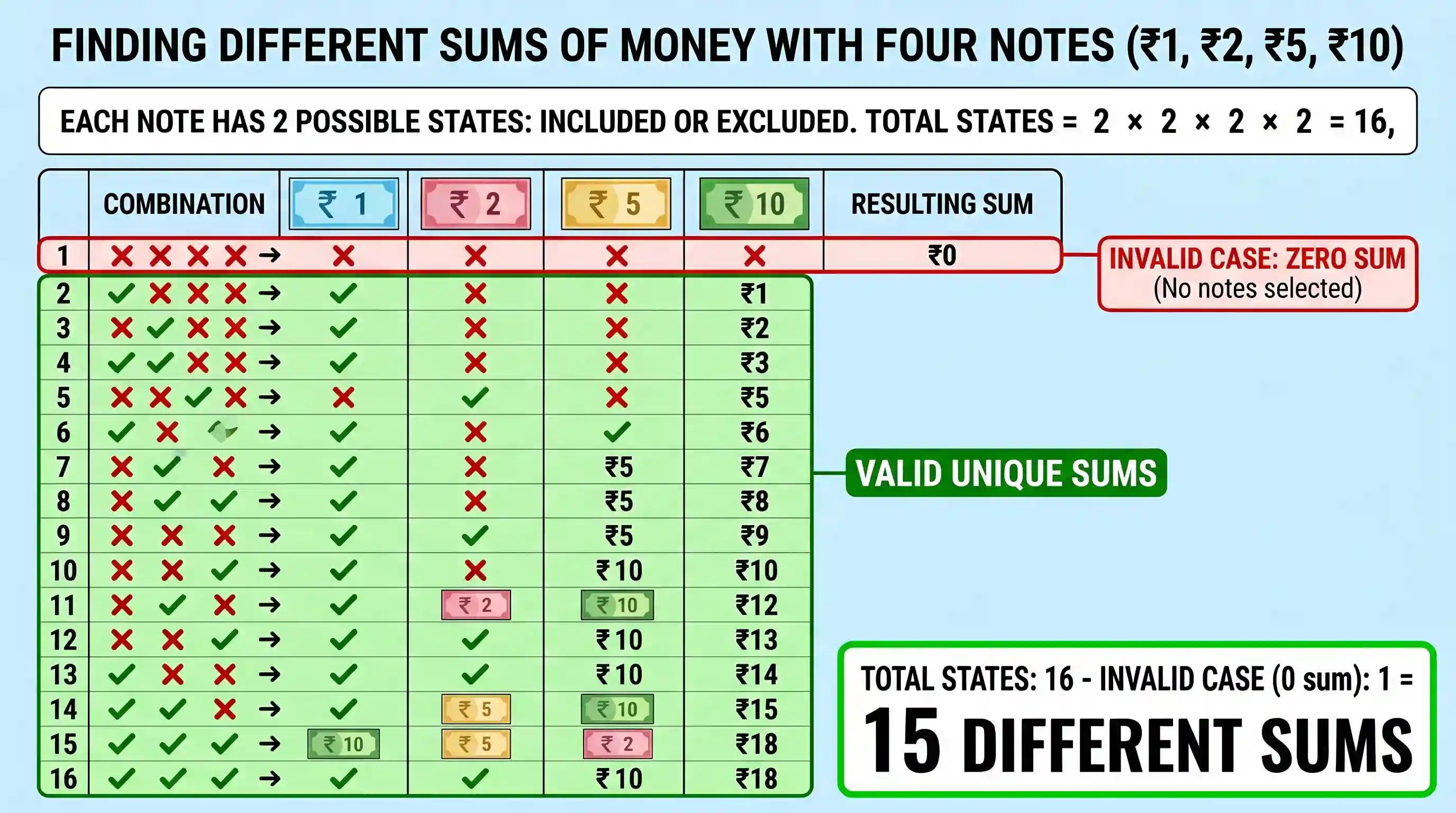
The person has 4 distinct notes: 1, 2, 5, and 10 rupees. For each note, there are two possibilities: either the note is included in the sum or it is not included.
Since there are 4 notes, the total number of combinations is 2 raised to the power of 4, which equals 16.
However, these 16 combinations include the case where none of the notes are selected, resulting in a sum of zero. Because a sum of money must involve at least one note, we subtract this one empty case.
Calculation: 16 minus 1 equals 15.
Since all the denominations are such that every combination produces a unique total, there are exactly 15 different sums of money possible.
Therefore, the correct option is B.
Related questions
More UPSC Prelims practice from the same subject and topic.
- Prelims 2010GS1economy
Which one of the following statements is an appropriate description of deflation?
- Prelims 2010GS1economy
In the parlance of financial investments, the term ‘bear’ denotes
- Prelims 2010GS1economy
In the context of Indian economy, consider the following pairs: Term Most appropriate description 1. Melt down Fall in stock prices 2. Recession Fall in growth rate 3. Slow down Fall in GDP Which of t…
- Prelims 2010GS1economy
Stiglitz Commission established by the President of the United Nations General Assembly was in the international news. The commission was supposed to deal with
- Prelims 2010GS1economy
Two numbers X and Y are respectively 20% and 28% less than a third number Z. By what percentage is the number Y less than the number X?
- Prelims 2010GS1economy
The difference between the simple interest received from two banks on Rs. 500 for two years is Rs. 2.50. What is the difference between their rates?