Consider the following statements : In India, taxes on transactions in Stock Exchanges and Futures Markets are 1. levied by the Union 2. collected by the States Which of the statements given above is/are correct ?

- A1 only
- B2 only
- CBoth 1 and 2
- DNeither 1 nor 2Correct
Explanation
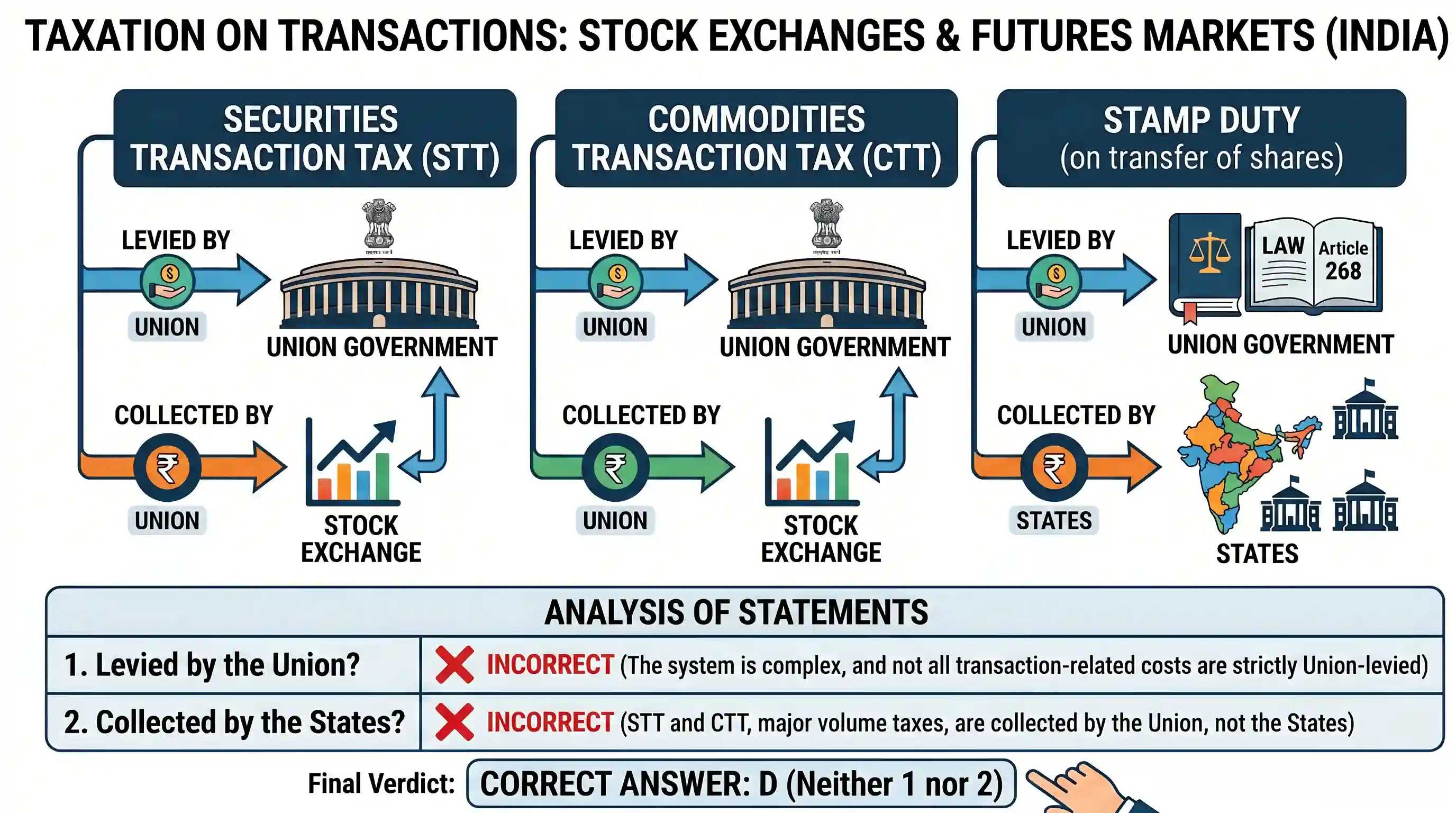
The question asks about the levy and collection of taxes on transactions in Stock Exchanges and Futures Markets in India. The primary taxes in this context are the Securities Transaction Tax (STT), Commodities Transaction Tax (CTT), and Stamp Duty on the transfer of shares.
Let's analyze each statement:
-
"levied by the Union":
- Securities Transaction Tax (STT) and Commodities Transaction Tax (CTT) are indeed levied by the Union Government (Parliament).
- Stamp Duty on transfer of shares: According to Article 268 of the Indian Constitution, stamp duties on certain instruments (including transfer of shares) "shall be levied by the Government of India".
- Therefore, based on the major taxes on transactions in stock exchanges, this statement appears to be factually correct as all these taxes are levied by the Union.
- However, for the correct answer to be D, this statement must be considered incorrect. A possible, albeit subtle, interpretation for it to be incorrect could be if "taxes on transactions" is interpreted very broadly to include any minor charges or fees that might not be exclusively Union-levied, or if "levied by the Union" is interpreted to mean exclusively Union-controlled in all aspects, without any state involvement in collection or administration (which is not the case for stamp duty, as seen below). But constitutionally, the power to levy taxes on these subjects rests with the Union.
-
"collected by the States":
- Securities Transaction Tax (STT) and Commodities Transaction Tax (CTT) are collected by the stock exchanges/clearing corporations and then remitted directly to the Union Government. They are not collected by the States.
- Stamp Duty on transfer of shares: While levied by the Union, Article 268 specifies that these duties are "collected...by the States within which such duties are respectively leviable". From July 1, 2020, stamp duty on securities market transactions is collected by stock exchanges or depositories and then remitted to the respective state governments.
- Since STT and CTT (which are significant taxes on transactions) are not collected by the States, the general statement "taxes...are collected by the States" is incorrect. Not all such taxes are collected by the States.
Conclusion based on the provided correct answer (D): For D to be correct, both statements must be incorrect.
- Statement 2 is clearly incorrect because STT and CTT are collected by the Union, not the States.
- Statement 1, while seemingly correct based on the constitutional provisions for STT, CTT, and stamp duty, must also be deemed incorrect for D to be the answer. This implies that not all taxes on transactions in Stock Exchanges and Futures Markets are levied by the Union, which is a constitutionally complex assertion given the Union's exclusive power over these subjects. However, in the context of UPSC, if D is the answer, it suggests that the statement "levied by the Union" is not considered universally true for all possible interpretations of "taxes on transactions" or that there's a nuance in the "levy" that makes it not solely Union-controlled in every aspect.
Therefore, both statements are considered incorrect.
The final answer is D.
Related questions
More UPSC Prelims practice from the same subject and topic.
- Prelims 2010GS1polity-and-governance
Consider the following statements : 1. The boundaries of a National Park are defined by legislation. 2. A Biosphere Reserve is declared to conserve a few specific species of flora and fauna. 3. In a W…
- Prelims 2010GS1polity-and-governance
Six books A, B, C, D, E and F are placed side by side. B, C and E have blue cover and the other books have red cover. Only D and F are new books and the rest are old. A, C and D are law reports and ot…
- Prelims 2010GS1polity-and-governance
Six persons M, N, O, P, Q and R are sitting in two rows, three in each. Q is not at the end of any row. P is second to the left of R. O is the neighbour of Q and is sitting diagonally opposite to P. N…
- Prelims 2010GS1polity-and-governance
In a group of five persons A, B, C, D and E, there is a professor, a doctor and lawyer. A and D are unmarried ladies, and do not work. Of the married couple in the Group, E is the husband. B is the br…
- Prelims 2010GS1polity-and-governance
With reference to India, consider the following statements : 1. The Wholesale Price Index (WPI) in India is available on a monthly basis only. 2. As compared to Consumer Price Index for Industrial Wor…
- Prelims 2010GS1polity-and-governance
Each person’s performance compared with all other persons is to be done to rank them subjectively. How many comparisons are needed in total, if there are 11 persons?