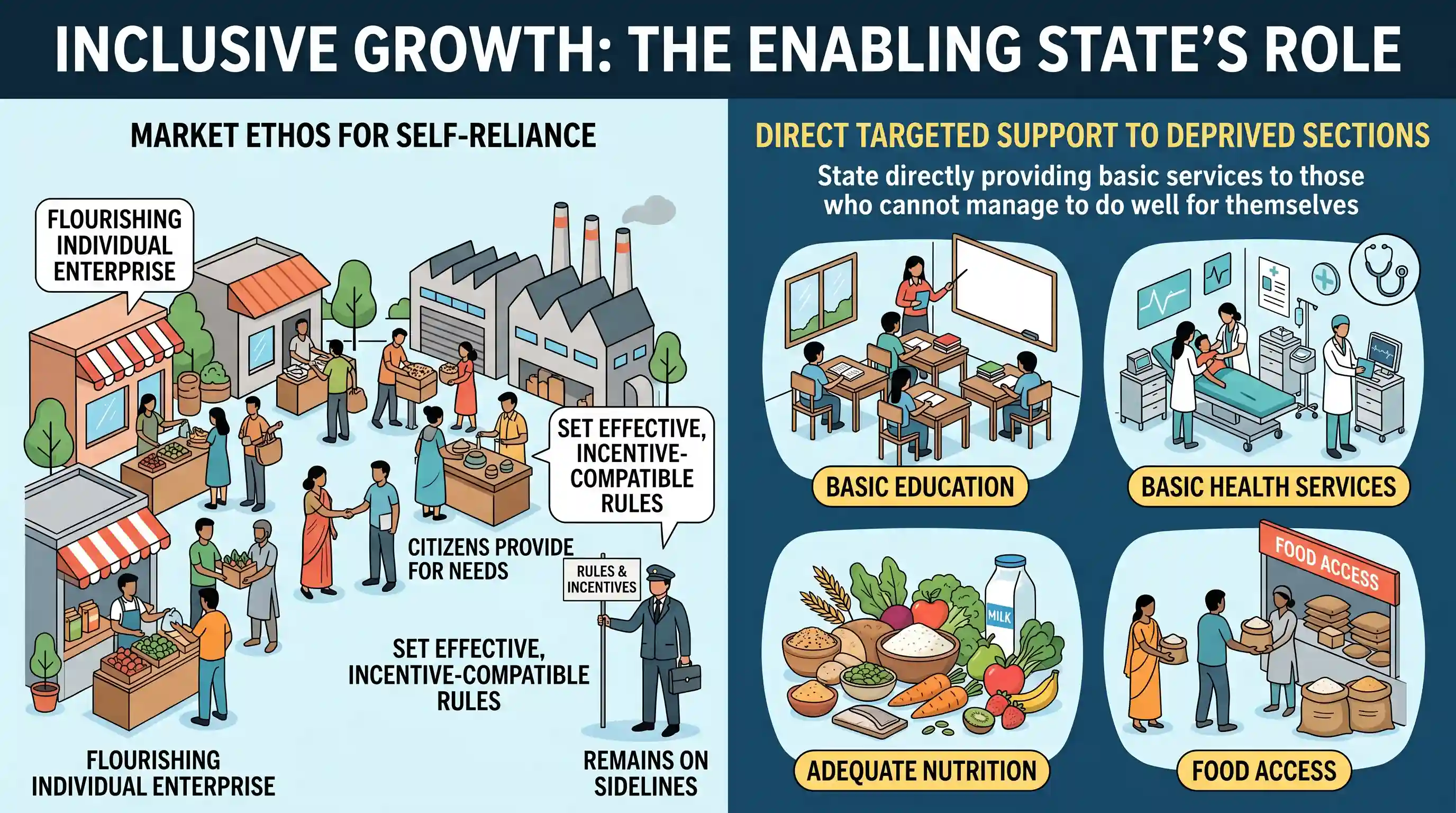
Passage-I For achieving inclusive growth there is- a critical need to rethink the- role of the State. The early debate among economists about the size of the Government can be misleading. The need of the hour is to have an enabling Government. India is too large and complex a nation for the State to be able to deliver all that is needed. Asking the Government to produce all the essential goods, create all the necessary jobs, and keep a curb on the prices of all goods is to lead to a large cumbersome bureaucracy and widespread corruption. The aim must be to stay with the objective of inclusive growth that was laid down by the founding fathers of the nation and also to take a more modern view of what the State can realistically deliver. This is what leads to the idea of an enabling State, that is, a Government that does not try to directly deliver to the citizens everything that they need. Instead, it (1) creates an enabling ethos for the market so that individual enterprise can flourish and citizens can, for the most part, provide for the needs of one another, and (2) steps in to help those who do not manage to do well for themselves, for there will always be individuals, no matter what the system, who need support and help. Hence we need a Government that, when it comes to the market, sets effective, incentive- compatible rules and remains on the sidelines with minimal interference, and, at the same time, plays an important role in directly helping the poor by ensuring that they get basic education and health services and receive adequate nutrition and food. According to the passage, the strategy of inclusive growth can be effected by focusing on

- Ameeting all the needs of every citizen in the country
- BIncreasing the regulations over the manufacturing sector
- CControlling the distribution of manufacturing goods
- DDelivery of the basic services to the deprived sections of the society.Correct
Explanation
The passage describes an "enabling State" as one that (1) creates an ethos for the market to flourish and (2) "steps in to help those who do not manage to do well for themselves." It further clarifies that this means "directly helping the poor by ensuring that they get basic education and health services and receive adequate nutrition and food."
A) meeting all the needs of every citizen in the country: The passage explicitly states that the government "does not try to directly deliver to the citizens everything that they need" and that "India is too large and complex a nation for the State to be able to deliver all that is needed." This contradicts the passage.
B) Increasing the regulations over the manufacturing sector: The passage advocates for "minimal interference" in the market and setting "effective, incentive-compatible rules," not necessarily increasing regulations, especially not specifically over the manufacturing sector as a primary strategy for inclusive growth.
C) Controlling the distribution of manufacturing goods: This implies direct intervention and goes against the idea of an enabling market where individual enterprise flourishes and citizens provide for each other's needs, with minimal government interference in market operations.
D) Delivery of the basic services to the deprived sections of the society: This directly aligns with the passage's statement that the government "plays an important role in directly helping the poor by ensuring that they get basic education and health services and receive adequate nutrition and food." These are basic services for deprived sections.
Therefore, option D correctly identifies a key focus of the inclusive growth strategy as described in the passage.
Related questions
More UPSC Prelims practice from the same subject and topic.
- Prelims 2011CSATReading Comprehension
Read each of the following two passages and answer the items that follow. Your answers to these items should be based on the passages only. Passage-I For achieving inclusive growth there is- a critica…
- Prelims 2011CSATReading Comprehension
Passage-I For achieving inclusive growth there is- a critical need to rethink the- role of the State. The early debate among economists about the size of the Government can be misleading. The need of …
- Prelims 2011CSATReading Comprehension
Passage- I For achieving inclusive growth there is- a critical need to rethink the- role of the State. The early debate among economists about the size of the Government can be misleading. The need of…
- Prelims 2011CSATReading Comprehension
Passage-I For achieving inclusive growth there is- a critical need to rethink the- role of the State. The early debate among economists about the size of the Government can be misleading. The need of …
- Prelims 2011CSATReading Comprehension
Passage-2 The concept of 'creative society' refers to a phase of development of a society in which a large number of potential contradictions become articulate and active. This is most evident when op…
- Prelims 2011CSATReading Comprehension
Passage-2 The concept of 'creative society' refers to a phase of development of a society in which a large number of potential contradictions become articulate and active. This is most evident when op…