Passage-2 The concept of 'creative society' refers to a phase of development of a society in which a large number of potential contradictions become articulate and active. This is most evident when oppressed social groups get politically mobilised and demand their rights. The upsurge of the peasants and tribals, the movements for regional autonomy and self-determination, the environmental movements, and the women's movements in the developing countries are signs of emergence of creative society in contemporary times. The forms of social movements and their intensity may vary from country to country and place to place within a country. But the very presence of movements for social transformation in various spheres of a society indicates the emergence of a creative society in a country. What according to the passage are the manifestations of social movements? 1. Aggressiveness and being incendiary. 2. Instigation by external forces. 3. Quest for social equality and individual freedom. 4. Urge for granting privileges and self-respect to disparaged sections of the society. Select the correct answer using the codes given below:

- A1 and 3 only
- B2 and 4 only
- C3 and 4 onlyCorrect
- D1, 2, 3 and 4
Explanation
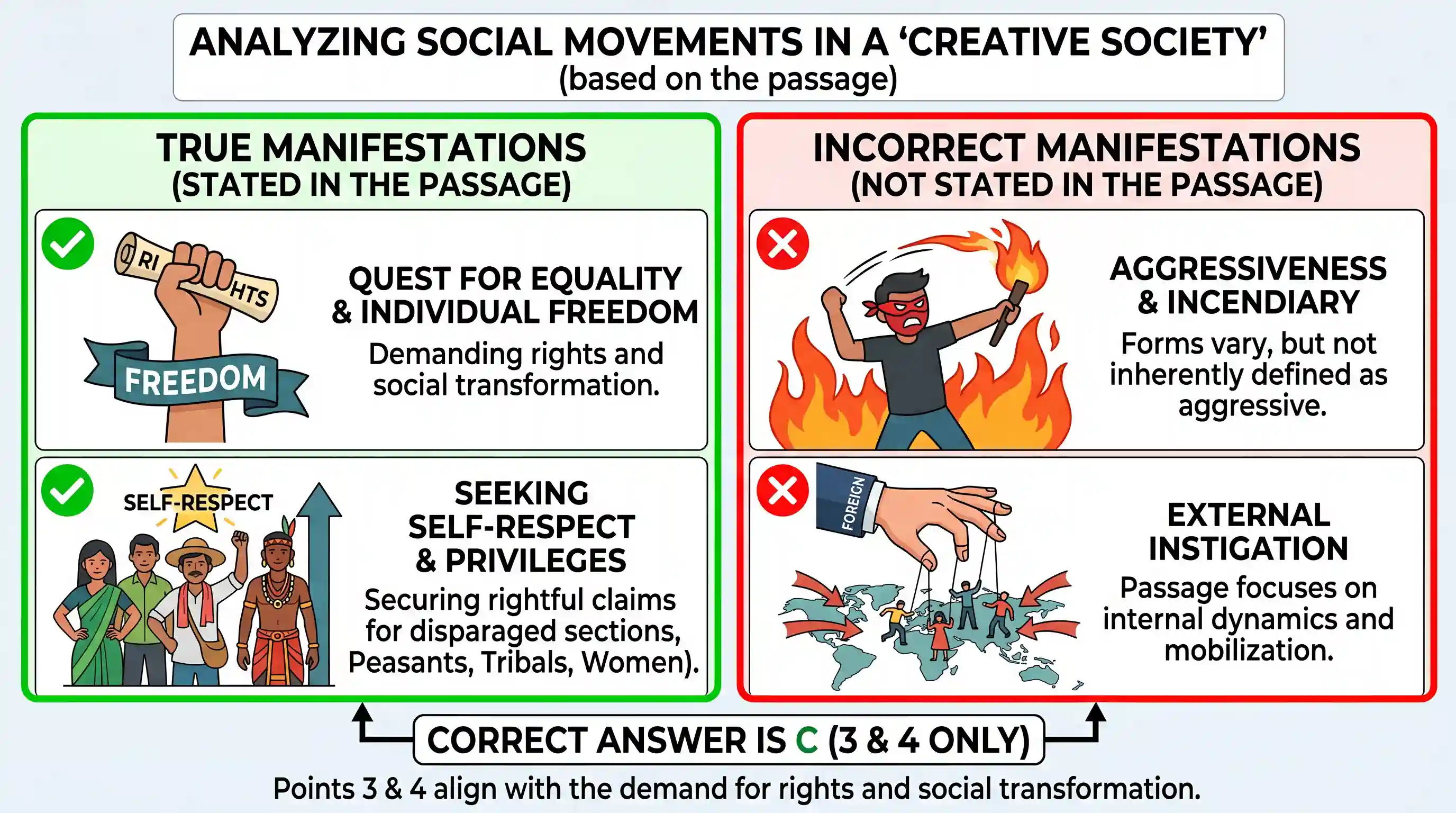
The passage defines a 'creative society' by the articulation and activation of contradictions, especially when oppressed groups mobilize and demand rights. It lists examples like movements of peasants, tribals, women, and for regional autonomy, all indicating a quest for social transformation.
Let's analyze each statement:
-
Aggressiveness and being incendiary: The passage describes movements as active and demanding rights, but it does not characterize them as inherently aggressive or incendiary. This is not a stated manifestation.
-
Instigation by external forces: The passage focuses on internal dynamics, such as oppressed social groups mobilizing and demanding their rights. There is no mention or implication of external instigation.
-
Quest for social equality and individual freedom: The core idea of "oppressed social groups get politically mobilised and demand their rights," along with examples like women's movements and movements for regional autonomy and self-determination, directly points to a quest for social equality and individual freedom.
-
Urge for granting privileges and self-respect to disparaged sections of the society: The movements of "peasants and tribals" and "women's movements" are explicitly mentioned as signs of a creative society. These groups are typically disparaged sections, and their mobilization to "demand their rights" directly reflects an urge to secure their rightful claims, which can be interpreted as granting them due status, respect, and addressing historical disadvantages (often framed as privileges to correct an imbalance) within society.
Therefore, statements 3 and 4 accurately reflect the manifestations of social movements as described in the passage.
The final answer is C.
Related questions
More UPSC Prelims practice from the same subject and topic.
- Prelims 2011CSATReading Comprehension
Read each of the following two passages and answer the items that follow. Your answers to these items should be based on the passages only. Passage-I For achieving inclusive growth there is- a critica…
- Prelims 2011CSATReading Comprehension
Passage-I For achieving inclusive growth there is- a critical need to rethink the- role of the State. The early debate among economists about the size of the Government can be misleading. The need of …
- Prelims 2011CSATReading Comprehension
Passage-I For achieving inclusive growth there is- a critical need to rethink the- role of the State. The early debate among economists about the size of the Government can be misleading. The need of …
- Prelims 2011CSATReading Comprehension
Passage- I For achieving inclusive growth there is- a critical need to rethink the- role of the State. The early debate among economists about the size of the Government can be misleading. The need of…
- Prelims 2011CSATReading Comprehension
Passage-I For achieving inclusive growth there is- a critical need to rethink the- role of the State. The early debate among economists about the size of the Government can be misleading. The need of …
- Prelims 2011CSATReading Comprehension
Passage-2 The concept of 'creative society' refers to a phase of development of a society in which a large number of potential contradictions become articulate and active. This is most evident when op…