Passage-1 Ecosystems provide people with a variety of goods and services; food, clean water, clean air, flood control, soil stabilization, pollination, climate regulation, spiritual fulfilment and aesthetic enjoyment, to name just a few. Most of these benefits either are irreplaceable or the technology necessary to replace them is prohibitively expensive. For example, potable fresh water can be provided by desalinating sea- water, but only at great cost. The rapidly expanding human population has greatly modified the Earth's ecosystems to meet their increased requirements of some of the goods and services, particularly food, fresh water, timber, fibre and fuel. These modifications have contributed substantially to human well being and economic development. The benefits have not been equally distributed. Some people have actually been harmed by these changes. Moreover, short- term increases in some ecosystem goods and services have come at the cost of the long- term degradation of others. For example, efforts to increase the production of food and fibre have decreased the ability of some ecosystems to provide clean water, regulate flooding and support biodiversity. With reference to the passage, consider the following statements: 1. It is imperative to modify the Earth's ecosystems for the well being of mankind. 2. Technology can never replace all the goods and services provided by ecosystems. Which of the statements given above is/are correct?

- A1 only
- B2 onlyCorrect
- CBoth 1 and 2
- DNeither 1 nor 2
Explanation
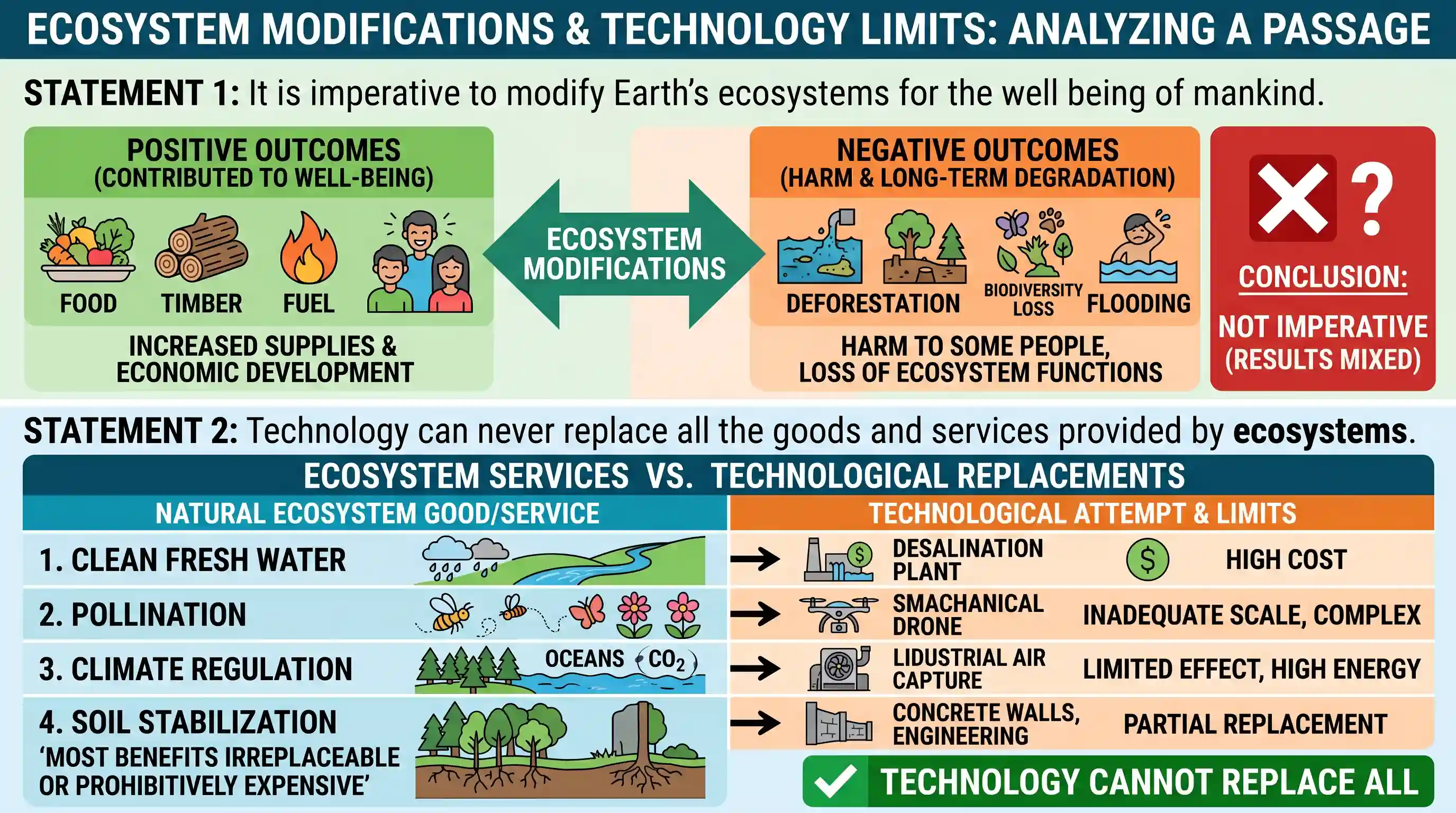
Statement 1: "It is imperative to modify the Earth's ecosystems for the well being of mankind." The passage states that modifications have occurred and "have contributed substantially to human well being and economic development." However, it also highlights negative consequences: "Some people have actually been harmed by these changes" and "short- term increases in some ecosystem goods and services have come at the cost of the long- term degradation of others." The word "imperative" (absolutely necessary) is too strong. The passage describes what has happened and its mixed results, not that it is an absolute necessity for overall well-being, especially given the stated negative impacts.
Statement 2: "Technology can never replace all the goods and services provided by ecosystems." The passage explicitly states: "Most of these benefits either are irreplaceable or the technology necessary to replace them is prohibitively expensive." If "most" benefits are either "irreplaceable" or "prohibitively expensive" to replace, it directly implies that technology cannot replace all of them, as some are explicitly stated as irreplaceable.
Therefore, only statement 2 is correct.
The final answer is B
Related questions
More UPSC Prelims practice from the same subject and topic.
- Prelims 2011CSATReading Comprehension
Read each of the following two passages and answer the items that follow. Your answers to these items should be based on the passages only. Passage-I For achieving inclusive growth there is- a critica…
- Prelims 2011CSATReading Comprehension
Passage-I For achieving inclusive growth there is- a critical need to rethink the- role of the State. The early debate among economists about the size of the Government can be misleading. The need of …
- Prelims 2011CSATReading Comprehension
Passage-I For achieving inclusive growth there is- a critical need to rethink the- role of the State. The early debate among economists about the size of the Government can be misleading. The need of …
- Prelims 2011CSATReading Comprehension
Passage- I For achieving inclusive growth there is- a critical need to rethink the- role of the State. The early debate among economists about the size of the Government can be misleading. The need of…
- Prelims 2011CSATReading Comprehension
Passage-I For achieving inclusive growth there is- a critical need to rethink the- role of the State. The early debate among economists about the size of the Government can be misleading. The need of …
- Prelims 2011CSATReading Comprehension
Passage-2 The concept of 'creative society' refers to a phase of development of a society in which a large number of potential contradictions become articulate and active. This is most evident when op…