Passage A country under foreign domination seeks escape from the present in dreams of a vanished age, and finds consolation in visions of past greatness. That is a foolish and dangerous pastime in which many of us indulge. An equally questionable practice for us in India is to imagine that we are still spiritually great though we have come down, in the world in other respects. Spiritual or any other greatness cannot be founded on lack of freedom and opportunity, or on starvation and misery. Many western writers have encouraged that notion that Indians are other- worldly. I suppose the poor and unfortunate in every country become to some extent other- worldly, unless they become revolutionaries, for this world is evidently not meant for them. So also subject peoples. As a man grows to maturity he is not entirely engrossed in, or satisfied with, the external objective world. He seeks also some inner meaning, some psychological and physical satisfactions. So also with peoples and civilizations as they mature and grow adult. Every civilization and every people exhibit these parallel streams of an external life and an internal life. Where they meet or keep close to each other, there is an equilibrium and stability. When they diverge conflict arises and the crises that torture the mind and spirit. The passage thematically centres on

- Athe state of mind of oppressed peopleCorrect
- Bstarvation and misery
- Cthe growth of civilization
- Dbody, mind and spirit of people in general
Explanation
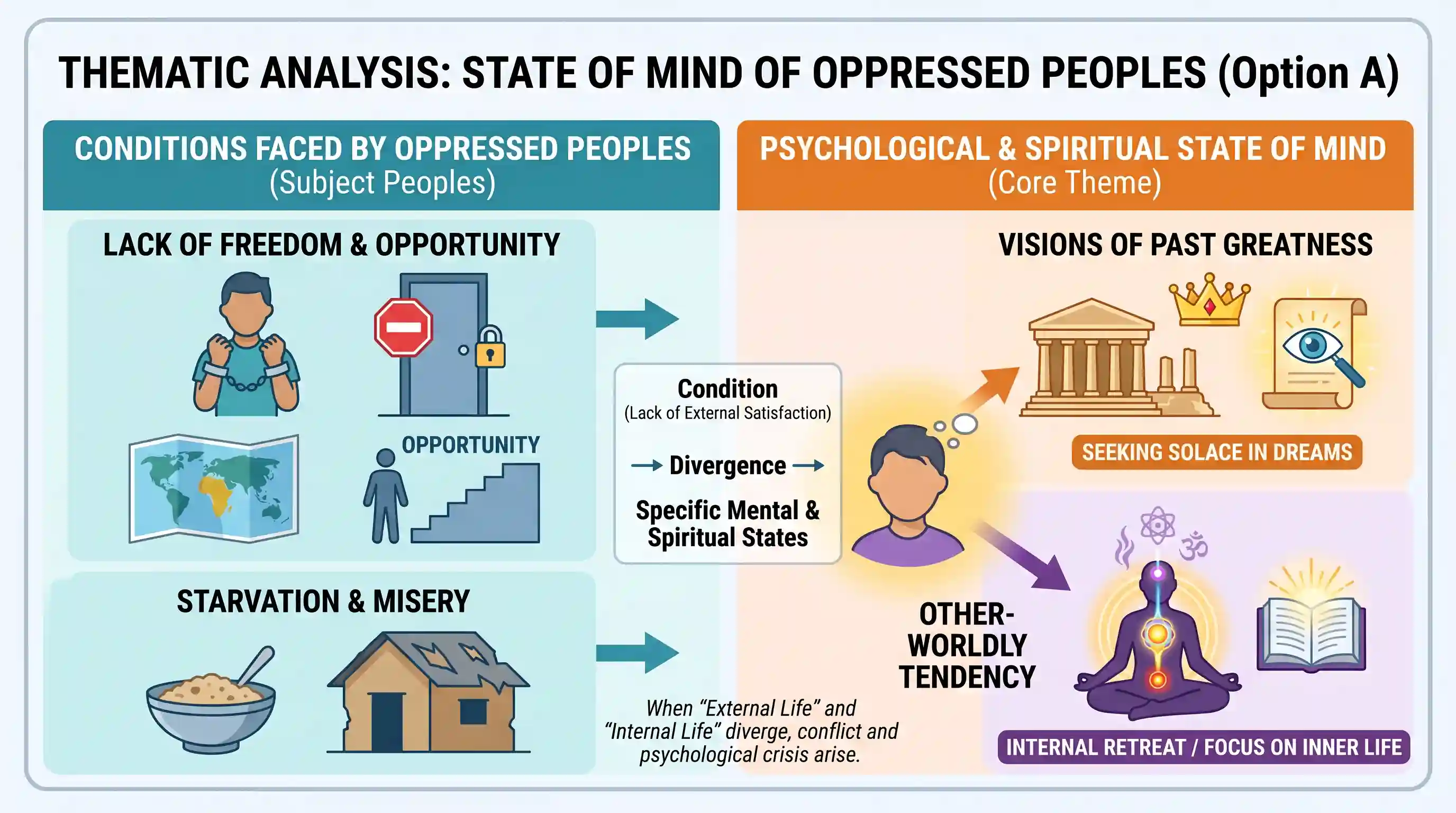
The passage primarily discusses the psychological and spiritual state of people living under foreign domination or oppression. It highlights their tendency to seek solace in past greatness or become "other-worldly" due to lack of freedom, opportunity, starvation, and misery. The latter part of the passage, while discussing the balance between external and internal life, extends this idea to explain the "crises that torture the mind and spirit" which arise when this balance is disturbed, implicitly linking it back to the conditions faced by subject peoples.
A) the state of mind of oppressed people: This is correct. The passage explicitly talks about "a country under foreign domination," "subject peoples," and the "poor and unfortunate." It delves into their dreams, their "other-worldly" tendencies, and the psychological impact of their situation, making this the central theme.
B) starvation and misery: These are mentioned as conditions that contribute to the state of mind of oppressed people, but they are not the thematic center themselves. The passage focuses more on the response and mindset in the face of these conditions.
C) the growth of civilization: While the passage mentions "peoples and civilizations as they mature," this is a broader concept introduced later as a general observation or analogy to explain the internal and external lives, rather than the primary focus. The core theme remains the specific situation of oppressed peoples.
D) body, mind and spirit of people in general: The passage does discuss mind and spirit, but not of "people in general." It specifically addresses these aspects in the context of oppressed or subject peoples, and how their conditions affect their inner lives.
The final answer is A because the entire passage, from its opening lines to its concluding thoughts, revolves around the psychological and spiritual experiences of people who are not free or are suffering under difficult circumstances.
Related questions
More UPSC Prelims practice from the same subject and topic.
- Prelims 2011CSATReading Comprehension
Read each of the following two passages and answer the items that follow. Your answers to these items should be based on the passages only. Passage-I For achieving inclusive growth there is- a critica…
- Prelims 2011CSATReading Comprehension
Passage-I For achieving inclusive growth there is- a critical need to rethink the- role of the State. The early debate among economists about the size of the Government can be misleading. The need of …
- Prelims 2011CSATReading Comprehension
Passage-I For achieving inclusive growth there is- a critical need to rethink the- role of the State. The early debate among economists about the size of the Government can be misleading. The need of …
- Prelims 2011CSATReading Comprehension
Passage- I For achieving inclusive growth there is- a critical need to rethink the- role of the State. The early debate among economists about the size of the Government can be misleading. The need of…
- Prelims 2011CSATReading Comprehension
Passage-I For achieving inclusive growth there is- a critical need to rethink the- role of the State. The early debate among economists about the size of the Government can be misleading. The need of …
- Prelims 2011CSATReading Comprehension
Passage-2 The concept of 'creative society' refers to a phase of development of a society in which a large number of potential contradictions become articulate and active. This is most evident when op…