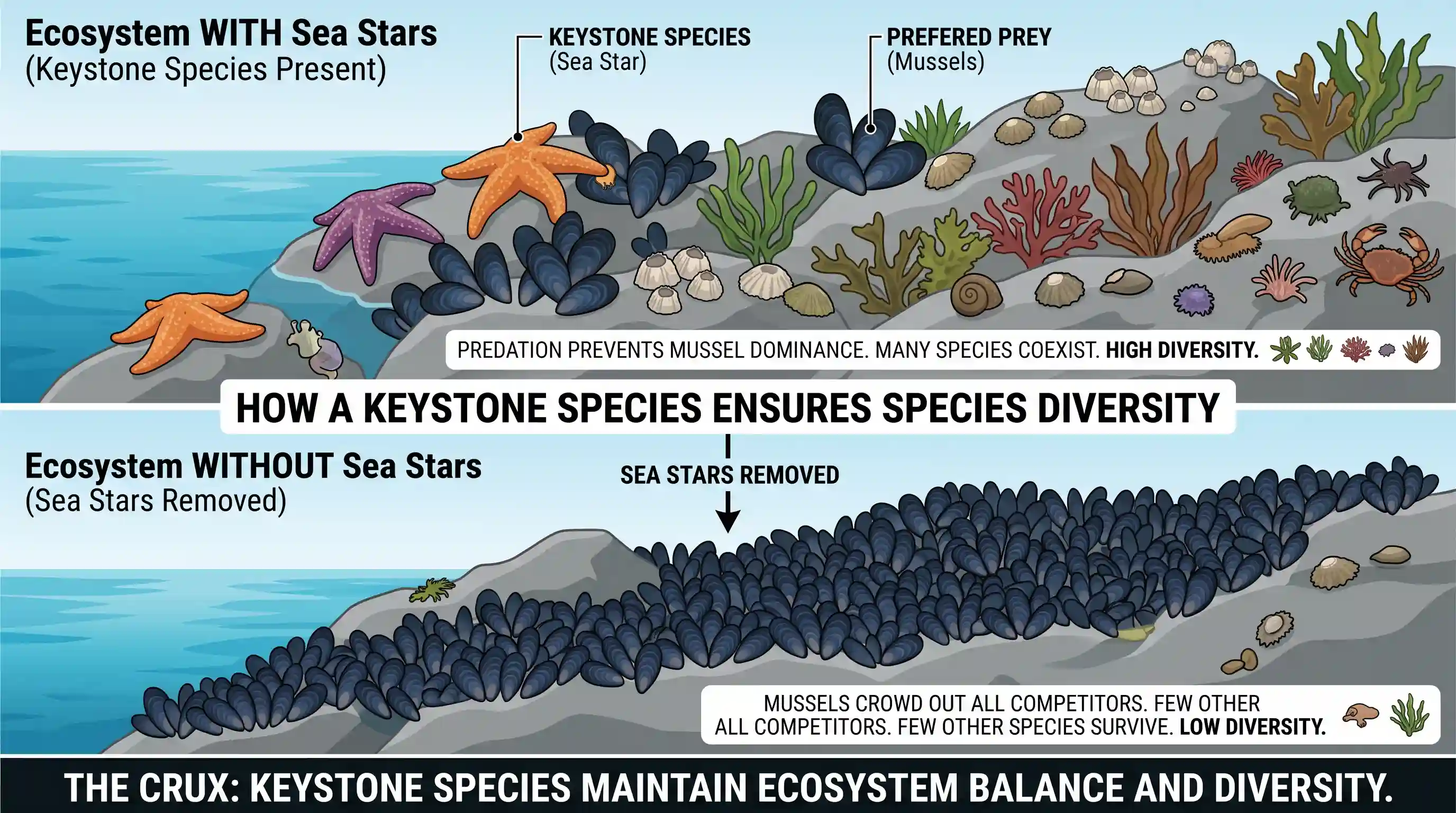
Passage A species that exerts. an influence out of proportion to its abundance in an ecosystem is called a keystone species. The keystone species may influence both the species richness of communities and the flow of energy and materials through ecosystems. The sea star Pisaster the flow of energy and materials through ecosystems. The sea star Pisaster ochraceus, which lives in rocky intertidal ecosystems on the Pacific coast of North America, is also an example of a keystone species. Its preferred prey is the mussel Mytilus californianus. In the absence of sea- stars, these mussels crowd out other competitors in a broad belt of the intertidal zone. By consuming mussels, sea star creates bare spaces that are taken over by a variety of other species. A study at the University of washington demonstrated the influence of Pisaster on species richness by removing sea stars from selected parts of the intertidal zone repeatedly over a period of five years. Two major changes occurred in the areas from which sea stars were removed. First, the lower edge of the 46. mussel bed extended farther down into the intertidal zone, showing that sea stars are able to eliminate mussels completely where they are covered with water most of the time. Second, and more dramatically, 28 species of animals and algae disappeared from the sea star removal zone. Eventually only Mytilus, the dominant competitor, occupied the entire substratum. Through its effect on competitive relationships, predation by Pisaster largely determines which species live in these rocky intertidal ecosystems. What is the crux of the passage?

- ASea star has a preferred prey
- BA preferred prey determines the survival of a keystone species
- CKeystone species ensures species diversityCorrect
- DSea star is the only keystone species on the Pacific coast of North America.
Explanation
The crux of the passage is the central message or main idea.
Analysis of options:
A) Sea star has a preferred prey: This is a factual detail mentioned in the passage (mussel Mytilus californianus), but it's a supporting detail, not the main point. The passage uses this fact to explain how the sea star exerts its influence, not as the influence itself.
B) A preferred prey determines the survival of a keystone species: The passage discusses how the sea star (keystone species) influences the ecosystem by preying on mussels. It does not discuss how the mussel (preferred prey) determines the survival of the sea star. This statement reverses the relationship or introduces a concept not elaborated in the passage.
C) Keystone species ensures species diversity: The passage explicitly states that in the absence of sea stars, mussels crowd out other competitors, leading to 28 species disappearing and eventually only Mytilus occupying the entire substratum. Conversely, by consuming mussels, sea stars "create bare spaces that are taken over by a variety of other species." This clearly demonstrates that the keystone species (sea star) maintains a variety of species, thus ensuring species diversity. This is the core message illustrated by the example and the study.
D) Sea star is the only keystone species on the Pacific coast of North America: The passage states, "The sea star Pisaster ochraceus... is also an example of a keystone species." The word "also" implies there might be other keystone species. The passage does not claim it is the only one. This statement is an overgeneralization not supported by the text.
Therefore, the crux of the passage is that a keystone species, like the sea star, plays a crucial role in maintaining species diversity within an ecosystem.
Related questions
More UPSC Prelims practice from the same subject and topic.
- Prelims 2011CSATReading Comprehension
Read each of the following two passages and answer the items that follow. Your answers to these items should be based on the passages only. Passage-I For achieving inclusive growth there is- a critica…
- Prelims 2011CSATReading Comprehension
Passage-I For achieving inclusive growth there is- a critical need to rethink the- role of the State. The early debate among economists about the size of the Government can be misleading. The need of …
- Prelims 2011CSATReading Comprehension
Passage-I For achieving inclusive growth there is- a critical need to rethink the- role of the State. The early debate among economists about the size of the Government can be misleading. The need of …
- Prelims 2011CSATReading Comprehension
Passage- I For achieving inclusive growth there is- a critical need to rethink the- role of the State. The early debate among economists about the size of the Government can be misleading. The need of…
- Prelims 2011CSATReading Comprehension
Passage-I For achieving inclusive growth there is- a critical need to rethink the- role of the State. The early debate among economists about the size of the Government can be misleading. The need of …
- Prelims 2011CSATReading Comprehension
Passage-2 The concept of 'creative society' refers to a phase of development of a society in which a large number of potential contradictions become articulate and active. This is most evident when op…