Passage Now India's children have a right to receive at least eight years of education, the gnawing question is whether it will remain 'on paper' or 'become a reality. One hardly needs a reminder that this right is different from the others enshrined in the Constitution, that the beneficiary - a six year old child cannot demand it, nor can she or he fight a legal battle when the right is denied or violated. In all cases, it is the adult society which must act on behalf of the child. In another peculiarity, where a child's right to education is denied, no compensation offered later can be adequate or relevant. This is so because childhood does not last if a legal battle fought on behalf of a child is eventually won, it may be of little use to the boy or girl because the opportunity missed at school during childhood cannot serve the same purpose later in life. This may be painfully true for girls because our society permits them only a short childhood, if at all. The Right to Education (RTE) has become law at a point in India's history when the ghastly practice of female infanticide has resurfaced in the form of foeticide. This is "symptomatic of a deeper turmoil" in society which compounding the traditional obstacles to the education of girls. "Tenacious prejudice against the intellectual potential of girls runs across our cultural diversity and the system of education has not been able to address it. On the basis of the passage, consider the following statements: 1. Right to Education is a legal right and not a fundamental right. 2. For realising the goal of universal education, the education system in the country must be made identical to that of developed countries. Which of the statements given above is/are correct?

- A1 only
- B2 only
- CBoth 1 and 2
- DNeither 1 nor 2Correct
Explanation
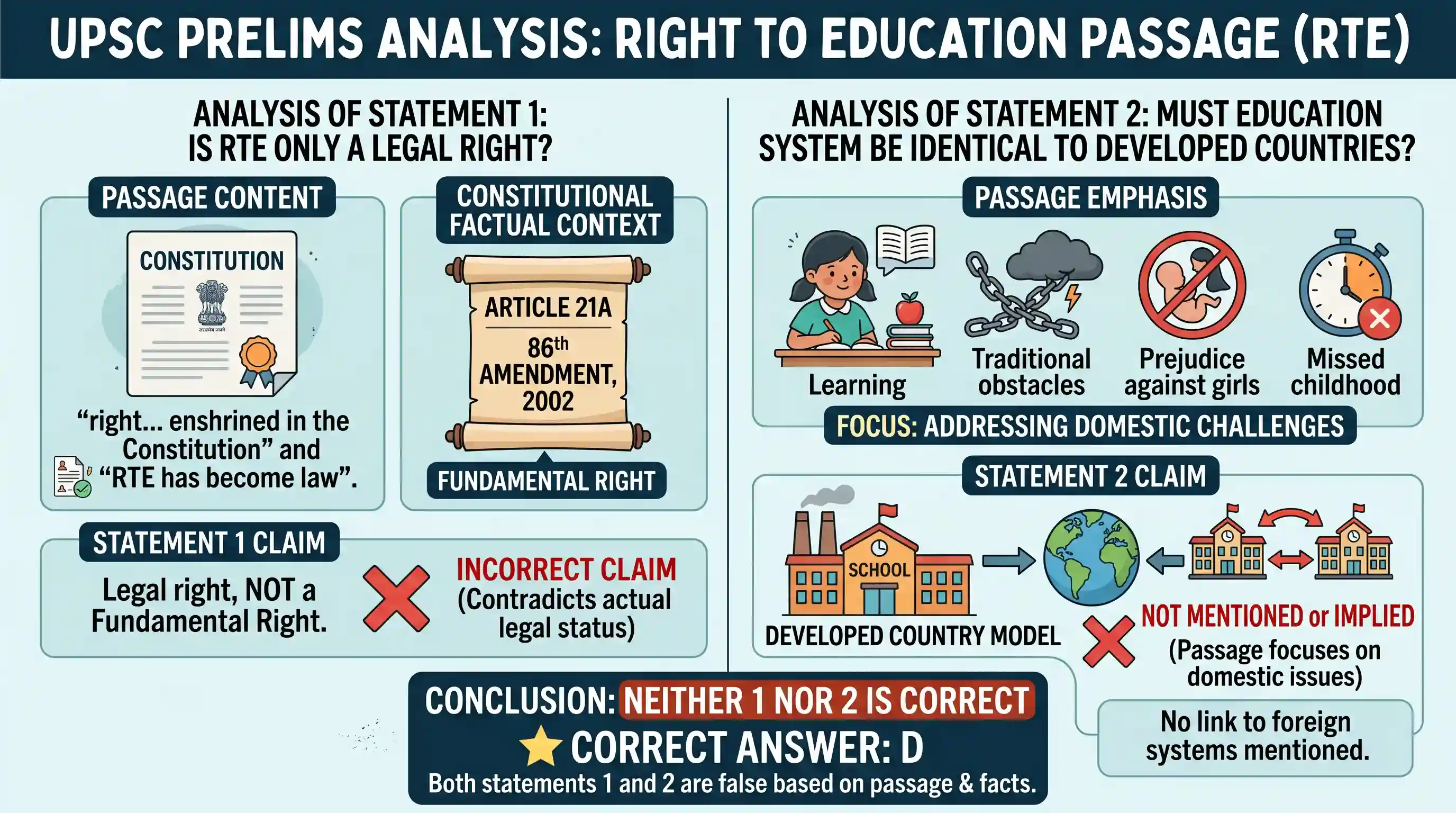
Statement 1 is incorrect. The Right to Education (RTE) was made a fundamental right in India through the 86th Constitutional Amendment Act in 2002, which inserted Article 21A into the Constitution. The passage refers to it as a right "enshrined in the Constitution," but it doesn't explicitly state whether it's fundamental or merely legal. However, based on constitutional knowledge, it is a fundamental right.
Statement 2 is incorrect. The passage discusses internal challenges like societal prejudice against girls and the unique nature of the right to education in India. It does not suggest or imply that the solution for universal education is to make the education system identical to that of developed countries. The passage focuses on addressing deep-seated societal issues and the system's inability to address them, not on adopting foreign models.
Since both statements are incorrect, the correct option is D.
Related questions
More UPSC Prelims practice from the same subject and topic.
- Prelims 2011CSATReading Comprehension
Read each of the following two passages and answer the items that follow. Your answers to these items should be based on the passages only. Passage-I For achieving inclusive growth there is- a critica…
- Prelims 2011CSATReading Comprehension
Passage-I For achieving inclusive growth there is- a critical need to rethink the- role of the State. The early debate among economists about the size of the Government can be misleading. The need of …
- Prelims 2011CSATReading Comprehension
Passage-I For achieving inclusive growth there is- a critical need to rethink the- role of the State. The early debate among economists about the size of the Government can be misleading. The need of …
- Prelims 2011CSATReading Comprehension
Passage- I For achieving inclusive growth there is- a critical need to rethink the- role of the State. The early debate among economists about the size of the Government can be misleading. The need of…
- Prelims 2011CSATReading Comprehension
Passage-I For achieving inclusive growth there is- a critical need to rethink the- role of the State. The early debate among economists about the size of the Government can be misleading. The need of …
- Prelims 2011CSATReading Comprehension
Passage-2 The concept of 'creative society' refers to a phase of development of a society in which a large number of potential contradictions become articulate and active. This is most evident when op…