In India, if a religious sect/community is given the status of a national minority, what special advantages it is entitled to? 1. It can establish and administer exclusive educational institutions. 2. The President of India automatically nominates a representative of the community to Lok Sabha. 3. It can derive benefits from the Prime Minister's 15-Point Programme. Which of the statements given above is/are correct?

- A1 only
- B2 and 3 only
- C1 and 3 onlyCorrect
- D1, 2 and 3
Explanation
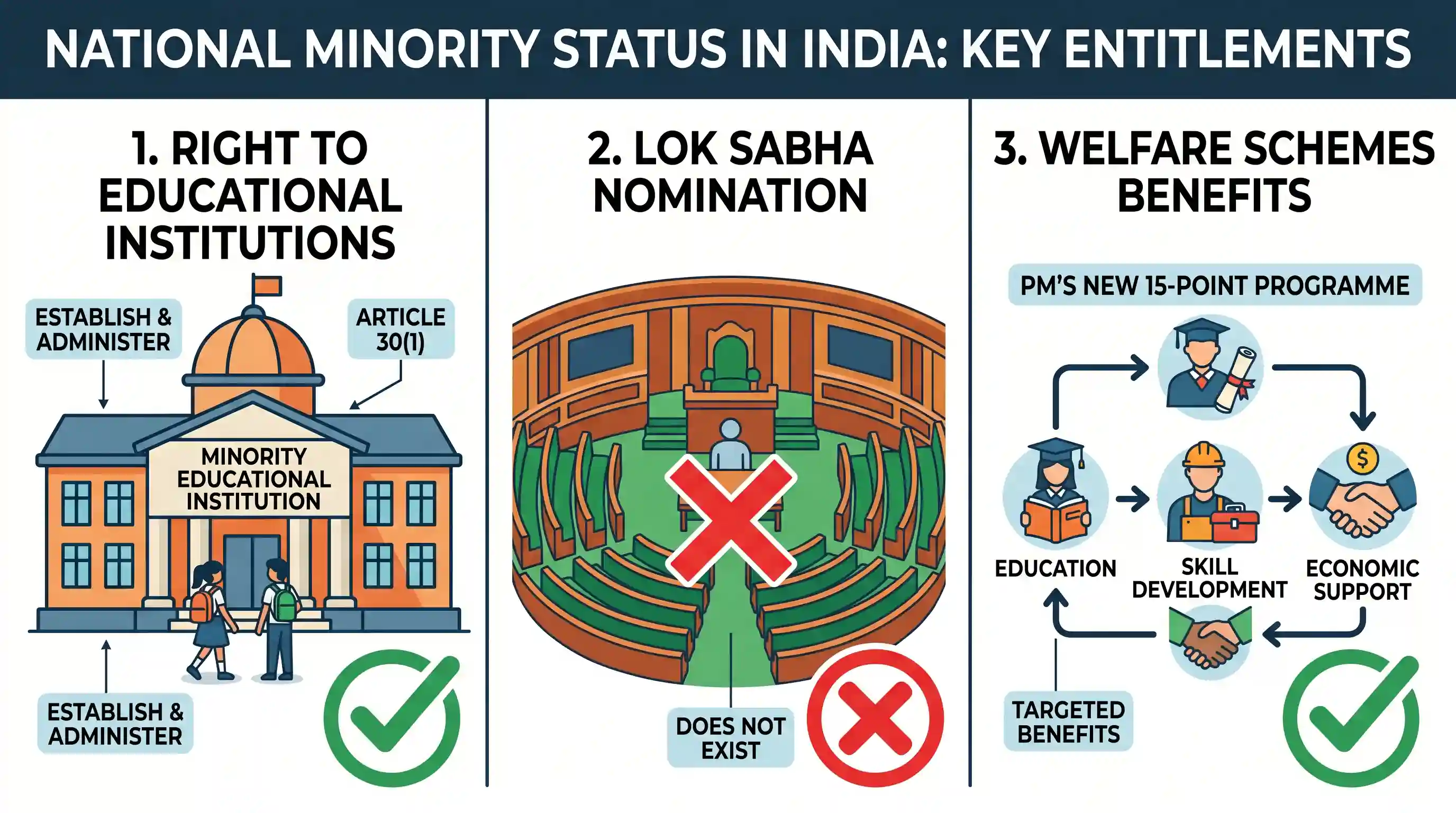
Statement 1 is correct. Article 30(1) of the Indian Constitution grants all minorities, whether based on religion or language, the right to establish and administer educational institutions of their choice. This is a fundamental right enjoyed by communities designated as minorities.
Statement 2 is incorrect. The President of India used to nominate two members from the Anglo-Indian community to the Lok Sabha if they were not adequately represented (Article 331). However, this provision was discontinued by the 104th Constitutional Amendment Act, 2019. There is no general provision for the President to automatically nominate representatives of any national minority community to the Lok Sabha.
Statement 3 is correct. The Prime Minister's New 15-Point Programme for the Welfare of Minorities is a government initiative aimed at improving the socio-economic conditions of the disadvantaged sections of the notified minority communities. If a community is given national minority status, it becomes eligible to derive benefits from such targeted welfare programmes.
Therefore, statements 1 and 3 are correct, making option C the right answer.
Related questions
More UPSC Prelims practice from the same subject and topic.
- Prelims 2011GS1polity-and-governance
The "New START" treaty was in the news. What is this treaty?
- Prelims 2011GS1polity-and-governance
Karl Marx explained the process of class struggle with the help of which one of the following theories?
- Prelims 2011GS1polity-and-governance
India is home to lakhs of persons with disabilities. What are the benefits available to them under the law? 1. Free schooling till the age of 18 years in government-run schools. 2. Preferential allotm…
- Prelims 2011GS1polity-and-governance
With reference to “Look East Policy” of India, consider the following statements: 1. India wants to establish itself as an important regional player in the East Asian affairs. 2. India wants to plug t…
- Prelims 2011GS1polity-and-governance
Consider the following: 1. Right to education. 2. Right to equal access to public service. 3. Right to food. Which of the above is/are Human Right/Human Rights under “Universal Declaration of Human Ri…
- Prelims 2011GS1polity-and-governance
Recently, the USA decided to support India's membership in multi-lateral export control regimes called the "Australia Group" and the "Wassenaar Arrangement". What is the difference between them? 1. Th…