The surface of a lake is frozen in severe winter, but the water at its bottom is still liquid. What is the reason?

- AIce is a bad conductor of heat
- BSince the surface of the lake is at the same temperature as the air, no heat is lost
- CThe density of water is maximum at 4°CCorrect
- DNone of the statements (a), (b) and (c) given above is correct
Explanation
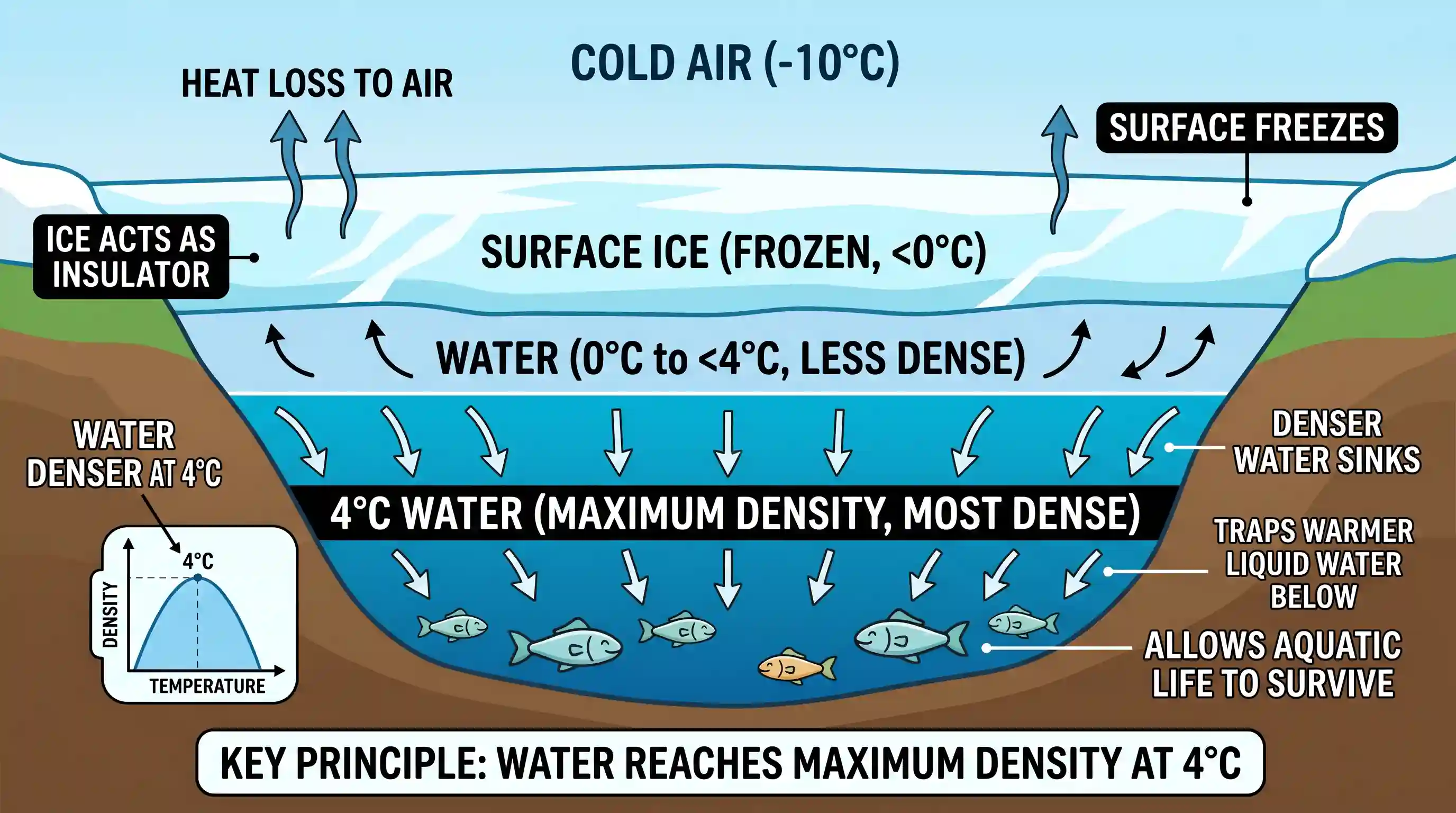
The correct answer is C because of the anomalous expansion of water. Most liquids contract and become denser as they cool, but water reaches its maximum density at 4 degrees Celsius.
As a lake cools in winter, the surface water becomes denser and sinks until the entire body of water reaches 4 degrees Celsius. Upon further cooling, the surface water becomes less dense and stays at the top until it freezes into ice. Since the densest water at 4 degrees Celsius stays at the bottom and ice acts as an insulator, the lower layers remain liquid, allowing aquatic life to survive even when the surface is frozen.
Related questions
More UPSC Prelims practice from the same subject and topic.
- Prelims 2011GS1geography
A layer in the Earth's atmosphere called Ionosphere facilitates radio communication. Why? 1. The presence of ozone causes the reflection of radio waves to Earth. 2. Radio waves have a very long wavele…
- Prelims 2011GS1geography
La Nina is suspected to have caused recent floods in Australia. How is La Nina different from El Nino? 1. La Nina is characterised by unusually cold ocean temperature in equatorial Indian Ocean wherea…
- Prelims 2011GS1geography
Westerlies in southern hemisphere are stronger and persistent than in northern hemisphere. Why? 1. Southern hemisphere has less landmass as compared to northern hemisphere. 2. Coriolis force is higher…
- Prelims 2011GS1geography
What could be the main reason/reasons for the formation of African and Eurasian desert belt? 1. It is located in the sub-tropical high pressure cells. 2. It is under the influence of warm ocean curren…
- Prelims 2011GS1geography
The jet aircrafts fly very easily and smoothly in the lower stratosphere. What could be the appropriate explanation? 1. There are no clouds or water vapour in the lower stratosphere. 2. There are no v…
- Prelims 2011GS1geography
The formation of ozone hole in the Antarctic region has been a cause of concern. What could be the reason for the formation of this hole?