A sandy and saline area is the natural habitat of an Indian animal species. The animal has no predators in that area but its existence is threatened due to the destruction of its habitat. Which one of the following could be that animal?

- AIndian wild buffalo
- BIndian wild assCorrect
- CIndian wild boar
- DIndian gazelle
Explanation
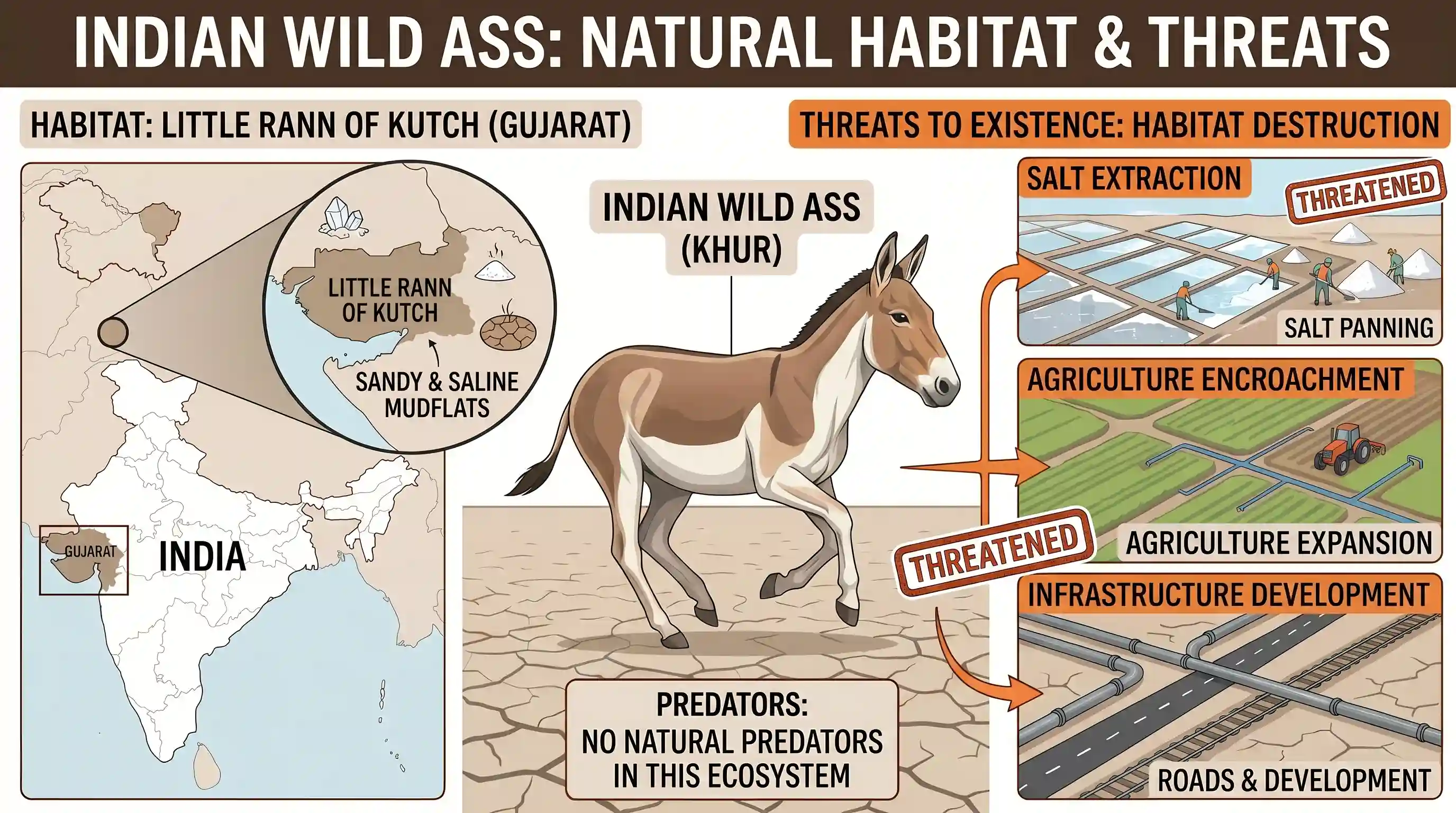
The Indian Wild Ass, also known as the Khur, is the correct answer because its natural habitat is the Little Rann of Kutch in Gujarat. This region is a unique landscape characterized by sandy and saline mudflats.
In this specific ecosystem, the Indian Wild Ass has no natural predators. However, its population faces threats primarily due to habitat destruction and fragmentation caused by human activities like salt panning, agriculture, and infrastructure development.
The other options do not fit the description. The Indian Wild Buffalo lives in wet grasslands and swamps of Northeast India. The Indian Wild Boar is found across various terrains and has several natural predators like tigers and leopards. The Indian Gazelle or Chinkara prefers arid plains and hills but is also preyed upon by carnivores. Therefore, the combination of a sandy saline habitat and a lack of natural predators specifically points to the Indian Wild Ass.
Related questions
More UPSC Prelims practice from the same subject and topic.
- Prelims 2011GS1geography
The formation of ozone hole in the Antarctic region has been a cause of concern. What could be the reason for the formation of this hole?
- Prelims 2011GS1geography
Regarding “carbon credits”, which one of the following statements is not correct?
- Prelims 2011GS1geography
When the bark of a tree is removed in a circular fashion all around near its base, it gradually dries up and dies because
- Prelims 2011GS1geography
Three of the following criteria have contributed to the recognition of Western Ghats-Sri Lanka and Indo-Burma regions as hotspots of biodiversity: 1. Species richness 2. Vegetation density 3. Endemism…
- Prelims 2011GS1geography
Human activities in the recent past have caused the increased concentration of carbon dioxide in the atmosphere, but a lot of it does not remain in the lower atmosphere because of 1. its escape into t…
- Prelims 2011GS1geography
In the context of ecosystem productivity, marine upwelling zones are important as they increase the marine productivity by bringing the 1. decomposer microorganisms to the surface. 2. nutrients to the…