Read the following passages and answer the items that follow passage. Your answer to these items should be based on the passage only. Chemical pesticides lose their role in sustainable agriculture if the pests evolve resistance. The evolution of pesticide resistance is simply natural selection in action. It is almost certain to occur when vast numbers of a genetically variable population are killed. One or a few individuals may be unusually resistant (perhaps because they possess an enzyme that can detoxify the pesticide). If the pesticide is applied repeatedly, each successive generation of the pest will contain a larger proportion of resistant individuals. Pests typically have a high intrinsic rate of reproduction, and so few individual in one generation may give rise to hundreds or thousands in the next, and resistance spreads very rapidly in a population. This problem was often ignored in the past, even though the first case of DDT (dichlorodiphenyltrichloroethane) resistance was reported early as 1946. There is exponential increase in the numbers of vertebrates that have evolved resistance and in the number of pesticides against which resistance has evolved. Resistance has been recorded in every family of arthropod pests (including dipterans such as mosquitoes and house flies, as well as beetles, moths, wasps, fleas, Lice and mites) as well as well as in weeds and plant pathogens, Take the Alabama leaf- worm, a moth pest of cotton, as an example. It has developed resistance in one or more regions of the world to aldrin, DDT, dieldrin, endrin, lindane and toxaphene. If chemical pesticides brought nothing but, problem- if their use was intrinsically and acutely unsustainable then they would already have fallen out of widespread use. This has not happened. Instead, their rate of production has increased rapidly. The ratio of cost of benefit for the individual agricultural producer has remained in favour of pesticide use. In the USA insecticides have been estimated to benefit the agricultural products to the tune of around 5 foreveryl spent. Moreover, in many poorer countries, the prospect of imminent mass starvation, or of an epidemic diseases, are so frightening that the social and health cost of using pesticides have to be ignored. In general the use of pesticides is justified by objective measures such as lives saved, economic efficiency of food production and total food produced. In these very fundamental senses, their use may be described as sustainable. In practice, sustainability depends on continually developing new pesticides that keep at least one step ahead of the pests pesticides that are less persistent, biodegradable and more accurately targeted at the pests. Why is the use of chemical pesticides generally justified by giving the examples of poor and developing countries? 1) Developed countries can afford to do away with use of pesticides by adapting to organic farming, but it is imperative for poor and developing countries to use chemical pesticides. 2) In poor and developing countries, the pesticides addressing the problem of epidemic diseases of crops, eases the food problem. 3) The social and health costs of pesticide use are generally ignored in poor and developing countries. Which of the statements given above is/are correct?

- AOnly 1
- BBoth 1 and 2
- COnly 2Correct
- DAll 1, 2 and 3
Explanation
The correct answer is C because it directly aligns with the specific reasons mentioned in the passage regarding why pesticide use is justified in poorer countries.
Explanation:
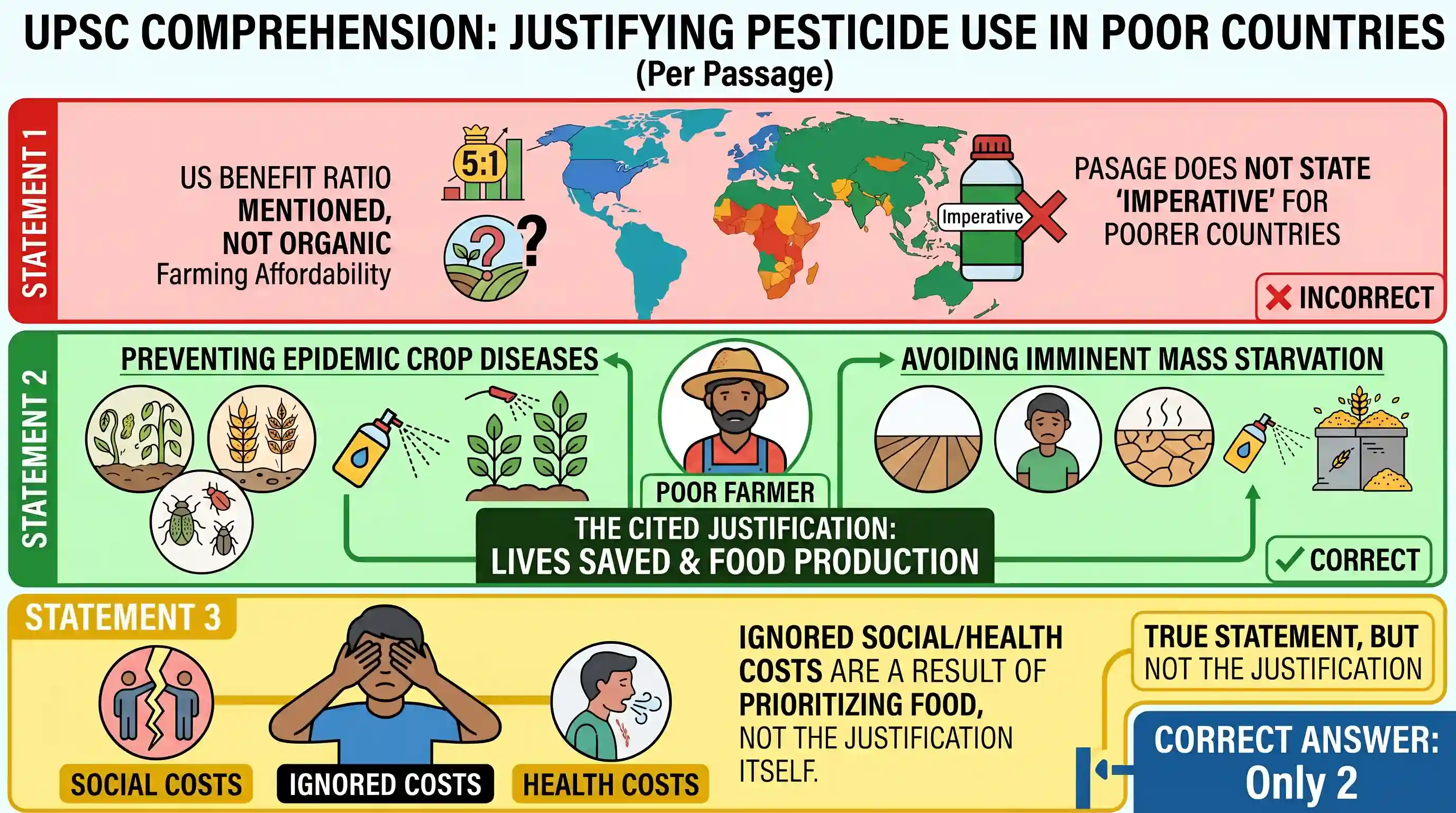
Statement 1 is incorrect because the passage never mentions that developed countries can afford to switch to organic farming or that they should do away with pesticides. It actually states that in the USA, pesticides provide a high cost benefit ratio.
Statement 2 is correct because the passage explicitly states that in poorer countries, the prospect of mass starvation or epidemic diseases is so frightening that pesticides are used to ensure food production and save lives. This addresses the food problem as mentioned in the option.
Statement 3 is incorrect in the context of the question. While the passage does mention that social and health costs are ignored in poorer countries, this is a consequence or a condition of their use, not the reason why the use of pesticides is justified. The justification lies in preventing starvation and disease, as reflected in Statement 2.
Therefore, only Statement 2 provides the correct reasoning for the justification as per the text.
Related questions
More UPSC Prelims practice from the same subject and topic.
- Prelims 2012CSATReading Comprehension
Read the following passages and answer the items that follow passage. Your answer to these items should be based on the passage only. Education, without a doubt, has an important functional, instrumen…
- Prelims 2012CSATReading Comprehension
Read the following passages and answer the items that follow passage. Your answer to these items should be based on the passage only. Education, without a doubt, has an important functional, instrumen…
- Prelims 2012CSATReading Comprehension
Read the following passages and answer the items that follow passage. Your answer to these items should be based on the passage only. Education, without a doubt, has an important functional, instrumen…
- Prelims 2012CSATReading Comprehension
Read the following passages and answer the items that follow passage. Your answer to these items should be based on the passage only. Chemical pesticides lose their role in sustainable agriculture if …
- Prelims 2012CSATReading Comprehension
Read the following passages and answer the items that follow passage. Your answer to these items should be based on the passage only. Chemical pesticides lose their role in sustainable agriculture if …
- Prelims 2012CSATReading Comprehension
Read the following passages and answer the items that follow passage. Your answer to these items should be based on the passage only. Chemical pesticides lose their role in sustainable agriculture if …