Read the following passages and answer the items that follow passage. Your answer to these items should be based on the passage only. Today's developing economies use much less energy per capita than developed countries such as the United States did at similar incomes, showing the potential for lower- carbon growth. Adaptation and mitigation need to be integrated into a climate smart development strategy that increases resilience, reduces the threat of further global warming, and improves development outcomes. Adaptation and mitigation measures can advance development, and prosperity can raise incomes and foster better institutions. A healthier population living in better- built houses and with access to bank loans and social security is better equipped to deal with a changing climate and its consequences. Advancing robust, resilient development policies that promote adaptation is needed today because changes in the climate, already begun, will increase even in the short term. The spread of economic prosperity has always been intertwined with adaptation to changing ecological conditions. But as growth has altered the environment and as environmental change has adaptability demands greater capacity to understand our environment, generate new adaptive technologies and practices, and diffuse them widely. As economic historians have explained, much of humankind's creative potential has been directed at adapting to the changing world. But adaptation cannot cope with all the impacts related to climate change, especially as large changes unfold in the long term. Countries cannot grow out of harm's way fast enough to match the changing climate. And some growth strategies, whether driven by the government or the market, can also add to vulnerability- particularly if they overexploit natural resources. Under the Soviet development plan, irrigated cotton cultivation expanded in water- stressed Central Asia and led to the near disappearance of the Aral Sea, threatening the livelihoods of fisherman, herders and farmers. And clearing mangroves- the natural coastal buffers against storm surges- to make way for intensive farming or housing development, increases the physical vulnerability of coastal settlements, whether in Guinea or in Louisiana. What does low- carbon growth imply in the present context? 1) More emphasis on the use of renewable sources of energy. 2) Less emphasis on manufacturing sector and more emphasis on agriculture sector. 3) Switching over from monoculture practices to mixed farming. 4) Less demand for goods and services. Select the correct answer using the codes given below:

- AOnly 1Correct
- BOnly 2, 3 and 4
- COnly 1 and 4
- DNone of the above implies low-carbon growth
Explanation
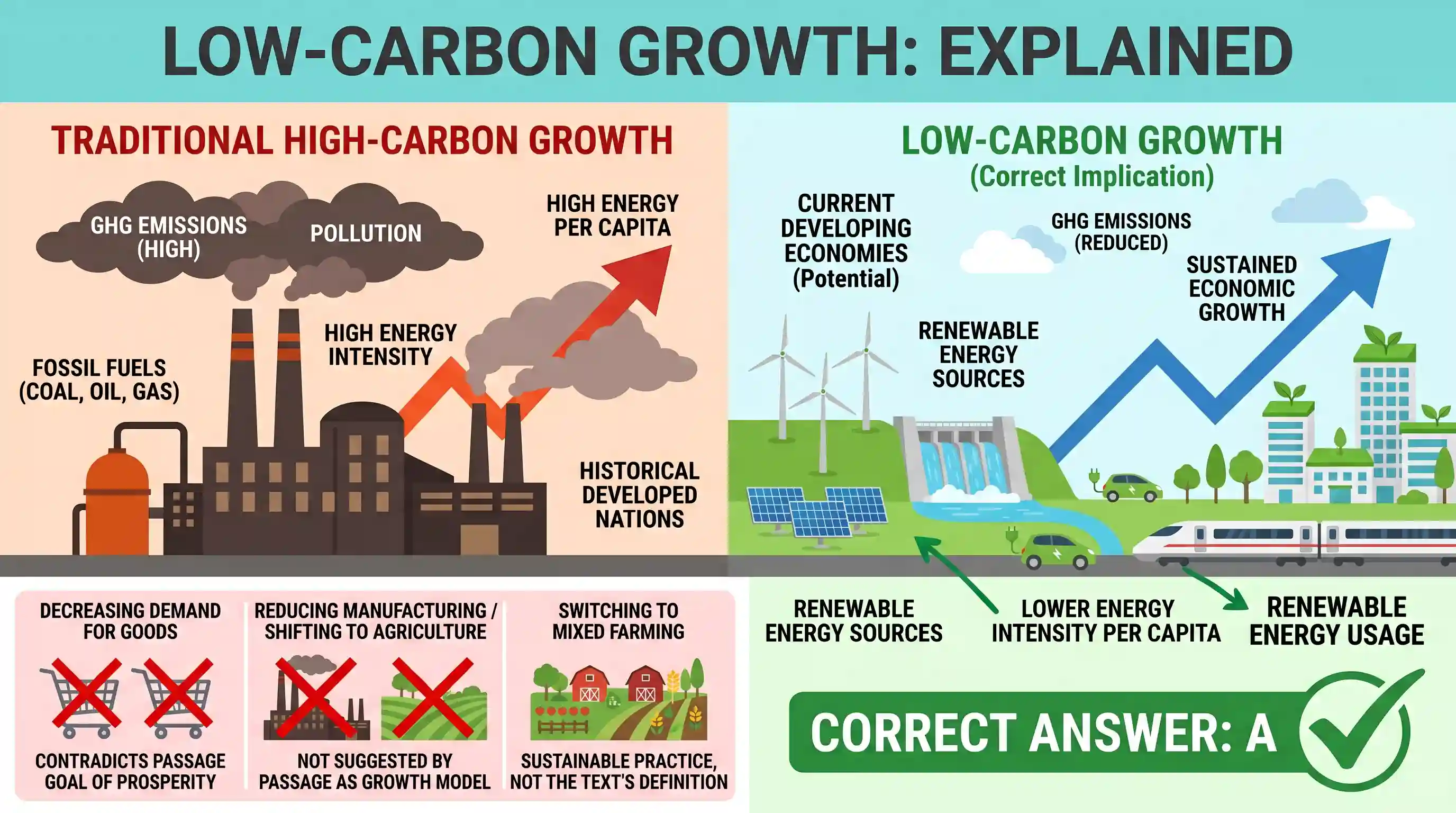
The correct answer is A because low carbon growth refers to economic development that minimizes greenhouse gas emissions. In the context of the passage, the first sentence highlights that developing economies are using less energy per capita than developed nations did at similar income levels, showing a potential for lower carbon growth. Among the given options, the use of renewable sources of energy directly aligns with the objective of reducing carbon intensity while maintaining growth.
Option 2 is incorrect because the passage does not suggest abandoning manufacturing for agriculture. Option 3 is incorrect because, while mixed farming is a sustainable practice mentioned in general ecological contexts, it is not defined as the basis for low carbon growth in this specific text. Option 4 is incorrect because the passage emphasizes increasing prosperity and income, which typically leads to higher, not lower, demand for goods and services. Therefore, only statement 1 is a logical implication of low carbon growth.
Related questions
More UPSC Prelims practice from the same subject and topic.
- Prelims 2012CSATReading Comprehension
Read the following passages and answer the items that follow passage. Your answer to these items should be based on the passage only. Education, without a doubt, has an important functional, instrumen…
- Prelims 2012CSATReading Comprehension
Read the following passages and answer the items that follow passage. Your answer to these items should be based on the passage only. Education, without a doubt, has an important functional, instrumen…
- Prelims 2012CSATReading Comprehension
Read the following passages and answer the items that follow passage. Your answer to these items should be based on the passage only. Education, without a doubt, has an important functional, instrumen…
- Prelims 2012CSATReading Comprehension
Read the following passages and answer the items that follow passage. Your answer to these items should be based on the passage only. Chemical pesticides lose their role in sustainable agriculture if …
- Prelims 2012CSATReading Comprehension
Read the following passages and answer the items that follow passage. Your answer to these items should be based on the passage only. Chemical pesticides lose their role in sustainable agriculture if …
- Prelims 2012CSATReading Comprehension
Read the following passages and answer the items that follow passage. Your answer to these items should be based on the passage only. Chemical pesticides lose their role in sustainable agriculture if …