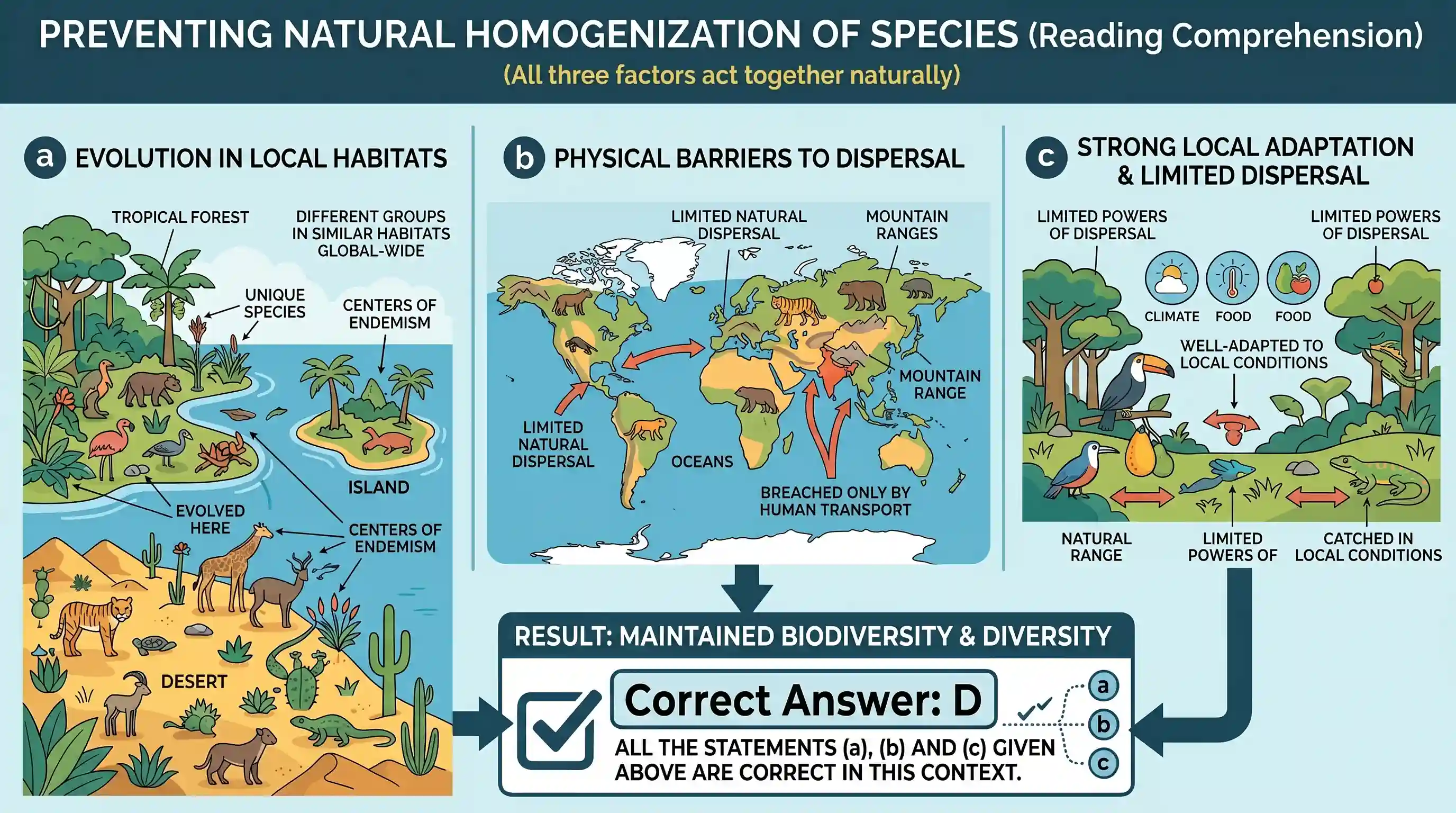
Read the following passages and answer the items that follow each passage. Your answers to these items should be based on the passages only. Invasions of exotic species into new geographic areas sometimes occur naturally and without-human agency. However, human actions have increased this trickle to a flood. Human-caused introductions may occur either accidentally as a consequence of human transport, or intentionally but illegally to serve some private purpose or legitimately to procure some hoped-for public benefit by bringing a pest under control, producing new agricultural products or providing novel recreational opportunities. Many introduced species are assimilated into communities without much obvious effect. However, some have been responsible for dramatic changes to native species and natural communities. For example, the accidental introduction of the brown tree snake Boiga irregularis into Guam, an island in the Pacific, has through nest predation reduced 10 endemic forest bird species to the point of extinction. One of the major reasons for the world's great biodiversity is the occurrence of centers of endemism so that similar habitats in different parts of the world are occupied by different groups of species that happen to have evolved there. If every species naturally had access to everywhere on the globe, we might expect a relatively small number of successful species to become dominant in each biome. The extent to which this homogenization can happen naturally is restricted by the limited powers of dispersal of most species in the face of the physical barriers that exist to dispersal. By virtue of the transport opportunities offered by humans, these barriers have been breached by an ever-increasing number of exotic species. The effects of introductions have been to convert a hugely diverse range of local community compositions into something much more homogeneous. It would be wrong, however, to conclude that introducing species to a region will inevitably cause a decline in species richness there. For example, there are numerous species of plants, invertebrates and vertebrates found in continental Europe but absent from the British Isles (many because they have so far failed to recolonize after the last glaciations). Their introduction would be likely to augment British biodiversity. The significant detrimental effect noted above arises where aggressive species provide a novel challenge to endemic biotas ill- equipped to deal with them. How is homogenization prevented under natural conditions?

- AEvolution of groups of species specific to local habitats
- BPresence of oceans and mountain ranges
- CStrong adaptation of groups of species to local physical and climatic conditions
- DAll the statements (a), (b) and (c) given above are correct in this context.Correct
Explanation
The correct answer is D because the passage highlights multiple factors that prevent natural homogenization.
First, the text mentions that the worlds biodiversity is due to centers of endemism where different species evolved in specific local habitats, supporting statement A.
Second, the passage explicitly states that natural homogenization is restricted by physical barriers to dispersal. In geographical terms, these physical barriers refer to features like oceans and mountain ranges, supporting statement B.
Third, the passage explains that species evolve in specific habitats and that homogenization is limited because most species have limited powers of dispersal to move beyond their local environments. This implies a strong link between species and their local conditions, supporting the context of statement C.
Since the passage attributes the prevention of homogenization to evolution in isolation and the presence of physical barriers that limit dispersal, all three statements accurately reflect the reasons discussed in the text.
Related questions
More UPSC Prelims practice from the same subject and topic.
- Prelims 2012CSATReading Comprehension
Read the following passages and answer the items that follow passage. Your answer to these items should be based on the passage only. Education, without a doubt, has an important functional, instrumen…
- Prelims 2012CSATReading Comprehension
Read the following passages and answer the items that follow passage. Your answer to these items should be based on the passage only. Education, without a doubt, has an important functional, instrumen…
- Prelims 2012CSATReading Comprehension
Read the following passages and answer the items that follow passage. Your answer to these items should be based on the passage only. Education, without a doubt, has an important functional, instrumen…
- Prelims 2012CSATReading Comprehension
Read the following passages and answer the items that follow passage. Your answer to these items should be based on the passage only. Chemical pesticides lose their role in sustainable agriculture if …
- Prelims 2012CSATReading Comprehension
Read the following passages and answer the items that follow passage. Your answer to these items should be based on the passage only. Chemical pesticides lose their role in sustainable agriculture if …
- Prelims 2012CSATReading Comprehension
Read the following passages and answer the items that follow passage. Your answer to these items should be based on the passage only. Chemical pesticides lose their role in sustainable agriculture if …