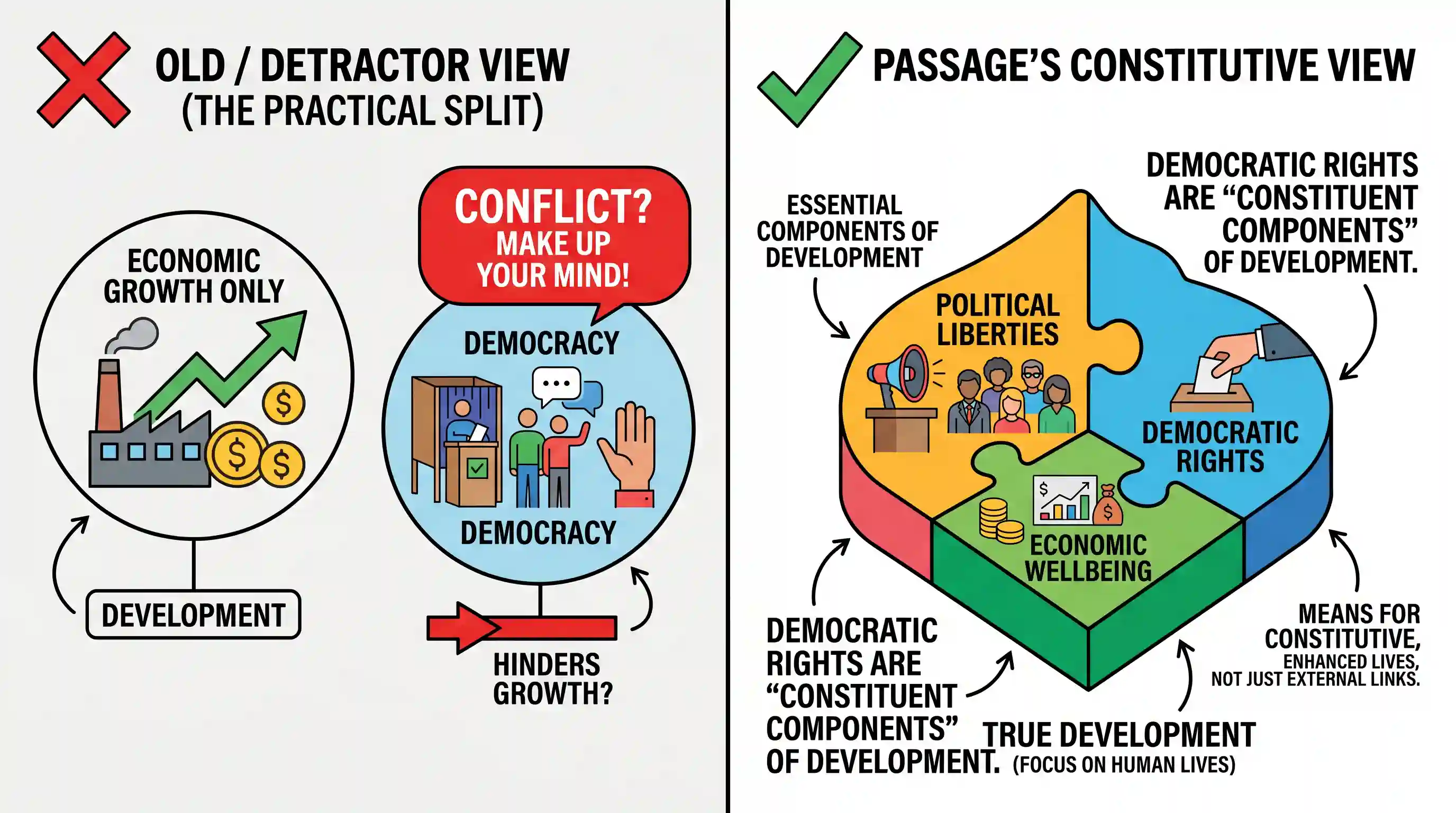
Read the following passages and answer the items that follow each passage. Your answers to these items should be based on the passages only. Most champions of democracy have been rather reticent in suggesting that democracy would itself promote development and enhancement of social welfare – they have tended to see them as good but distinctly separate and largely independent goals. The detractors of democracy, on the other hand, seemed to have been quite willing to express their diagnosis of what they see as serious tensions between democracy and development. The theorists of the practical split – "Make up your mind: do you want democracy, or instead, do you want development?" – often came, at least to start with, from East Asian countries, and their voice grew in influence as several of these countries were immensely successful – through the 1970s and 1980s and even later – in promoting economic growth without pursuing democracy. To deal with these issues we have to pay particular attention to both the content of what can be called development and to the interpretation of democracy (in particular to the respective roles of voting and of public reasoning). The assessment of development cannot be divorced from the lives that people can lead and the real freedom that they enjoy. Development can scarcely be seen merely in terms of enhancement of inanimate objects of convenience, such as a rise in the GNP (or in personal incomes), or industrialization – important as they may be as means to the real ends. Their value must depend on what they do to the lives and freedom of the people involved, which must be central to the idea of development. If development is understood in a broader way, with a focus on human lives, then it becomes immediately clear that the relation between development and democracy has to be seen partly in terms of their constitutive connection, rather than only through their external links. Even though the question has often been asked whether political freedom is "conducive to development", we must not miss the crucial recognition that political liberties and democratic rights are among the "constituent components" of development. Their relevance for development does not have to be established indirectly through their contribution to the growth of GNP. What does a "constitutive" connection between democracy and development imply?

- AThe relation between them has to be seen through external links
- BPolitical and civil rights only can lead to economic development
- CPolitical liberties and democratic rights are essential elements of developmentCorrect
- DNone of the statements (a), (b) and (c) given above is correct in this context.
Explanation
The passage explicitly states: "political liberties and democratic rights are among the 'constituent components' of development." It further clarifies that their relevance does not have to be established indirectly, but they are part of development itself.
Analyzing the options: A) The relation between them has to be seen through external links - This contradicts the passage, which says the relation should be seen "partly in terms of their constitutive connection, rather than only through their external links." B) Political and civil rights only can lead to economic development - The passage discusses "development" in a broader sense, not just "economic development," and does not state that these rights are the only factors. It says they are "constituent components" of development itself. C) Political liberties and democratic rights are essential elements of development - This aligns perfectly with the passage's statement that they are "constituent components" of development, implying they are fundamental or essential parts of it.
Therefore, C is the correct answer.
Related questions
More UPSC Prelims practice from the same subject and topic.
- Prelims 2012CSATReading Comprehension
Read the following passages and answer the items that follow passage. Your answer to these items should be based on the passage only. Education, without a doubt, has an important functional, instrumen…
- Prelims 2012CSATReading Comprehension
Read the following passages and answer the items that follow passage. Your answer to these items should be based on the passage only. Education, without a doubt, has an important functional, instrumen…
- Prelims 2012CSATReading Comprehension
Read the following passages and answer the items that follow passage. Your answer to these items should be based on the passage only. Education, without a doubt, has an important functional, instrumen…
- Prelims 2012CSATReading Comprehension
Read the following passages and answer the items that follow passage. Your answer to these items should be based on the passage only. Chemical pesticides lose their role in sustainable agriculture if …
- Prelims 2012CSATReading Comprehension
Read the following passages and answer the items that follow passage. Your answer to these items should be based on the passage only. Chemical pesticides lose their role in sustainable agriculture if …
- Prelims 2012CSATReading Comprehension
Read the following passages and answer the items that follow passage. Your answer to these items should be based on the passage only. Chemical pesticides lose their role in sustainable agriculture if …