Read the following passages and answer the items that follow each passage. Your answers to these items should be based on the passages only. The poor especially in market economies need the strength that collectivities offer for creating more economic, social and political space for themselves, for enhancing their socio-economic well-being and voice, and as a protection against free market individualism. It has been argued that a group approach to farming, especially in the form of bottom up agricultural production collectivities, offers substantial scope for poverty alleviation and empowering the poor as well as enhancing agricultural productivity. To realise this potential, however, the groups would need to be voluntary in nature, small in size, participative in decision making and equitable in work sharing and benefit distribution. There are many notable examples of such collectivities to be found in varied contexts, such as in the transition economies. All of them bear witness to the possibility of successful cooperation under given conditions. And although the gender impact of the family cooperatives in the transition economies are uncertain, the Indian examples of women-only groups farming offer considerable potential for benefiting women. What does the author imply by talking about "gender impact"?

- AWomen are doubtful participants in cooperatives
- BFamily cooperatives may not include women
- CWomen considerably benefit from group farmingCorrect
- DWomen's role in transition economies is, highly restrictive.
Explanation
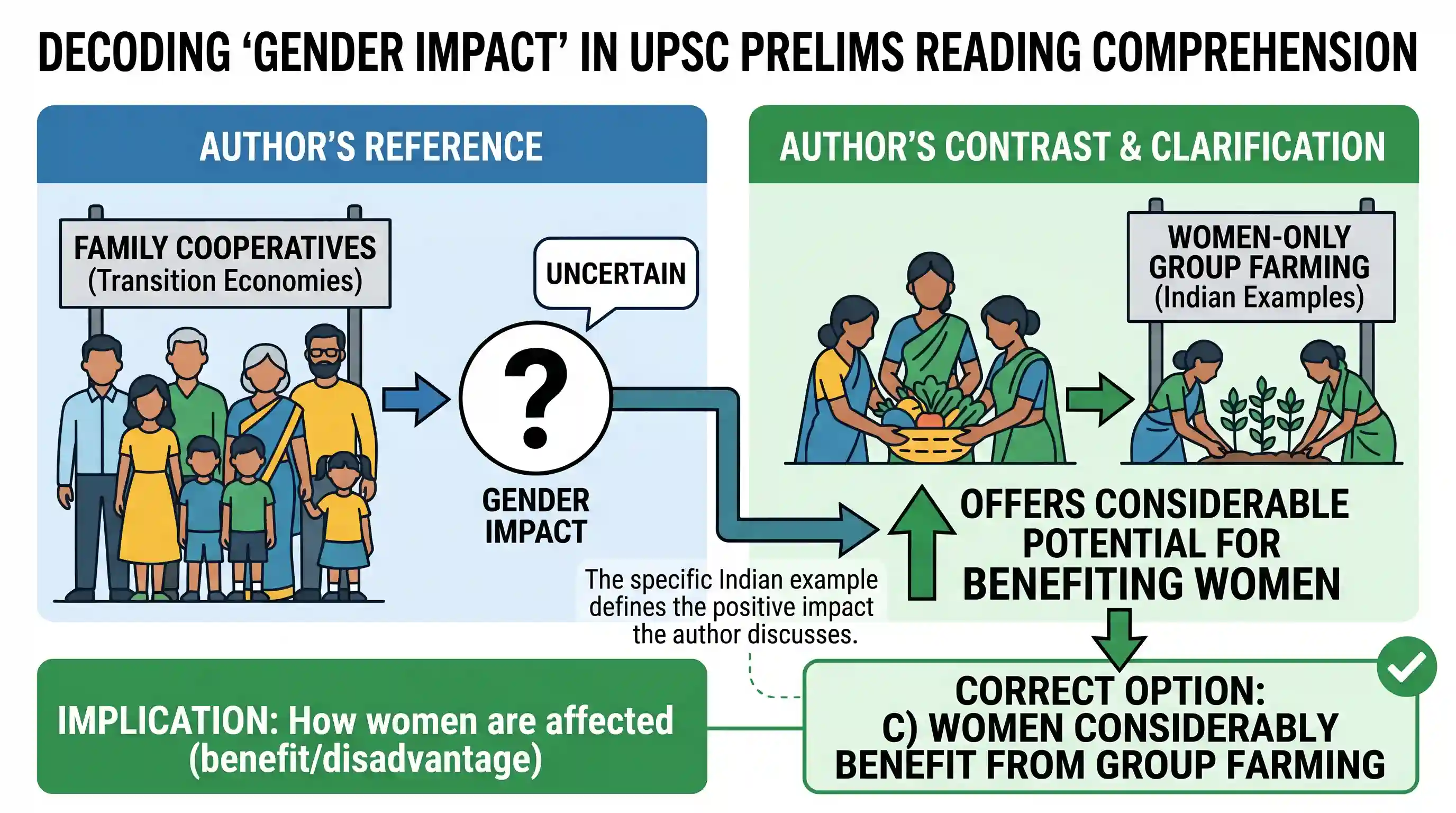
The author discusses "gender impact" in the context of family cooperatives in transition economies, stating it is "uncertain." Immediately after, the author contrasts this with "the Indian examples of women-only groups farming offer considerable potential for benefiting women." This direct juxtaposition implies that "gender impact" refers to how women are affected by these collectivities, specifically in terms of benefits or disadvantages. The Indian examples then clarify a positive "gender impact" by showing women considerably benefiting from group farming.
Analyzing the options: A) Women are doubtful participants in cooperatives: The passage does not state that women are doubtful participants. It discusses the impact on them, not their willingness to participate. B) Family cooperatives may not include women: "Family cooperatives" by definition would typically include women. The uncertainty is about the impact on women within these structures, not their inclusion. C) Women considerably benefit from group farming: This aligns directly with the passage's statement about "Indian examples of women-only groups farming offer considerable potential for benefiting women," which is presented as a counterpoint or clarification to the "uncertain" gender impact in transition economies. The author uses the Indian example to illustrate a positive gender impact. D) Women's role in transition economies is highly restrictive: The passage states the gender impact is "uncertain," which does not necessarily mean "highly restrictive." It simply means the effects are not clear.
Therefore, the author implies that "gender impact" relates to how women are affected, and the subsequent example highlights the potential for women to considerably benefit.
Related questions
More UPSC Prelims practice from the same subject and topic.
- Prelims 2012CSATReading Comprehension
Read the following passages and answer the items that follow passage. Your answer to these items should be based on the passage only. Education, without a doubt, has an important functional, instrumen…
- Prelims 2012CSATReading Comprehension
Read the following passages and answer the items that follow passage. Your answer to these items should be based on the passage only. Education, without a doubt, has an important functional, instrumen…
- Prelims 2012CSATReading Comprehension
Read the following passages and answer the items that follow passage. Your answer to these items should be based on the passage only. Education, without a doubt, has an important functional, instrumen…
- Prelims 2012CSATReading Comprehension
Read the following passages and answer the items that follow passage. Your answer to these items should be based on the passage only. Chemical pesticides lose their role in sustainable agriculture if …
- Prelims 2012CSATReading Comprehension
Read the following passages and answer the items that follow passage. Your answer to these items should be based on the passage only. Chemical pesticides lose their role in sustainable agriculture if …
- Prelims 2012CSATReading Comprehension
Read the following passages and answer the items that follow passage. Your answer to these items should be based on the passage only. Chemical pesticides lose their role in sustainable agriculture if …