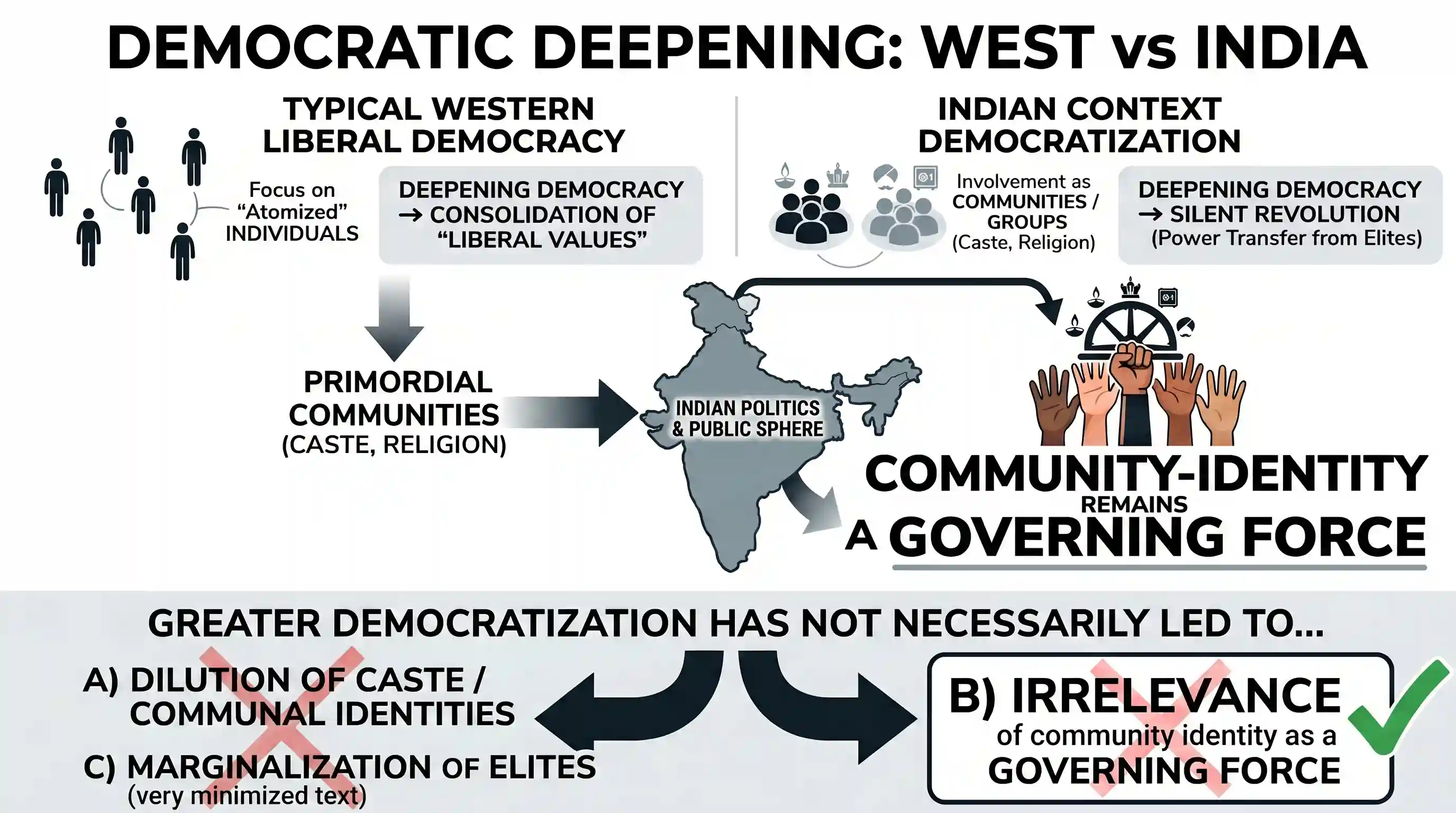
Read the following passages and answer the items that follow each passage. Your answers to these items should be based on the passages only. In a typical Western liberal context, deepening of democracy invariably leads to consolidation of 'liberal values'. In the Indian context, democratization is translated into greater involvement of people not as 'individuals' which is a staple to liberal discourse, but as communities or groups. Individuals are getting involved in the public sphere not as 'atomized' individuals but as members of primordial communities drawn on religious or caste Community-identity seems governing force. It is not therefore surprising that the so-called peripheral groups continue to maintain their identities with reference to the social groups (caste, religion or sect) to which they belong while getting involved in the political processes despite the fact that their political goals remain more or less identical. By helping to articulate the political voice of the marginalized, democracy in India has led to 'a loosening of social strictures' and empowered the peripherals to be confident of their ability to improve the socioeconomic conditions in which they are placed. This is a significant political process that had led to a silent revolution through a meaningful transfer of power from the upper caste elites to various subaltern groups within the democratic amework of public identity governance. With reference to the passage, identify the most appropriate statement that can complete the given sentence: "Greater democratization in India has not necessarily led to _________

- Athe dilution of caste and communal identities in the public sphere
- Birrelevance of community identity as a governing force in Indian politicsCorrect
- Cmarginalization of elite groups in society
- Drelative unimportance of hereditary identities over class identities.
Explanation
The passage explicitly states that in the Indian context, "democratization is translated into greater involvement of people... as communities or groups" and that "Community-identity seems governing force." It further notes that "peripheral groups continue to maintain their identities... while getting involved in the political processes."
Let's analyze the options:
A) the dilution of caste and communal identities in the public sphere The passage states that groups "continue to maintain their identities." If identities are maintained, they are not diluted. So, democratization has not led to their dilution. This statement is consistent with the passage.
B) irrelevance of community identity as a governing force in Indian politics The passage explicitly states, "Community-identity seems governing force." If it is a governing force, then it is certainly not irrelevant as a governing force. Therefore, greater democratization has not led to its irrelevance as a governing force. This statement is a direct consequence of the passage's assertion.
C) marginalization of elite groups in society The passage mentions a "meaningful transfer of power from the upper caste elites to various subaltern groups." This indicates a shift in power, but it does not necessarily imply the complete "marginalization" of elite groups in society as a whole. The passage focuses on a transfer of political power, not their overall societal marginalization.
D) relative unimportance of hereditary identities over class identities. The passage discusses "primordial communities drawn on religious or caste" (hereditary identities) but does not mention "class identities" or compare their relative importance. Therefore, this statement cannot be concluded from the passage.
Comparing A and B: Both A and B are consistent with the passage. However, the passage's central argument regarding community identity in Indian democracy is its role as a "governing force." The sentence "Community-identity seems governing force" is a direct statement about its political efficacy and importance. Option B directly addresses this "governing force" aspect, stating that it has not become irrelevant. While identities are also maintained (negating dilution, option A), the emphasis on community identity as a governing force makes B a more direct and central completion to the sentence, reflecting the passage's main point about the unique nature of Indian democracy.
Therefore, the most appropriate statement is B, as it directly negates the idea that community identity has lost its explicit role as a "governing force" in Indian politics, a point strongly emphasized in the passage.
The final answer is B.
Related questions
More UPSC Prelims practice from the same subject and topic.
- Prelims 2012CSATReading Comprehension
Read the following passages and answer the items that follow passage. Your answer to these items should be based on the passage only. Education, without a doubt, has an important functional, instrumen…
- Prelims 2012CSATReading Comprehension
Read the following passages and answer the items that follow passage. Your answer to these items should be based on the passage only. Education, without a doubt, has an important functional, instrumen…
- Prelims 2012CSATReading Comprehension
Read the following passages and answer the items that follow passage. Your answer to these items should be based on the passage only. Education, without a doubt, has an important functional, instrumen…
- Prelims 2012CSATReading Comprehension
Read the following passages and answer the items that follow passage. Your answer to these items should be based on the passage only. Chemical pesticides lose their role in sustainable agriculture if …
- Prelims 2012CSATReading Comprehension
Read the following passages and answer the items that follow passage. Your answer to these items should be based on the passage only. Chemical pesticides lose their role in sustainable agriculture if …
- Prelims 2012CSATReading Comprehension
Read the following passages and answer the items that follow passage. Your answer to these items should be based on the passage only. Chemical pesticides lose their role in sustainable agriculture if …