Which of the following is/are the principal feature(s) of the Government of India Act, 1919? 1. Introduction of dyarchy in the executive government of the provinces 2. Introduction of separate communal electorates for Muslims 3. Devolution of legislative authority by the centre to the provinces Select the correct answer using the codes given below:

- A1 only
- B2 and 3 only
- C1 and 3 onlyCorrect
- D1, 2 and 3
Explanation
The correct answer is C because of the following reasons:
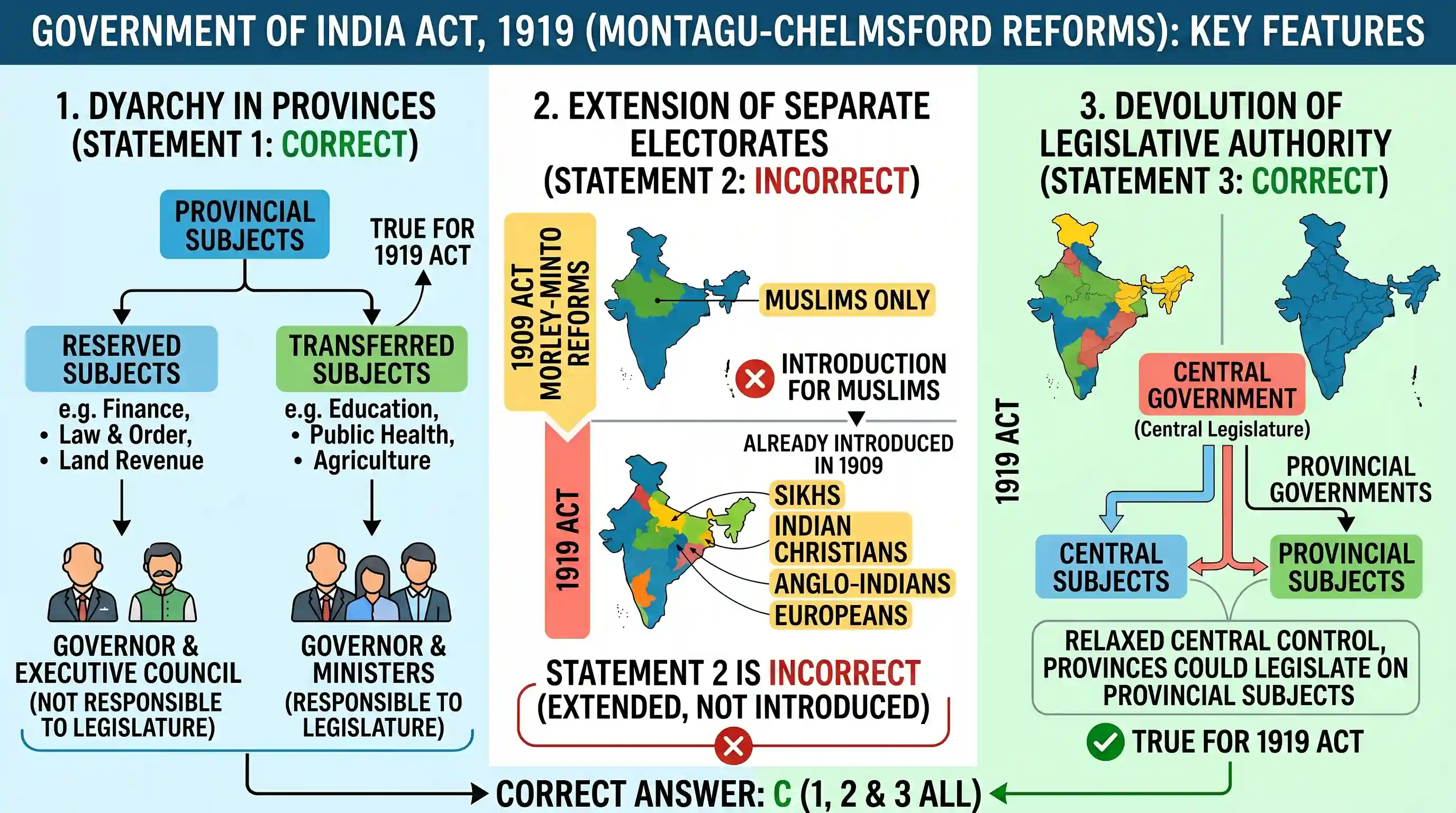
Statement 1 is correct. The Government of India Act of 1919, also known as the Montagu Chelmsford Reforms, introduced Dyarchy in the provinces. This divided provincial subjects into two parts: Transferred and Reserved.
Statement 2 is incorrect. Separate communal electorates for Muslims were actually introduced earlier by the Morley Minto Reforms or the Government of India Act of 1909. The 1919 Act merely extended this system to Sikhs, Indian Christians, Anglo Indians, and Europeans.
Statement 3 is correct. The Act relaxed central control over the provinces by demarcating and separating the central and provincial subjects. This allowed provinces to make laws on subjects in their own list, effectively devolving legislative authority.
Therefore, only statements 1 and 3 are principal features of the 1919 Act.
Related questions
More UPSC Prelims practice from the same subject and topic.
- Prelims 2012GS1polity-and-governance
In the areas covered under the Panchayat (Extension to the Scheduled Areas) Act, 1996, what is the role/power of Gram Sabha? 1. Gram Sabha has the power to prevent alienation of land in the Scheduled …
- Prelims 2012GS1polity-and-governance
In the Parliament of India, the purpose of an adjournment motion is:
- Prelims 2012GS1polity-and-governance
How does National Biodiversity Authority (NBA) help in protecting the Indian agriculture? 1. NBA checks the biopiracy and protects the indigenous and traditional genetic resources. 2. NBA directly mon…
- Prelims 2012GS1polity-and-governance
The National Green Tribunal Act, 2010 was enacted in consonance with which of the following provisions of the Constitution of India? 1. Right to healthy environment, construed as a part of Right to li…
- Prelims 2012GS1polity-and-governance
With reference to consumers' rights/privileges under the provisions of law in India, which of the following statements is/are correct? 1. Consumers are empowered to take samples for food testing. 2. W…
- Prelims 2012GS1polity-and-governance
Which of the following can be said to be essentially the parts of Inclusive Governance? 1. Permitting the Non-Banking Financial Companies to do banking 2. Establishing effective District Planning Comm…