When you travel in Himalayas, you will see the following: 1. Deep gorges 2. U-turn river courses 3. Parallel mountain ranges 4. Steep gradients causing land-sliding Which of the above can be said to be the evidences for Himalayas being young fold mountains?

- A1 and 2 only
- B1, 2 and 4 only
- C3 and 4 only
- D1, 2, 3 and 4Correct
Explanation
The correct answer is D because all four features are characteristic markers of the Himalayas ongoing tectonic activity and geological youth.
-
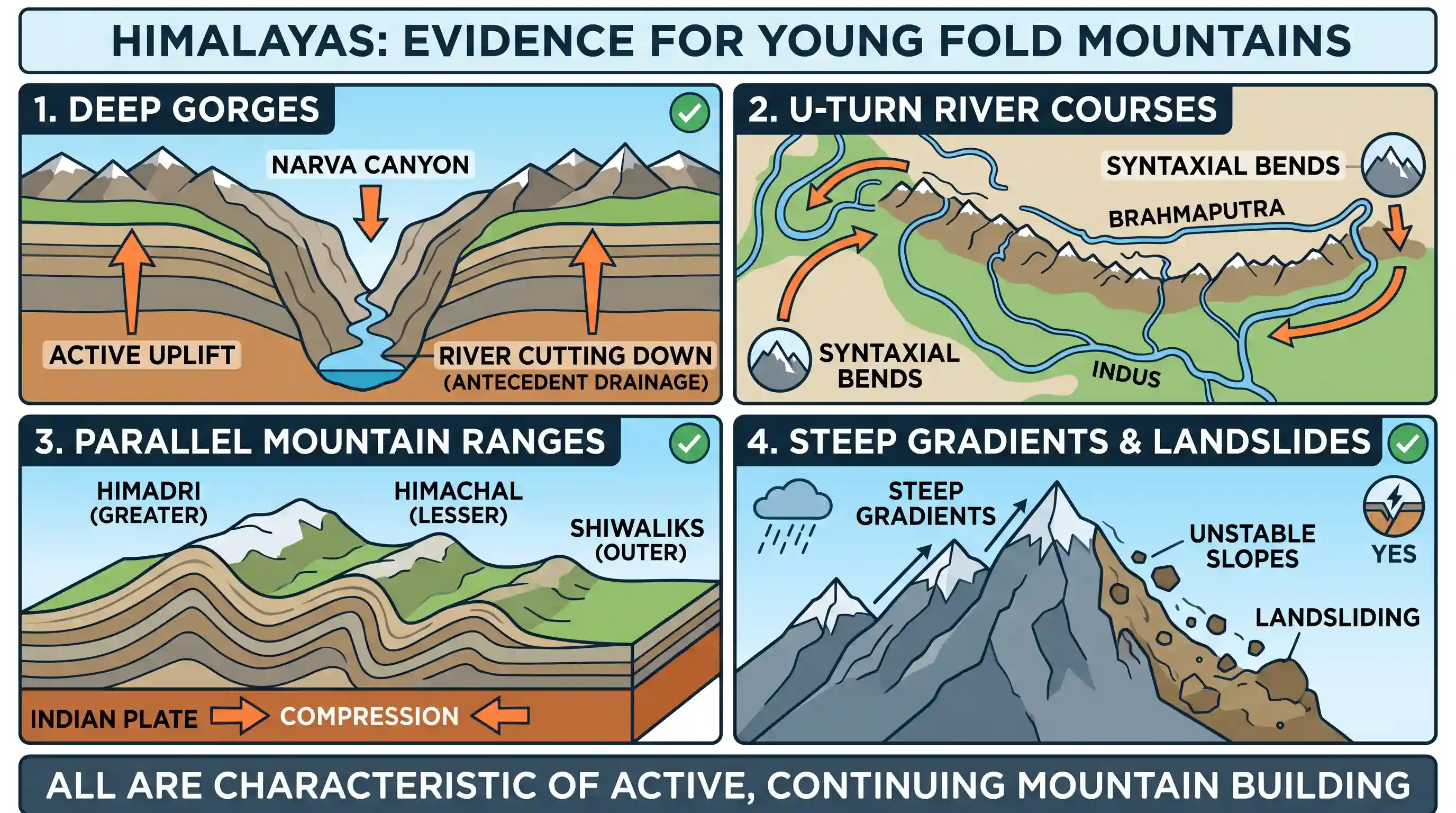
Deep Gorges: These are formed because the rivers are older than the mountains. As the Himalayas uplifted, the rivers cut down through them at a rapid rate, creating deep V shaped valleys which indicate recent and active mountain building.
-
U turn River Courses: Rivers like the Brahmaputra take sharp turns, known as syntaxial bends, around the eastern and western extremities of the Himalayas. This occurs because the mountain range is still folding and bending due to the northward movement of the Indian Plate.
-
Parallel Mountain Ranges: The Himalayas consist of three distinct parallel ranges, the Himadri, Himachal, and Shiwaliks. This structural arrangement is a classic feature of fold mountains formed by the compression of the earth's crust.
-
Steep Gradients causing Land sliding: Since the Himalayas are young and still rising, they are composed of unstable sedimentary rocks and have very steep slopes. The high relief combined with tectonic instability makes them highly prone to landslides, unlike the older, stable plateaus of central or southern India.
Related questions
More UPSC Prelims practice from the same subject and topic.
- Prelims 2012GS1geography
If National Water Mission is properly and completely implemented, how will it impact the country? 1. Part of the water needs of urban areas will be met through recycling of wastewater. 2. The water re…
- Prelims 2012GS1geography
Consider the following statements: Chlorofluorocarbons, known as ozone-depleting substances, are used 1. in the production of plastic foams 2. in the production of tubeless tyres 3. in cleaning certai…
- Prelims 2012GS1geography
Electrically charged particles from space travelling at speeds of several hundred km/sec can severely harm living beings if they reach the surface of the Earth. What prevents them from reaching the su…
- Prelims 2012GS1geography
Consider the following specific stages of demographic transition associated with economic development: 1. Low birthrate with low death rate 2. High birthrate with high death rate 3. High birthrate wit…
- Prelims 2012GS1geography
Government of India encourages the cultivation of 'sea buckthorn'. What is the importance of this plant? 1. It helps in controlling soil erosion and in preventing desertification. 2. It is a rich sour…
- Prelims 2012GS1geography
Which of the following is the chief characteristic of 'mixed farming?