What is the provision to safeguard the autonomy of the Supreme Court of India? 1. While appointing the Supreme Court Judges, the President of India has to consult the Chief Justice of India. 2. The Supreme Court Judges can be removed by the Chief Justice of India only. 3. The salaries of the Judges are charged on the Consolidated Fund of India to which the legislature does not have to vote. 4. All appointments of officers and staffs of the Supreme Court of India are made by the Government only after consulting the Chief Justice of India. Which of the statements given above is/are correct?

- A1 and 3 onlyCorrect
- B3 and 4 only
- C4 only
- D1, 2, 3 and 4
Explanation
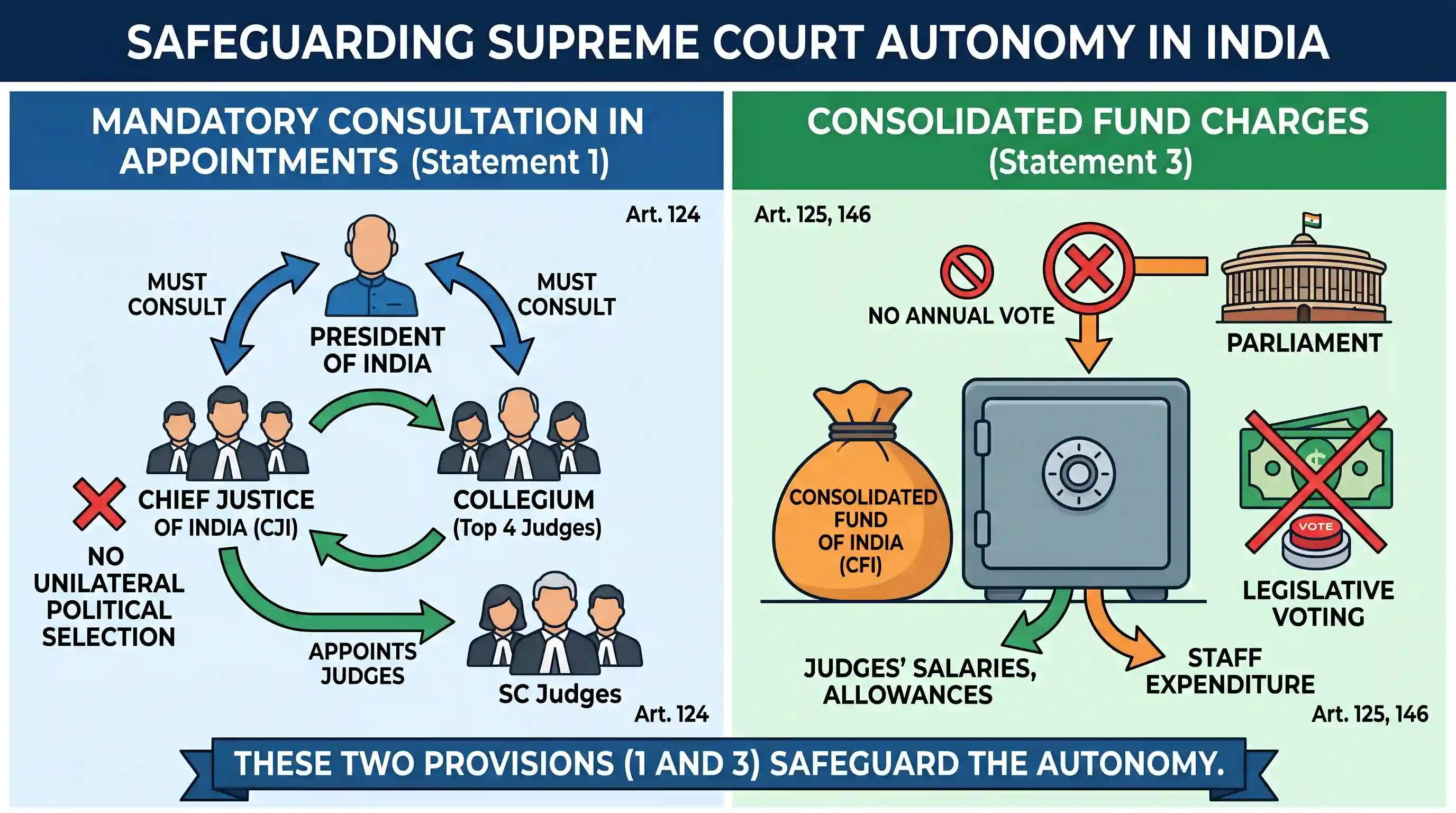
Statement 1 is correct because the Constitution and subsequent judicial interpretations make it mandatory for the President to consult the Chief Justice of India and the collegium to ensure appointments are not purely political.
Statement 2 is incorrect because Supreme Court judges can only be removed by the President following an address by Parliament on grounds of proved misbehaviour or incapacity. The Chief Justice does not have the power to remove them.
Statement 3 is correct because the salaries and allowances of judges are charged on the Consolidated Fund of India. This means they are not subject to the annual vote of Parliament, protecting the judiciary from legislative pressure.
Statement 4 is incorrect because according to Article 146, appointments of officers and staff of the Supreme Court are made by the Chief Justice of India or such other judge or officer as he may direct, not by the Government.
Since only statements 1 and 3 are accurate, option A is the correct answer.
Related questions
More UPSC Prelims practice from the same subject and topic.
- Prelims 2012GS1polity-and-governance
Which of the following are included in the original jurisdiction of the Supreme Court? 1. A dispute between the Government of India and one or more States 2. A dispute regarding elections to either Ho…
- Prelims 2012GS1polity-and-governance
In the areas covered under the Panchayat (Extension to the Scheduled Areas) Act, 1996, what is the role/power of Gram Sabha? 1. Gram Sabha has the power to prevent alienation of land in the Scheduled …
- Prelims 2012GS1polity-and-governance
In the Parliament of India, the purpose of an adjournment motion is:
- Prelims 2012GS1polity-and-governance
How does National Biodiversity Authority (NBA) help in protecting the Indian agriculture? 1. NBA checks the biopiracy and protects the indigenous and traditional genetic resources. 2. NBA directly mon…
- Prelims 2012GS1polity-and-governance
The National Green Tribunal Act, 2010 was enacted in consonance with which of the following provisions of the Constitution of India? 1. Right to healthy environment, construed as a part of Right to li…
- Prelims 2012GS1polity-and-governance
Consider the following provisions under the Directive Principles of State Policy as enshrined in the Constitution of India: 1. Securing for citizens of India a uniform civil code 2. Organizing village…