The Rowlatt Act aimed at

- Acompulsory economic support to war efforts
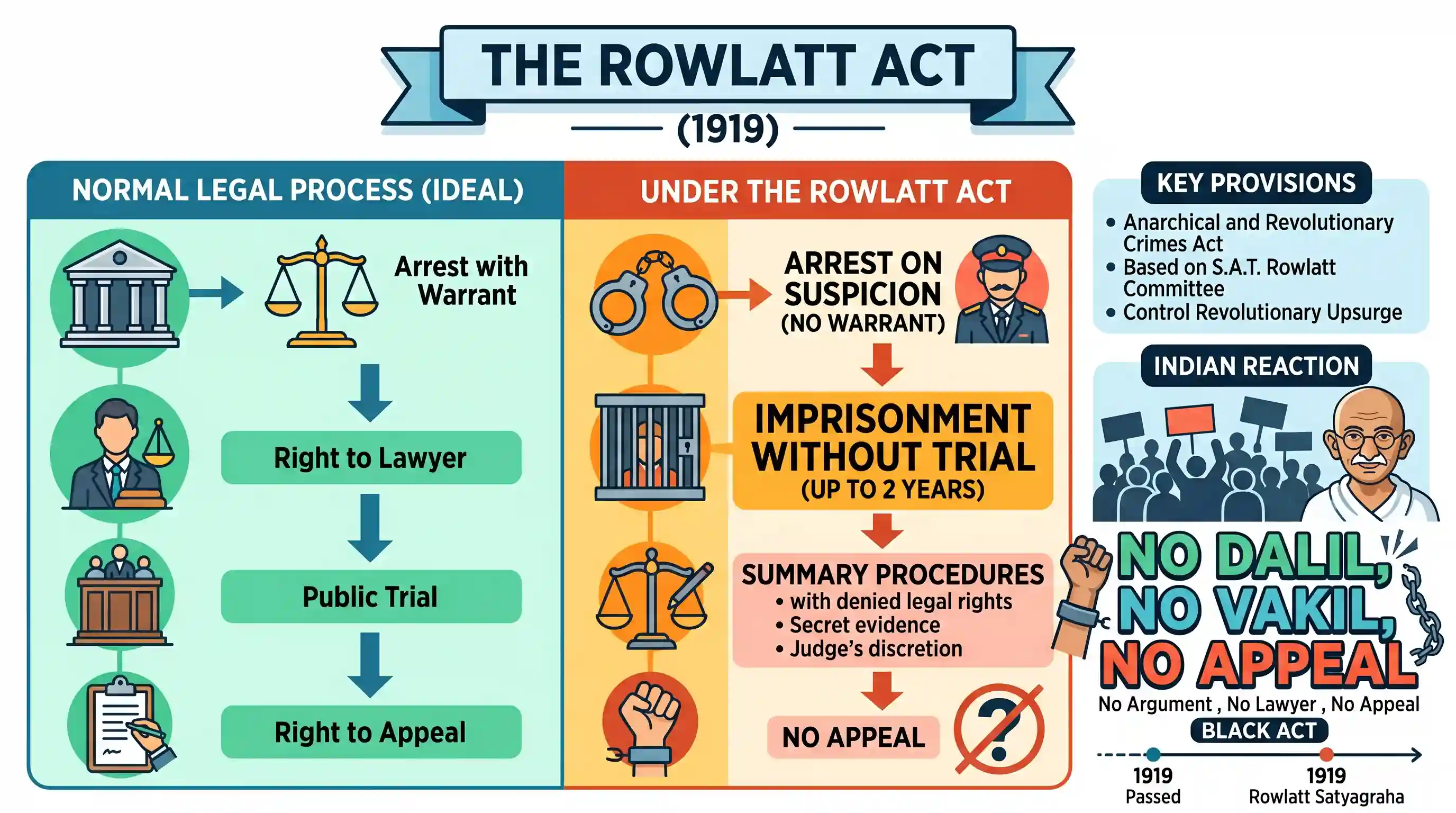
- Bimprisonment without trial and summary procedures for trialCorrect
- Csuppression of the Khilafat Movement
- Dimposition of restrictions on freedom of the press
Explanation
The Rowlatt Act, officially known as the Anarchical and Revolutionary Crimes Act of 1919, was passed by the Imperial Legislative Council. It was based on the recommendations of the Sedition Committee chaired by Justice S.A.T. Rowlatt.
The primary objective of the act was to curb the growing nationalist upsurge and revolutionary activities in India. It authorized the British government to imprison any person suspected of terrorism for up to two years without any trial. It also allowed for summary procedures where the accused were denied the right to know their accusers or the evidence against them.
This led to the famous description of the law by Indians as No Dalil, No Vakil, No Appeal, meaning no argument, no lawyer, and no appeal. Mahatma Gandhi organized the Rowlatt Satyagraha in response to this act, which he called a Black Act. Therefore, option B is the correct answer.
Related questions
More UPSC Prelims practice from the same subject and topic.
- Prelims 2012GS1history
The Congress ministries resigned in the seven provinces in 1939, because
- Prelims 2012GS1history
During Indian freedom struggle, the National Social Conference was formed. What was the reason for its formation?
- Prelims 2012GS1history
Mahatma Gandhi undertook fast unto death in 1932, mainly because
- Prelims 2012GS1history
With reference to Ryotwari Settlement, consider the following statements: 1. The rent was paid directly by the peasants to the Government. 2. The Government gave Pattas to the Ryots. 3. The lands were…
- Prelims 2012GS1history
Consider the following statements: The most effective contribution made by Dadabhai Naoroji to the cause of Indian National Movement was that he: 1. exposed the economic exploitation of India by the B…
- Prelims 2012GS1history
The Lahore Session of the Indian National Congress (1929) is very important in history, because 1. the Congress passed a resolution demanding complete independence 2. the rift between the extremists a…