The Congress ministries resigned in the seven provinces in 1939, because

- Athe Congress could not form ministries in the other four provinces
- Bemergence of a left wing in the Congress made the working of the ministries impossible
- Cthere were widespread communal disturbances in their provinces
- DNone of the statements (a), (b) and (c) given above is correctCorrect
Explanation
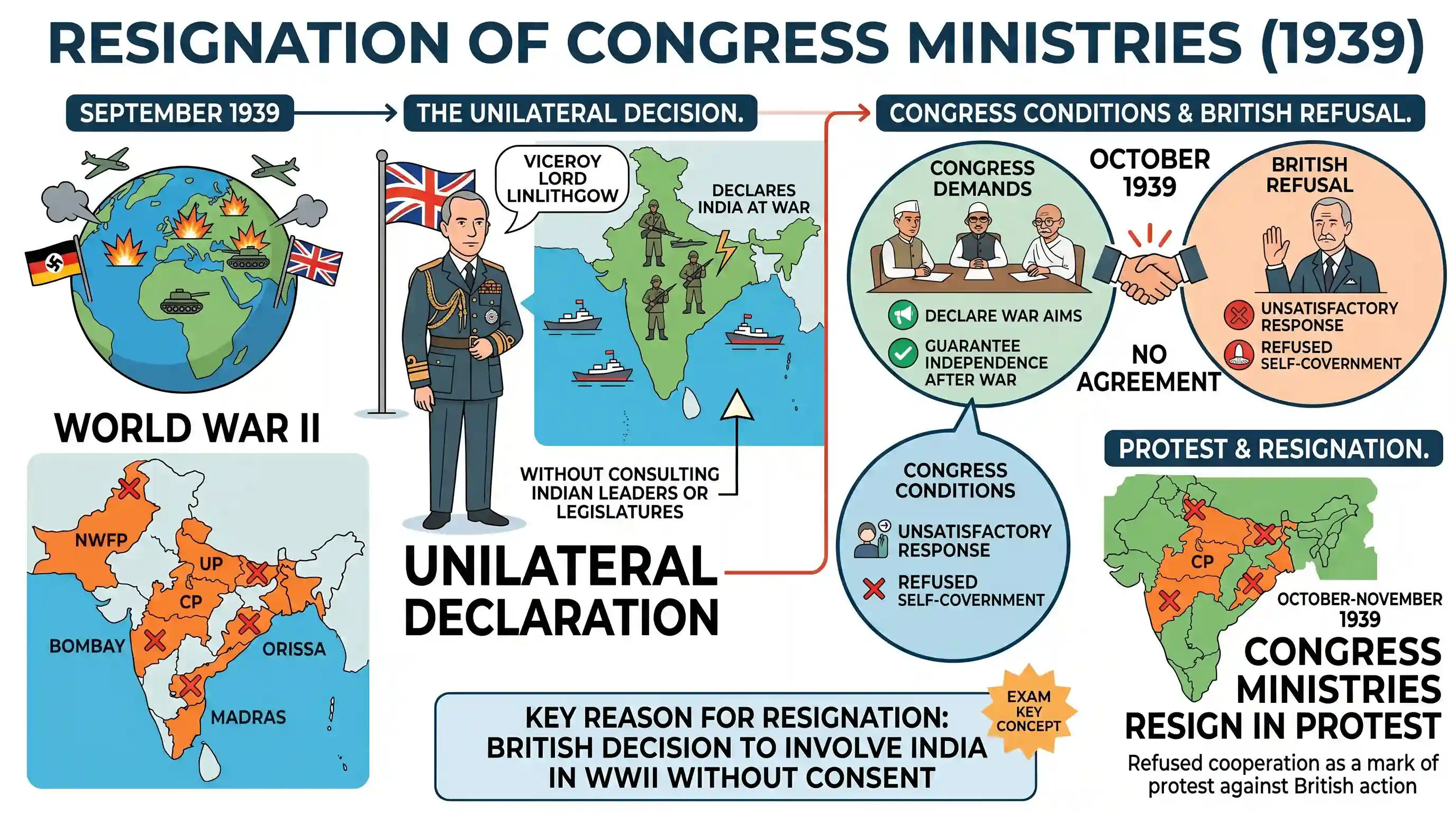
The correct answer is D because the primary reason for the resignation of the Congress ministries in 1939 was the unilateral decision of the British government to involve India in World War II.
The Viceroy, Lord Linlithgow, declared India a party to the war against Germany without consulting the Indian National Congress or the provincial legislatures. The Congress demanded that the British government state its war aims and guarantee immediate self government or independence after the war as a condition for cooperation. When the British government failed to provide a satisfactory response, the Congress Working Committee ordered the provincial ministries to resign in protest.
Since none of the options A, B, or C mention the British involvement of India in the war without consent, they are all incorrect.
Related questions
More UPSC Prelims practice from the same subject and topic.
- Prelims 2012GS1history
During Indian freedom struggle, the National Social Conference was formed. What was the reason for its formation?
- Prelims 2012GS1history
Mahatma Gandhi undertook fast unto death in 1932, mainly because
- Prelims 2012GS1history
With reference to Ryotwari Settlement, consider the following statements: 1. The rent was paid directly by the peasants to the Government. 2. The Government gave Pattas to the Ryots. 3. The lands were…
- Prelims 2012GS1history
Consider the following statements: The most effective contribution made by Dadabhai Naoroji to the cause of Indian National Movement was that he: 1. exposed the economic exploitation of India by the B…
- Prelims 2012GS1history
The Rowlatt Act aimed at
- Prelims 2012GS1history
The Lahore Session of the Indian National Congress (1929) is very important in history, because 1. the Congress passed a resolution demanding complete independence 2. the rift between the extremists a…