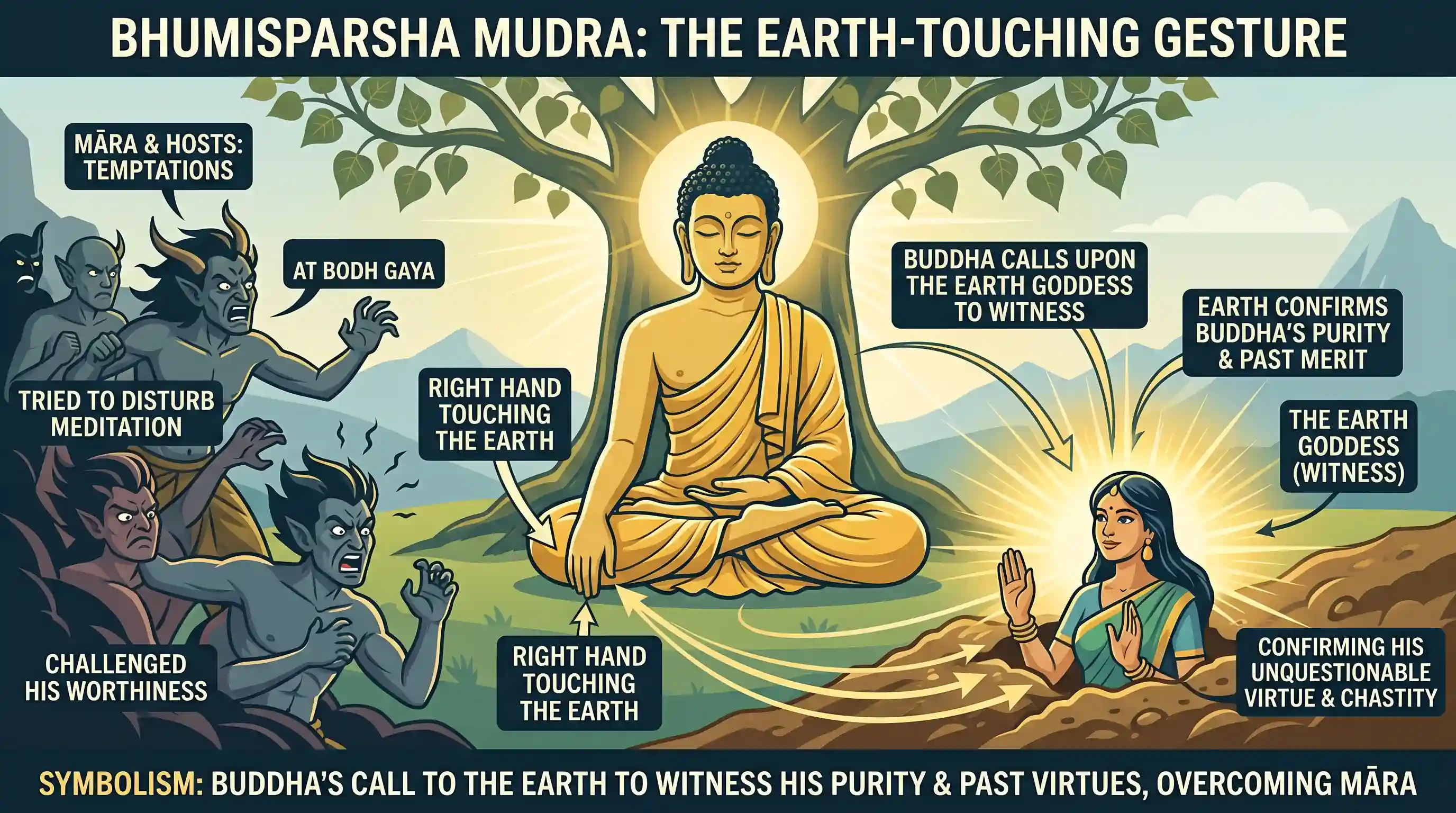
Lord Buddha's image is sometimes shown with the hand gesture called 'Bhumisparsha Mudra'. It symbolizes

- ABuddha's calling of the Earth to watch over Māra and to prevent Māra from disturbing his meditation
- BBuddha's calling of the Earth to witness his purity and chastity despite the temptations of MāraCorrect
- CBuddha's reminder to his followers that they all arise from the Earth and finally dissolve into the Earth, and thus this life is transitory
- DBoth the statements (a) and (b) are correct in this context
Explanation
The Bhumisparsha Mudra, or the earth touching gesture, represents the moment of Buddha's enlightenment at Bodh Gaya. According to Buddhist tradition, the demon Mara attempted to tempt and disturb Siddhartha Gautama to prevent him from reaching enlightenment. When Mara challenged his right to be there, Buddha touched the ground with his right hand, calling upon the Earth Goddess to witness his many lifetimes of virtue, purity, and merit. The Earth roared in confirmation, witnessing his worthiness and causing Mara to flee. Therefore, statement B is the most accurate description of this symbolic gesture.
Related questions
More UPSC Prelims practice from the same subject and topic.
- Prelims 2012GS1art-and-culture
The Nagara, the Dravida and the Vesara are the
- Prelims 2012GS1art-and-culture
With reference to Dhrupad, one of the major traditions of India that has been kept alive for centuries, which of the following statements are correct? 1. Dhrupad originated and developed in the Rajput…
- Prelims 2012GS1art-and-culture
How do you distinguish between Kuchipudi and Bharatanatyam dances? 1. Dancers occasionally speaking dialogues is found in Kuchipudi dance but not in Bharatanatyam. 2. Dancing on the brass plate by kee…
- Prelims 2025GS1art-and-culture
The first Gandharva Mahavidyalaya, a music training school, was set up in 1901 by Vishnu Digambar Paluskar in
- Prelims 2025GS1art-and-culture
Consider the following statements in respect of the first Kho Kho World Cup : I. The event was held in Delhi, India. II. Indian men beat Nepal with a score of 78-40 in the final to become the World Ch…
- Prelims 2025GS1art-and-culture
Consider the following statements : I. In the finals of the 45th Chess Olympiad held in 2024, Gukesh Dommaraju became the world's youngest winner after defeating the Russian player Ian Nepomniachtchi.…