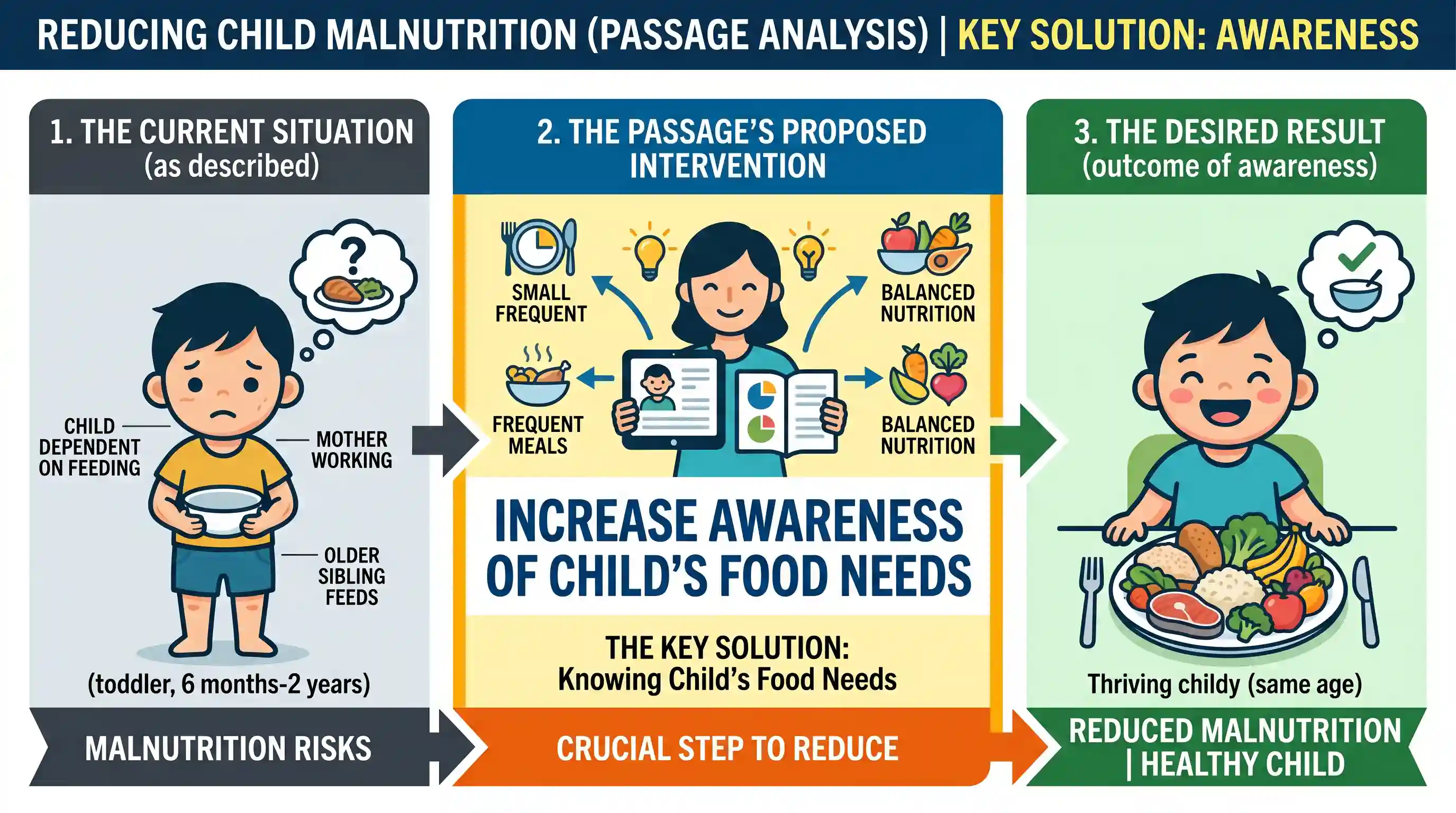
Passage-3 Malnutrition most commonly occurs between the ages of six months and two years. This happens despite the child's food requirements being less than that of an older child. Malnutrition is often attributed to poverty, but it has been found that even in households where adults eat adequate quantities of food, more than 50 per cent of children-under-five do not consume enough food. The child's dependence on someone else to feed him/her is primarily responsible for the malnutrition. Very often the mother is working and the responsibility of feeding the young child is left to an older sibling. It is therefore crucial to increase awareness regarding the child's food needs and how to satisfy them. According to the passage, malnutrition in children can be reduced

- Aif the children have regular intake of food
- Bafter they cross the age of five
- Cif the food needs of younger children are knownCorrect
- Dif the responsibility of feeding younger children is given to adults.
Explanation
The passage concludes by stating, "It is therefore crucial to increase awareness regarding the child's food needs and how to satisfy them."
Analyzing the options: A) if the children have regular intake of food - While regular intake of food is the goal, the passage identifies the reason for lack of regular intake (dependence, lack of awareness) and proposes a solution to address that reason. This option describes the desired outcome, not the direct solution proposed to achieve it. B) after they cross the age of five - The passage mentions malnutrition commonly occurs between six months and two years and among under-fives, but does not suggest it reduces or is solved by crossing the age of five. This is not supported. C) if the food needs of younger children are known - This directly aligns with the passage's concluding statement about increasing "awareness regarding the child's food needs." Knowing the needs is key to satisfying them. D) if the responsibility of feeding younger children is given to adults - The passage notes that older siblings often feed, implying adults might be better. However, the ultimate solution proposed is awareness of food needs, not simply shifting responsibility to any adult, as an unaware adult might still feed inadequately. The focus is on what needs to be known, not primarily who does the feeding.
Therefore, C is the most direct and accurate reflection of the solution proposed in the passage.
Related questions
More UPSC Prelims practice from the same subject and topic.
- Prelims 2013CSATReading Comprehension
Read the following passage and answer the two items that follow. Your answers to these items should be based on the passage only. Passage Ecological - research over the last quarter of the century has…
- Prelims 2013CSATReading Comprehension
What is the purpose of maintaining the continuity of forested landscapes and corridors? 1. Preservation of biodiversity. 2. Management of mineral resources. 3. Grant of forest lands for human activiti…
- Prelims 2013CSATReading Comprehension
Read the following passages and answer the items that follow passage. Your answers to these items should be based on the passages only The law in many parts of the world increasingly restricts the dis…
- Prelims 2013CSATReading Comprehension
Read the following passages and answer the items that follow passage. Your answers to these items should be based on the passages only The law in many parts of the world increasingly restricts the dis…
- Prelims 2013CSATReading Comprehension
Read the following passages and answer the items that follow passage. Your answers to these items should be based on the passages only The law in many parts of the world increasingly restricts the dis…
- Prelims 2013CSATReading Comprehension
Read the following passages and answer the items that follow passage. Your answers to these items should be based on the passages only . The law in many parts of the world increasingly restricts the d…