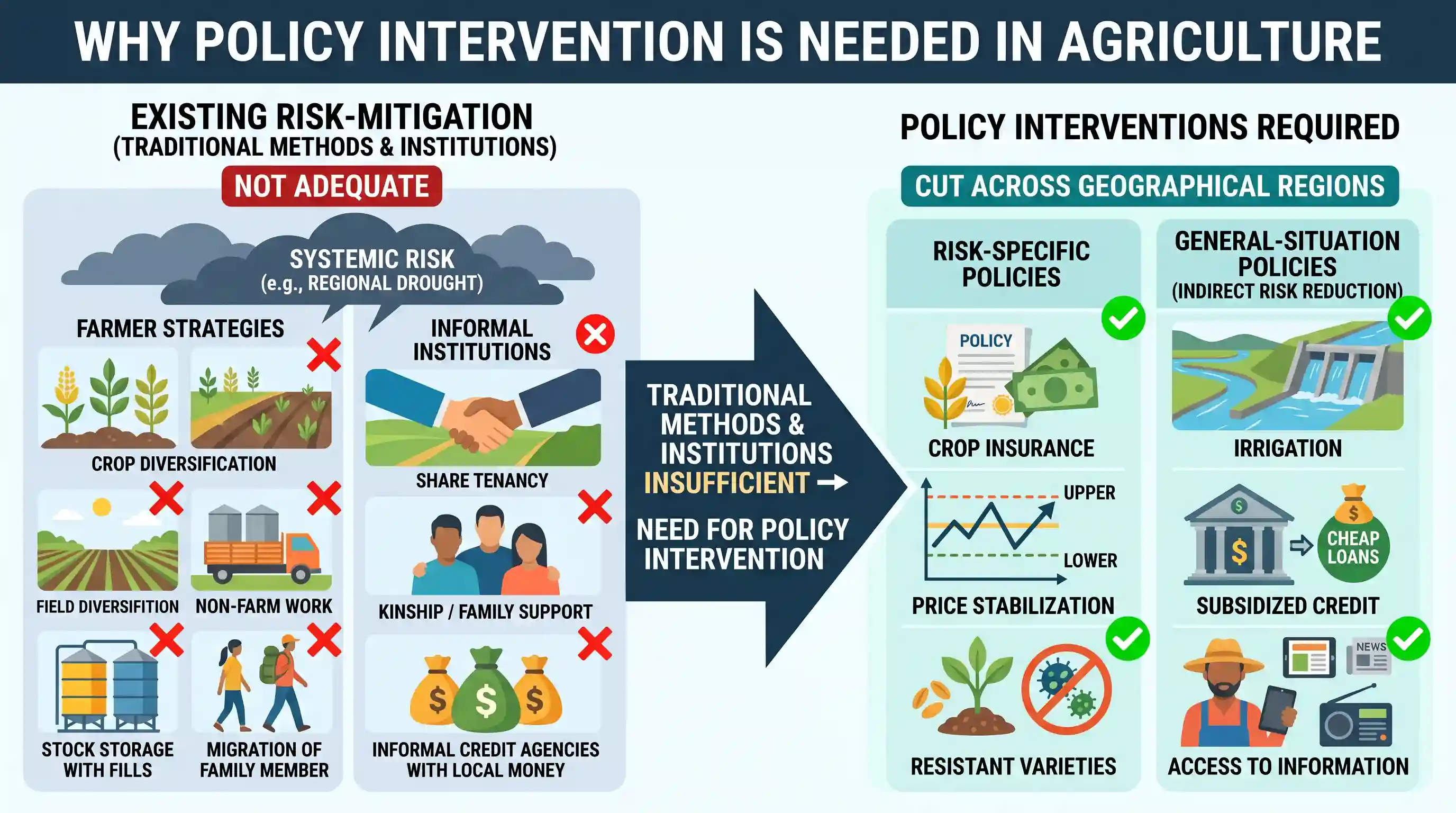
Passage-4 A number of empirical studies find that farmers are risk- (-2.5, -0.83) averse, though only moderately in many cases. There is also evidence to show that farmers' risk aversion results in cropping patterns and input use designed to reduce risk rather than to maximize income. Farmers adopt a number of strategies to manage and cope with agricultural risks. These include practices like crop and field diversification, non-farm employment, storage of stocks and strategic migration of family members. There are also institutions ranging from share tenancy to kinship, extended family and informal credit agencies. One major obstacle to risk sharing by farmers is that the same type of risks can affect a large number of farmers in the region. Empirical studies show that the traditional methods are not adequate. Hence there is a need for policy interventions, especially measures that cut across geographical regions. Policies may aim at tackling agricultural risks directly or indirectly. Examples of risk- specific policies arc crop insurance, price stabilization and the development of varieties resistant to pests and diseases. Policies which affect risk indirectly are irrigation, subsidized credit and access to information. No single risk- specific policy is sufficient to reduce risk and is without side- effects, whereas policies not specific to risk influence the general situation and affect risks only indirectly. Crop insurance, as a policy measure to tackle agricultural risk directly, deserves careful consideration in the Indian context and in many other developing countries because the majority of farmers depend on rain- fed agriculture and in many areas yield variability is the predominant cause of their income instability. The need for policy intervention to mitigate risks in agriculture is because

- Afarmers are extremely risk-averse
- Bfarmers do not know how to mitigate risks
- Cthe methods adopted by farmers and existing risk sharing institutions are not adequateCorrect
- Dmajority of farmers depend on rain-fed agriculture.
Explanation
The passage explicitly states, "Empirical studies show that the traditional methods are not adequate. Hence there is a need for policy interventions..." The "traditional methods" refer to the strategies adopted by farmers (like crop diversification, non-farm employment) and the existing institutions (like share tenancy, kinship, informal credit agencies) mentioned earlier in the text. Therefore, the inadequacy of these existing methods and institutions is the direct reason cited for the need for policy intervention.
Let's look at the other options: A) farmers are extremely risk-averse: The passage says farmers are risk-averse, "though only moderately in many cases," not "extremely." While risk aversion is a factor, the passage highlights the inadequacy of existing solutions as the primary driver for policy intervention. B) farmers do not know how to mitigate risks: This is incorrect. The passage clearly states, "Farmers adopt a number of strategies to manage and cope with agricultural risks," indicating they do know how to mitigate risks, even if their methods are insufficient. D) majority of farmers depend on rain-fed agriculture: This is mentioned as a reason why "Crop insurance... deserves careful consideration in the Indian context," not as the general reason for the overall need for policy intervention to mitigate agricultural risks. The general need is established earlier due to the inadequacy of existing methods.
Related questions
More UPSC Prelims practice from the same subject and topic.
- Prelims 2013CSATReading Comprehension
Read the following passage and answer the two items that follow. Your answers to these items should be based on the passage only. Passage Ecological - research over the last quarter of the century has…
- Prelims 2013CSATReading Comprehension
What is the purpose of maintaining the continuity of forested landscapes and corridors? 1. Preservation of biodiversity. 2. Management of mineral resources. 3. Grant of forest lands for human activiti…
- Prelims 2013CSATReading Comprehension
Read the following passages and answer the items that follow passage. Your answers to these items should be based on the passages only The law in many parts of the world increasingly restricts the dis…
- Prelims 2013CSATReading Comprehension
Read the following passages and answer the items that follow passage. Your answers to these items should be based on the passages only The law in many parts of the world increasingly restricts the dis…
- Prelims 2013CSATReading Comprehension
Read the following passages and answer the items that follow passage. Your answers to these items should be based on the passages only The law in many parts of the world increasingly restricts the dis…
- Prelims 2013CSATReading Comprehension
Read the following passages and answer the items that follow passage. Your answers to these items should be based on the passages only . The law in many parts of the world increasingly restricts the d…