Which one of the following statements is correct?

- AIn India, the same person cannot be appointed as Governor for two or more States at the same time
- BThe Judges of the High Court of the States in India are appointed by the Governor of the State just as the Judges of the Supreme Court are appointed by the President
- CNo procedure has been laid down in the Constitution of India for the removal of a Governor from his/her postCorrect
- DIn the case of a Union Territory having a legislative setup, the Chief Minister is appointed by the Lt. Governor on the basis of majority support
Explanation
Correct Answer: C) No procedure has been laid down in the Constitution of India for the removal of a Governor from his/her post
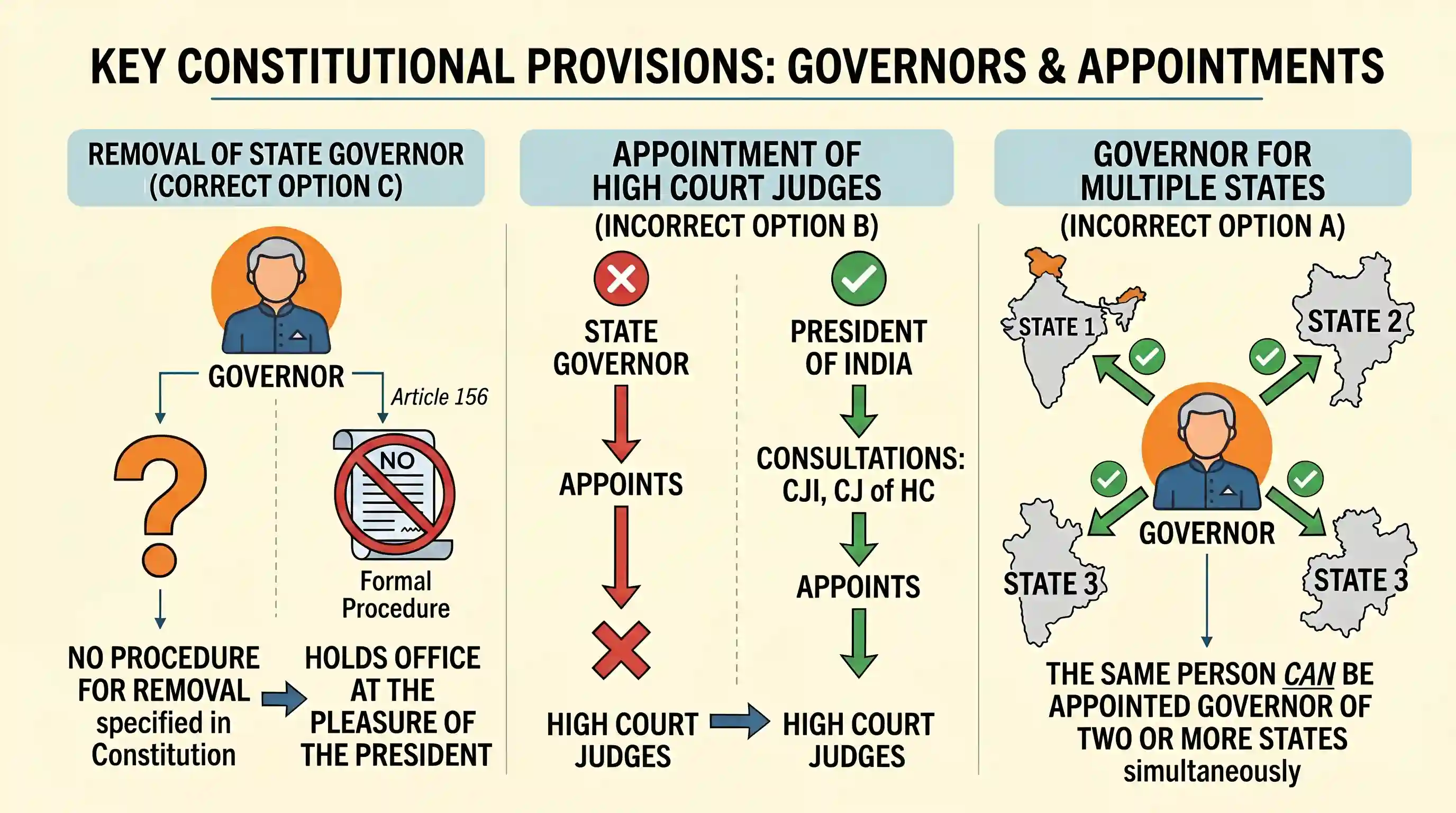
This is correct. The Constitution of India does not specify any formal procedure for the removal of a Governor. While the Governor holds office at the pleasure of the President (Article 156), this doesn't translate to a defined removal process like impeachment. The President can remove a Governor without stating any reason.
Let's analyze why other options are incorrect:
A) In India, the same person cannot be appointed as Governor for two or more States at the same time - This is incorrect. The President can appoint the same person as Governor for multiple states simultaneously. This practice has been followed in the past to address administrative convenience.
B) The Judges of the High Court of the States in India are appointed by the Governor of the State just as the Judges of the Supreme Court are appointed by the President - This is incorrect. High Court Judges are appointed by the President in consultation with the Chief Justice of India and the Chief Justice of the High Court concerned. The Governor plays no direct role in their appointment. Supreme Court Judges are appointed by the President in consultation with the CJI and other senior judges.
D) In the case of a Union Territory having a legislative setup, the Chief Minister is appointed by the Lt. Governor on the basis of majority support - This is incorrect. In UTs with legislative assemblies, the Lt. Governor appoints the Chief Minister who commands the majority in the assembly. However, this is done based on the election results and the support demonstrated by the elected representatives, not simply 'on the basis of majority support' as a continuous process.
Related questions
More UPSC Prelims practice from the same subject and topic.
- Prelims 2013GS1polity-and-governance
Which of the following bodies does not/do not find mention in the Constitution? 1. National Development Council 2. Planning Commission 3. Zonal Councils Select the correct answer using the codes given…
- Prelims 2013GS1polity-and-governance
Which of the following bodies does not/do not find mention in the Constitution? 1. National Development Council 2. Planning Commission 3. Zonal Councils Select the correct answer using the codes given…
- Prelims 2013GS1polity-and-governance
The Government enacted the Panchayat Extension to Scheduled Areas (PESA) Act in 1996. Which one of the following is not identified as its objective?
- Prelims 2013GS1polity-and-governance
Under the Scheduled Tribes and Other Traditional Forest Dwellers (Recognition of Forest Rights) Act, 2006, who shall be the authority to initiate the process for determining the nature and extent of i…
- Prelims 2013GS1polity-and-governance
Consider the following statements : The Parliamentary Committee on Public Accounts 1. consists of not more than 25 Members of the Lok Sabha 2. scrutinizes appropriation and finance accounts of the Gov…
- Prelims 2013GS1polity-and-governance
Consider the following statements : 1. National Development Council is an organ of the Planning Commission. 2. The Economic and Social Planning is kept in the Concurrent List in the Constitution of In…