The Government enacted the Panchayat Extension to Scheduled Areas (PESA) Act in 1996. Which one of the following is not identified as its objective?

- ATo provide self-governance
- BTo recognize traditional rights
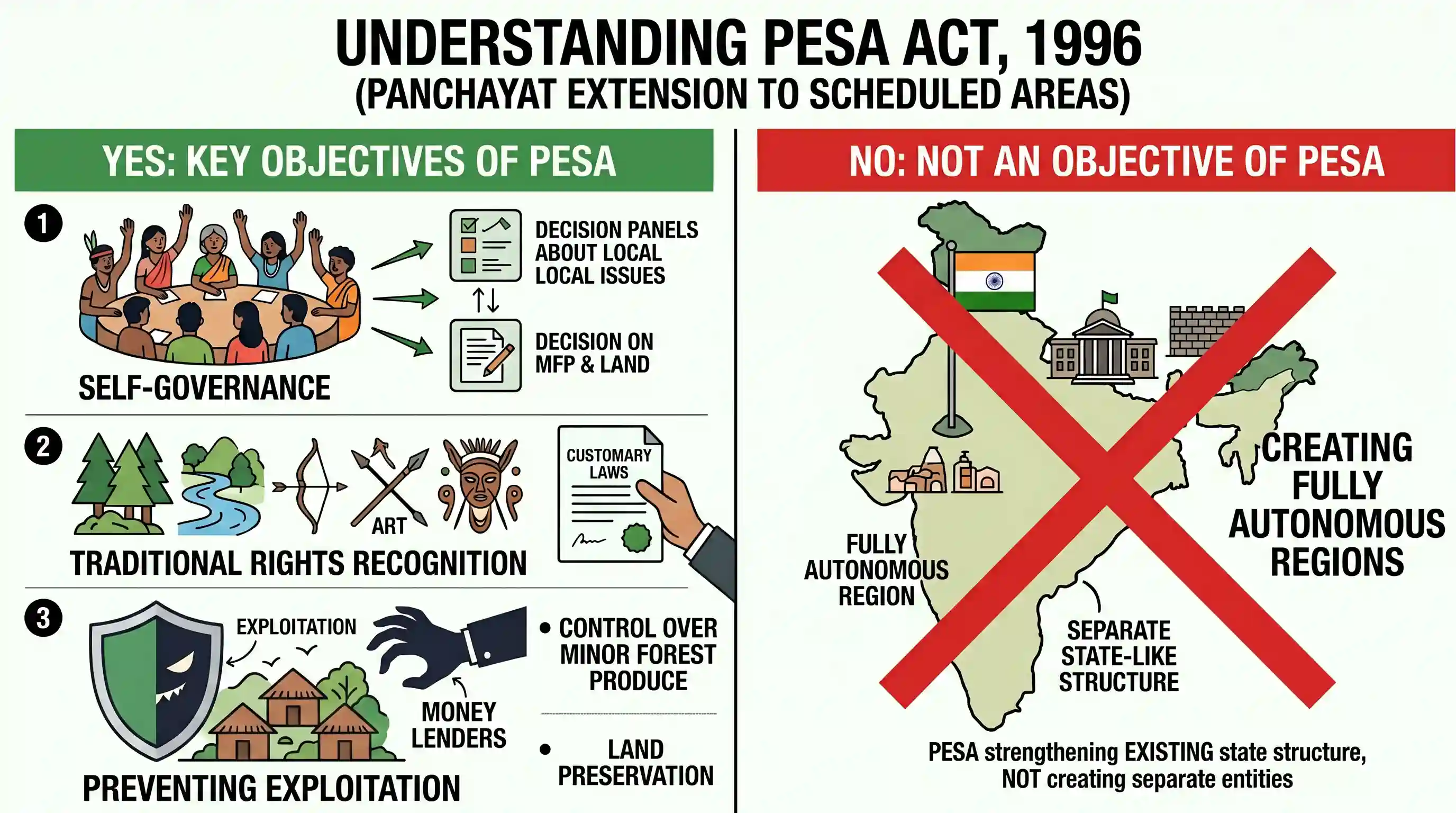
- CTo create autonomous regions in tribal areasCorrect
- DTo free tribal people from exploitation
Explanation
The correct answer is C) To create autonomous regions in tribal areas. The PESA Act, 1996, aims to empower Panchayats at the appropriate level, especially in Scheduled Areas, to enable them to function as institutions of self-governance. It does not aim to create fully autonomous regions.
A) To provide self-governance: This is a core objective of PESA. It aims to promote self-rule through Gram Sabhas and Panchayats.
B) To recognize traditional rights: PESA explicitly recognizes and protects the traditional rights of tribal communities, including their customary laws and practices.
D) To free tribal people from exploitation: By empowering tribal communities and giving them control over their resources, PESA aims to reduce exploitation and promote their socio-economic development.
PESA focuses on strengthening existing governance structures within the framework of the Constitution, rather than creating separate autonomous entities. The Act is about devolution of powers to Panchayats, not creating separate regions from the existing state structure.
Related questions
More UPSC Prelims practice from the same subject and topic.
- Prelims 2013GS1polity-and-governance
Which one of the following statements is correct?
- Prelims 2013GS1polity-and-governance
Which of the following bodies does not/do not find mention in the Constitution? 1. National Development Council 2. Planning Commission 3. Zonal Councils Select the correct answer using the codes given…
- Prelims 2013GS1polity-and-governance
Which of the following bodies does not/do not find mention in the Constitution? 1. National Development Council 2. Planning Commission 3. Zonal Councils Select the correct answer using the codes given…
- Prelims 2013GS1polity-and-governance
Under the Scheduled Tribes and Other Traditional Forest Dwellers (Recognition of Forest Rights) Act, 2006, who shall be the authority to initiate the process for determining the nature and extent of i…
- Prelims 2013GS1polity-and-governance
Consider the following statements : The Parliamentary Committee on Public Accounts 1. consists of not more than 25 Members of the Lok Sabha 2. scrutinizes appropriation and finance accounts of the Gov…
- Prelims 2013GS1polity-and-governance
Consider the following statements : 1. National Development Council is an organ of the Planning Commission. 2. The Economic and Social Planning is kept in the Concurrent List in the Constitution of In…