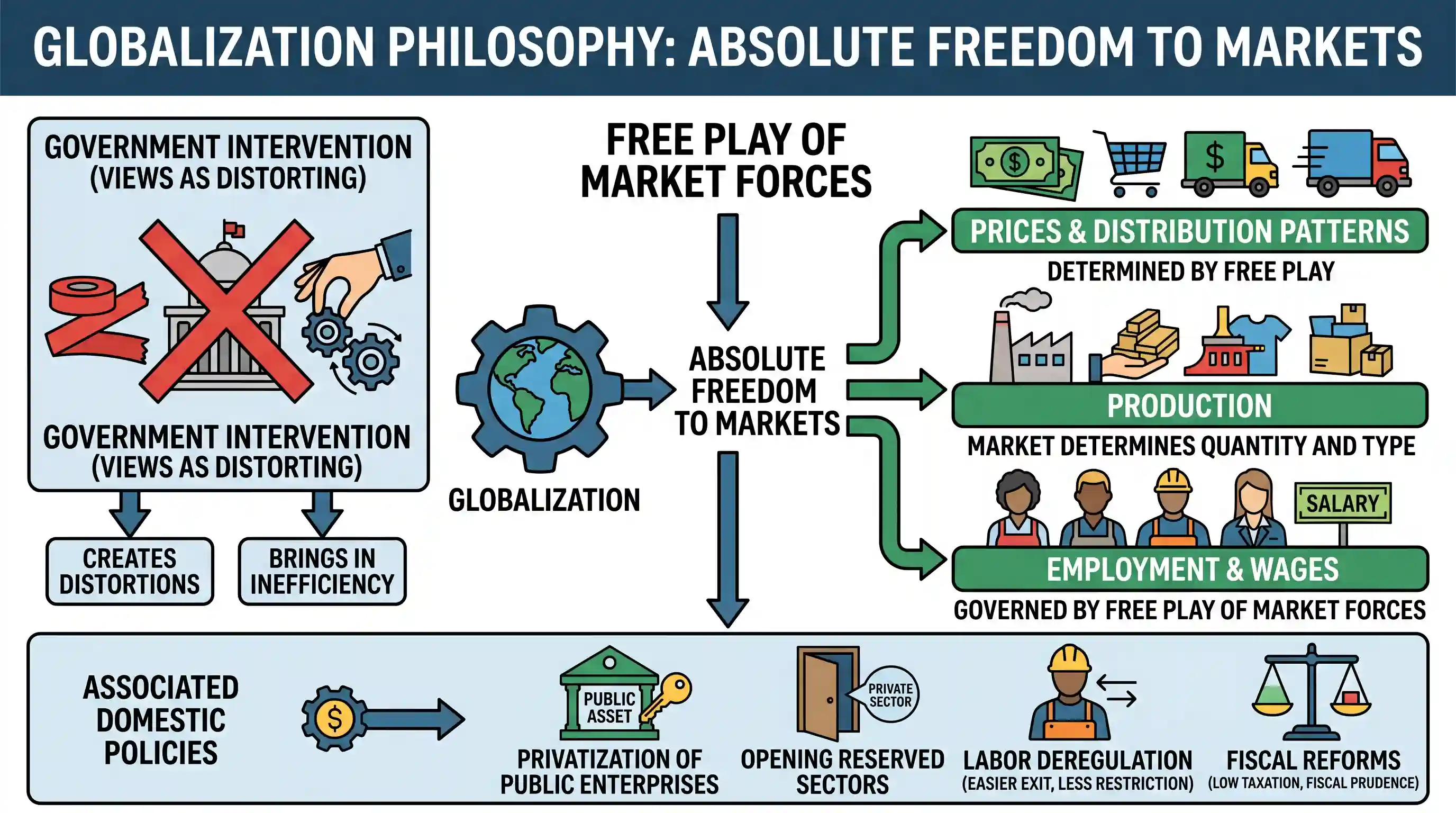
Passage-2 It is often forgotten that globalization, is not only about policies on international economic relationships and transactions, but has equally to do with domestic policies of a nation. Policy changes necessitated by meeting the internationally set conditions (by WTO etc.) of free trade and investment flows obviously affect domestic producers and investors. But the basic philosophy underlying globalization emphasizes absolute freedom to markets to determine prices and production and distribution patterns, and view government interventions as processes that create distortions and bring in inefficiency. Thus, public enterprises have to be privatized through disinvestments and sales; sectors and activities hitherto reserved for the public sector have to be opened to the private sector. This logic extends to the social services like education and health. Any restrictions on the adjustments in workforce by way of retrenchment of workers should also be removed and exit should be made easier by removing any restrictions on closures. Employment and wages should be governed by free play of market forces, as any measure to regulate them can discourage investment and also create inefficiency in production. Above all, in line with the overall philosophy of reduction in the role of the state, fiscal reforms should be undertaken to have generally low levels of taxation and government expenditure should be kept to the minimum to abide by the principle of fiscal prudence. All these are policy actions on the domestic front and are not directly related to the core items of the globalization agenda, namely free international flow of goods and finance. According to the passage, the basic philosophy of globalization is to

- Agive absolute freedom to producers to determine prices and production
- Bgive freedom to producers to evolve distribution patterns
- Cgive absolute freedom to markets to determine prices, production and employmentCorrect
- Dgive freedom to producers to import and export.
Explanation
The passage explicitly states, "But the basic philosophy underlying globalization emphasizes absolute freedom to markets to determine prices and production and distribution patterns, and view government interventions as processes that create distortions and bring in inefficiency." It further elaborates that "Employment and wages should be governed by free play of market forces."
Option A is incorrect because it specifies "producers" instead of "markets" and omits "distribution patterns" and "employment." Option B is incorrect as it focuses only on "distribution patterns" and again specifies "producers" instead of "markets." Option C is correct because it accurately reflects "absolute freedom to markets" and includes "prices, production" (from "prices and production and distribution patterns") and "employment" (from "Employment and wages should be governed by free play of market forces"). Option D describes aspects of international trade, which are "core items of the globalization agenda," but not the "basic philosophy" itself as defined by the passage in terms of market determination of domestic economic variables.
Related questions
More UPSC Prelims practice from the same subject and topic.
- Prelims 2014CSATReading Comprehension
Passage - 1 The Himalayan ecosystem is highly vulnerable to damage, both due to geological reasons and on account of the stress caused by increased pressure of population, exploitation of natural reso…
- Prelims 2014CSATReading Comprehension
Passage-1 The Himalayan ecosystem is highly vulnerable to damage, both due to geological reasons and on account of the stress caused by increased pressure of population, exploitation of natural resour…
- Prelims 2014CSATReading Comprehension
Passage-1 The Himalayan ecosystem is highly vulnerable to damage, both due to geological reasons and on account of the stress caused by increased pressure of population, exploitation of natural resour…
- Prelims 2014CSATReading Comprehension
Passage-1 The Himalayan ecosystem is highly vulnerable to damage, both due to geological reasons and on account of the stress caused by increased pressure of population, exploitation of natural resour…
- Prelims 2014CSATReading Comprehension
Passage-2 It is often forgotten that globalization, is not only about policies on international economic relationships and transactions, but has equally to do with domestic policies of a nation. Polic…
- Prelims 2014CSATReading Comprehension
Passage-2 It is often forgotten that globalization, is not only about policies on international economic relationships and transactions, but has equally to do with domestic policies of a nation. Polic…