Four children are sitting in a row. A is occupying the seat next to B but not next to C. If C is not sitting next to D, who is/are occupying seat/seats adjacent to D?

- AB
- BACorrect
- CB and A
- DImpossible to tell
Explanation
Let's denote the four seats in a row as 1, 2, 3, 4.
We are given three conditions:
- A is next to B. (A and B are adjacent)
- A is not next to C. (A and C are not adjacent)
- C is not next to D. (C and D are not adjacent)
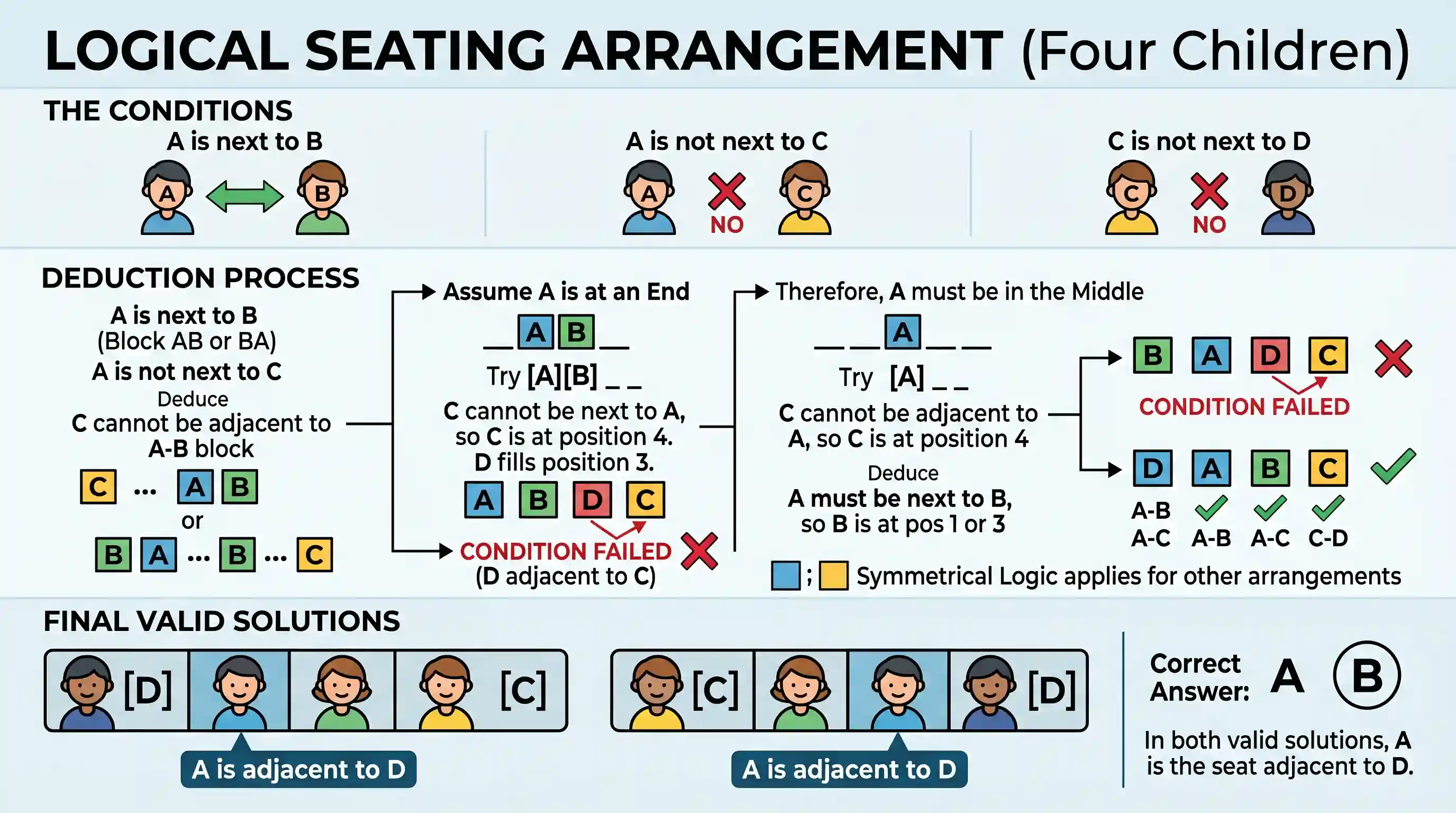
Let's deduce the possible arrangements:
Step 1: Analyze A's position.
- Assume A is at an end seat, say position 1. Then B must be at position 2 (from condition 1). So, A B _ _.
- From condition 2 (A not next to C), C cannot be at position 3. Therefore, C must be at position 4. The arrangement becomes A B D C (D fills the remaining spot).
- Now, check condition 3 (C not next to D). In A B D C, D is at 3 and C is at 4, meaning they are adjacent. This violates condition 3. So, A B D C is an invalid arrangement.
- A similar logic applies if A is at position 4 (_ _ B A). C would have to be at position 1, and D at position 2 (C D B A). Again, C and D are adjacent, violating condition 3.
- Therefore, A cannot be at an end seat. A must be in a middle seat (position 2 or 3).
Step 2: A is in a middle seat.
Case 1: A is at position 2 (_ A _ _).
- From condition 2 (A not next to C), C cannot be at position 1 or 3. So, C must be at position 4. The arrangement is now _ A _ C.
- From condition 1 (A next to B), B must be at position 1 or 3.
- If B is at position 1: B A _ C. D must be at position 3. Arrangement: B A D C. Check condition 3: D is at 3, C is at 4. They are adjacent. This is INVALID.
- If B is at position 3: _ A B C. D must be at position 1. Arrangement: D A B C.
Check all conditions:
- A next to B (yes, A at 2, B at 3).
- A not next to C (yes, B is between A and C).
- C not next to D (yes, A and B are between C and D). This arrangement (D A B C) is VALID.
Case 2: A is at position 3 (_ _ A _). (This is symmetrical to Case 1)
- From condition 2 (A not next to C), C cannot be at position 2 or 4. So, C must be at position 1. The arrangement is now C _ A _.
- From condition 1 (A next to B), B must be at position 2 or 4.
- If B is at position 4: C _ A B. D must be at position 2. Arrangement: C D A B. Check condition 3: C is at 1, D is at 2. They are adjacent. This is INVALID.
- If B is at position 2: C B A _. D must be at position 4. Arrangement: C B A D.
Check all conditions:
- A next to B (yes, B at 2, A at 3).
- A not next to C (yes, B is between A and C).
- C not next to D (yes, B and A are between C and D). This arrangement (C B A D) is VALID.
Step 3: Identify who is adjacent to D in the valid arrangements. We have found two valid arrangements:
- D A B C: D is at position 1. The seat adjacent to D is position 2, occupied by A.
- C B A D: D is at position 4. The seat adjacent to D is position 3, occupied by A.
In both valid arrangements, A is the person occupying the seat adjacent to D.
The final answer is B
Related questions
More UPSC Prelims practice from the same subject and topic.
- Prelims 2014CSATLogical Reasoning
There are seven persons up on a ladder, A, B, C, D, E, F and G (not in that order). A is further up than E but is lower than C. B is in the middle. G is between A and B. E is between B and F. If F is …
- Prelims 2014CSATLogical Reasoning
Consider that: 1. A is taller than B. 2. C is taller than A. 3. D is taller than C. 4. E is the tallest of all. If they are made to sit in the above order of their height, who will occupy the mid posi…
- Prelims 2014CSATLogical Reasoning
Consider the following statements: There are six villages A, B, C, D, E and F. F is 1 km to the west of D. B is 1 km to the east of E. A is 2 km to the north of E. C is 1 km to the east of A. D is 1 k…
- Prelims 2014CSATLogical Reasoning
Read the passage given below and answer the items that follow. A, B, C, D, E, F are members of a family. They are engineer, stenographer, doctor, draughtsman, lawyer and judge (not in order). A, the e…
- Prelims 2014CSATLogical Reasoning
Read the passage given below and answer the items that follow. A, B, C, D, E, F are members of a family. They are engineer, stenographer, doctor, draughtsman, lawyer and judge (not in order). A, the e…
- Prelims 2014CSATLogical Reasoning
Read the passage given below and answer the items that follow. A, B, C, D, E, F are members of a family. They are engineer, stenographer, doctor, draughtsman, lawyer and judge (not in order). A, the e…