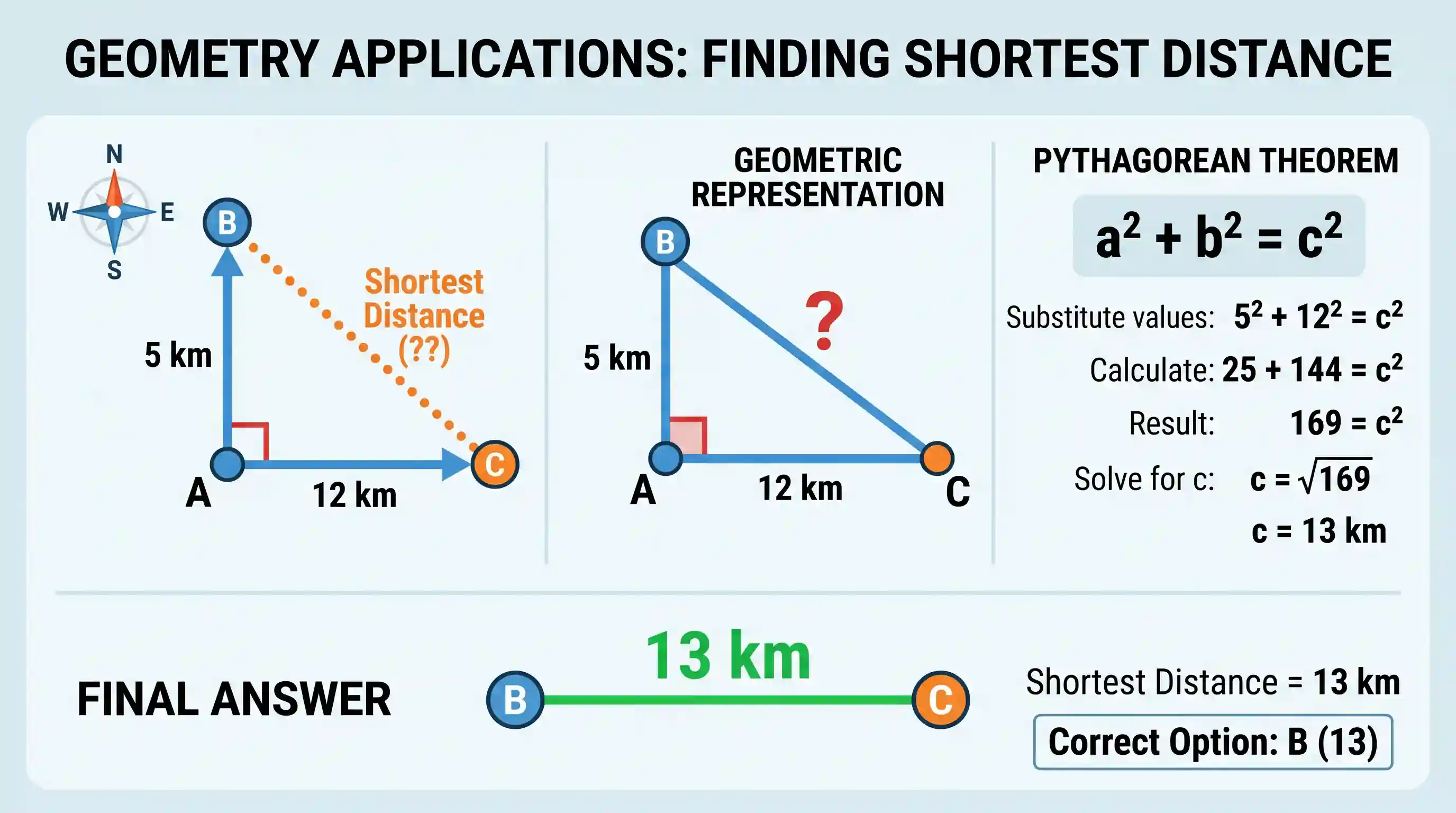
Location of B is north of A and location of C is east of A. The distances AB and AC are 5 km and 12 km respectively. The shortest distance (in km) between the locations B and C is

- A60
- B13Correct
- C17
- D7
Explanation
Explanation:
- Visualize the locations: Location A is the reference point. B is directly north of A, and C is directly east of A. This arrangement forms a right-angled triangle with the right angle at A.
- Identify the sides: The distance AB (5 km) is one leg of the triangle, and the distance AC (12 km) is the other leg. The shortest distance between B and C is the hypotenuse of this right-angled triangle.
- Apply Pythagorean theorem: For a right-angled triangle, a^2 + b^2 = c^2, where 'c' is the hypotenuse.
- BC^2 = AB^2 + AC^2
- BC^2 = 5^2 + 12^2
- BC^2 = 25 + 144
- BC^2 = 169
- BC = sqrt(169)
- BC = 13 km
Therefore, the shortest distance between B and C is 13 km.
Option Analysis: A) 60: Incorrect. This would be the product of the distances (5 * 12), not the shortest distance. B) 13: Correct. This is calculated using the Pythagorean theorem. C) 17: Incorrect. This would be the sum of the distances (5 + 12), which is the path distance, not the shortest straight-line distance. D) 7: Incorrect. This would be the difference of the distances (12 - 5), which is not relevant here.
The final answer is B.
Related questions
More UPSC Prelims practice from the same subject and topic.
- Prelims 2014CSATQuantitative Aptitude
The following table shows the marks obtained by two students in different subjects: | Subjects | Student A | Max Marks A | Student B | Max Marks B | | English | 60 | 100 | 80 | 150 | | Psychology | 70…
- Prelims 2014CSATQuantitative Aptitude
The following table gives population and total income of a city for four years: Year | 1992 | 1993 | 1994 | 1995 | Population in lakhs | 20 | 21 | 22 | 23 | Income in crores | 1010 | 1111 | 1225 | 134…
- Prelims 2014CSATQuantitative Aptitude
A bell rings every 18 minutes. A second bell rings every 24 minutes. A third bell rings every 32 minutes. If all the three bells ring at the same time at 8 o'clock in the morning, at what other time w…
- Prelims 2014CSATQuantitative Aptitude
A and B decide to travel from place X to place Y by bus. A has Rs. 10 with him and he finds that it is 80% of the bus fare for two persons. B finds that he has Rs. 3 with him and hands it over to A. I…
- Prelims 2014CSATQuantitative Aptitude
As per agreement with a bank, a businessman had to refund a loan in some equal installments without interest. After paying 18 installments he found that 60 percent of his loan was refunded. How many i…
- Prelims 2014CSATQuantitative Aptitude
A worker reaches his factory 3 minutes late if his speed from his house to the factory is 5 km/hr. If he walks at a speed of 6 km/hr then he reaches the factory 7 minutes early the distance of the fac…