A straight line segment is 36 cm long. Points are to be marked on the line from both the end points. From each end, the first point is at a distance of 1 cm from the end, the second point is at a distance of 2 cm from the first point and the third point is at a distance of 3 cm from the second point and so on. If the points on the ends are not counted and the common points are counted as one, what is the number of points?

- A10
- B12Correct
- C14
- D16
Explanation
The problem asks us to find the total number of unique points marked on a 36 cm line segment, excluding the end points. Points are marked from both ends following a specific pattern.
-
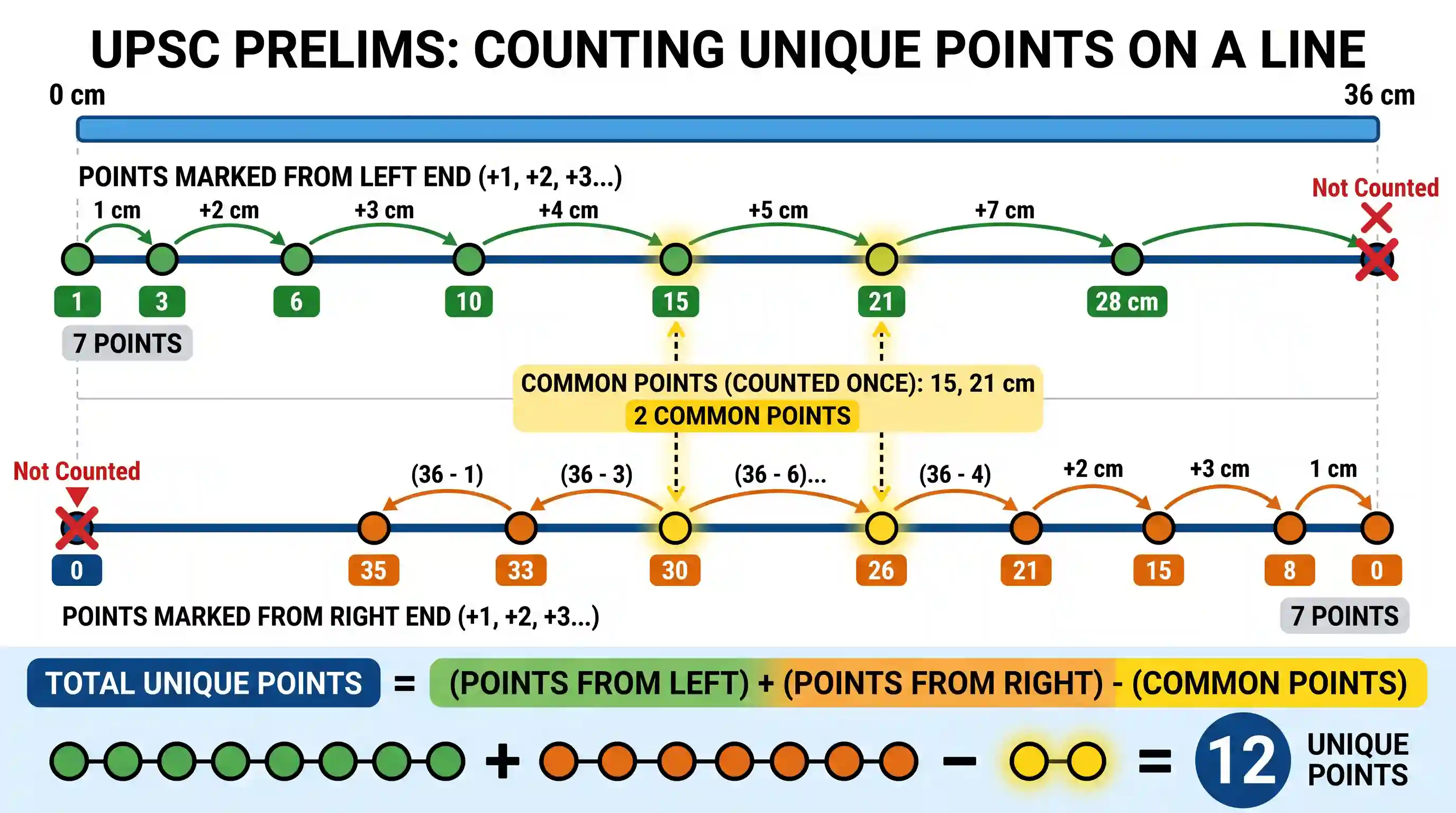
Points marked from the left end: The first point is at 1 cm from the end. The second point is at 1+2 = 3 cm from the end. The third point is at 1+2+3 = 6 cm from the end. The k-th point is at the sum of the first k integers, which is k(k+1)/2 cm from the end. We need to find points that are not at the end (36 cm). Let's list the positions from the left end: k=1: 1 cm k=2: 3 cm k=3: 6 cm k=4: 10 cm k=5: 15 cm k=6: 21 cm k=7: 28 cm For k=8, the position would be 8(8+1)/2 = 36 cm, which is the right end point and is not counted. So, points from the left end are: {1, 3, 6, 10, 15, 21, 28}. (Total 7 points)
-
Points marked from the right end: These points follow the same pattern, but their distances are measured from the right end. To compare them with points from the left, we convert their positions to distances from the left end (0 cm). The total length is 36 cm. 1st point from right: 1 cm from right end -> 36 - 1 = 35 cm from left end. 2nd point from right: 1+2 = 3 cm from right end -> 36 - 3 = 33 cm from left end. 3rd point from right: 1+2+3 = 6 cm from right end -> 36 - 6 = 30 cm from left end. 4th point from right: 1+2+3+4 = 10 cm from right end -> 36 - 10 = 26 cm from left end. 5th point from right: 1+2+3+4+5 = 15 cm from right end -> 36 - 15 = 21 cm from left end. 6th point from right: 1+2+3+4+5+6 = 21 cm from right end -> 36 - 21 = 15 cm from left end. 7th point from right: 1+2+3+4+5+6+7 = 28 cm from right end -> 36 - 28 = 8 cm from left end. For k=8, the position would be 36 cm from the right end, which is the left end point and is not counted. So, points from the right end (converted to distance from left end) are: {35, 33, 30, 26, 21, 15, 8}. (Total 7 points)
-
Combine and count unique points: Points from left: L = {1, 3, 6, 10, 15, 21, 28} Points from right: R = {8, 15, 21, 26, 30, 33, 35} (reordered for clarity) We need to find the number of unique points, counting common points as one. This is the size of the union of the two sets, |L U R|. Common points (intersection L and R): {15, 21}. There are 2 common points. Total unique points = |L| + |R| - |L intersection R| Total unique points = 7 + 7 - 2 = 14 - 2 = 12.
The number of points is 12.
The final answer is B
Related questions
More UPSC Prelims practice from the same subject and topic.
- Prelims 2014CSATQuantitative Aptitude
The following table shows the marks obtained by two students in different subjects: | Subjects | Student A | Max Marks A | Student B | Max Marks B | | English | 60 | 100 | 80 | 150 | | Psychology | 70…
- Prelims 2014CSATQuantitative Aptitude
The following table gives population and total income of a city for four years: Year | 1992 | 1993 | 1994 | 1995 | Population in lakhs | 20 | 21 | 22 | 23 | Income in crores | 1010 | 1111 | 1225 | 134…
- Prelims 2014CSATQuantitative Aptitude
A and B decide to travel from place X to place Y by bus. A has Rs. 10 with him and he finds that it is 80% of the bus fare for two persons. B finds that he has Rs. 3 with him and hands it over to A. I…
- Prelims 2014CSATQuantitative Aptitude
As per agreement with a bank, a businessman had to refund a loan in some equal installments without interest. After paying 18 installments he found that 60 percent of his loan was refunded. How many i…
- Prelims 2014CSATQuantitative Aptitude
A group of 630 children is seated in rows for a group photo session. Each row contains three less children than the row in front of it. Which one of the following number of rows is not possible?
- Prelims 2014CSATQuantitative Aptitude
For a charity show, the total tickets sold were 420. Half of these tickets were sold at the rate of Rs. 5 each, one-third at the rate of Rs. 3 each and the rest for Rs. 2 each. What was the total amou…