Six identical cards are placed on a table. Each card has number '1' marked on one side and number '2' marked on its other side. All the six cards are placed in such a manner that the number '1' is on the upper side. In one try, exactly four (neither more nor less) cards are turned upside down. In how many least number of tries can the cards be turned upside down such that all the six cards show number '2' on the upper side?

- A3Correct
- B5
- C7
- DThis cannot be achieved
Explanation
To solve this problem, we track the number of cards showing '1' on the upper side. The goal is to have 0 cards showing '1' (meaning all 6 cards show '2').
Initial state: All 6 cards show '1'. (6 '1's, 0 '2's)
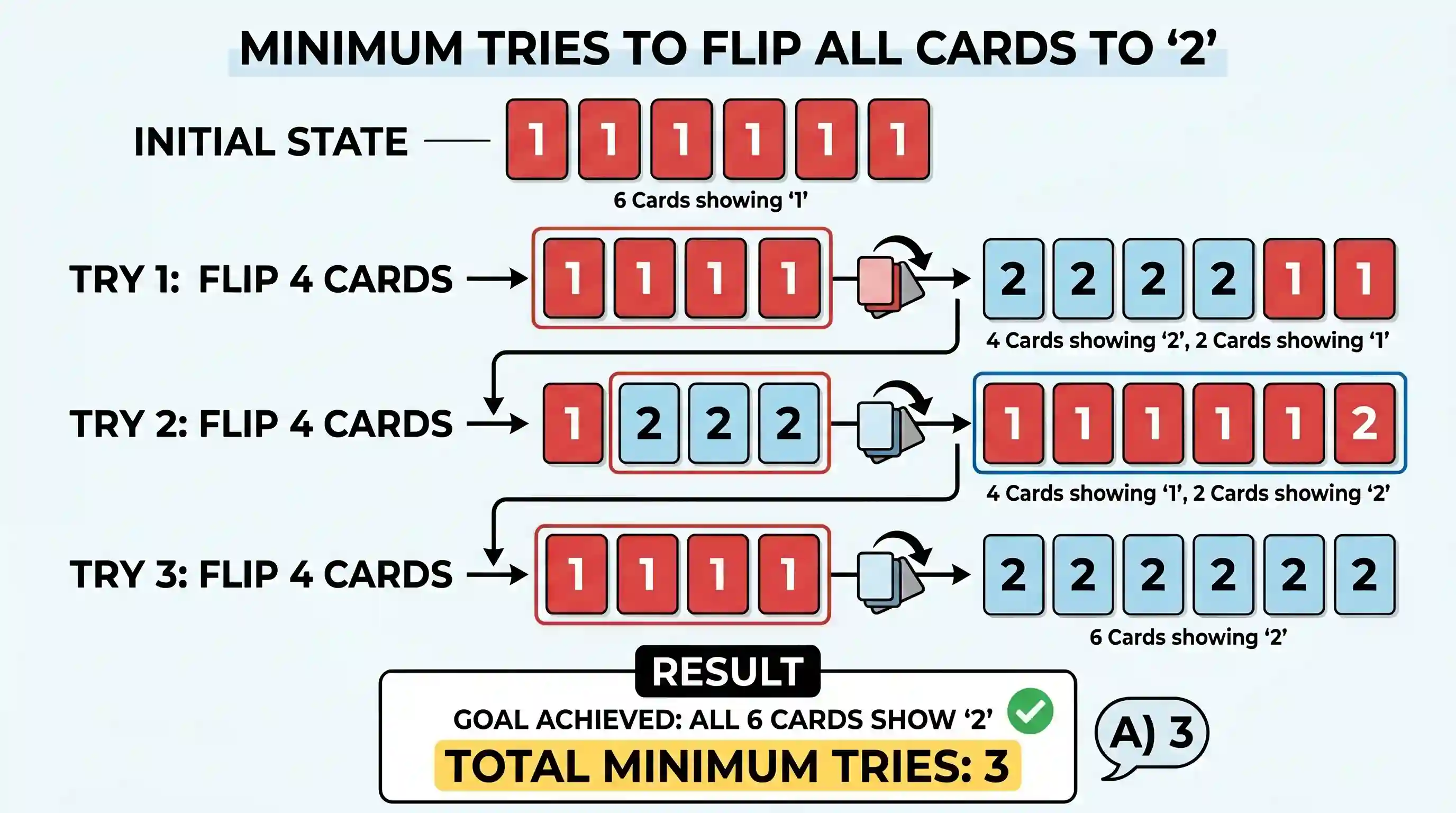
Try 1: We must flip exactly four cards. Since all cards are '1', we flip 4 cards that show '1'. These 4 cards change from '1' to '2'. Number of '1's remaining = 6 - 4 = 2. Number of '2's = 4. Current state: (2 '1's, 4 '2's)
Try 2: We have 2 cards showing '1' and 4 cards showing '2'. We must flip exactly four cards. To move towards the goal of 0 '1's, we want to flip as many '1's as possible and as few '2's as possible, or at least not increase the '1's significantly. Let x be the number of '1's we flip, and y be the number of '2's we flip. We know x + y = 4. Possible scenarios:
- Flip 2 '1's and 2 '2's (x=2, y=2): The 2 '1's become '2's. The 2 '2's become '1's. New number of '1's = (2 - 2) + 2 = 2. (This brings us back to the same state as after Try 1, no progress).
- Flip 1 '1' and 3 '2's (x=1, y=3): The 1 '1' becomes '2'. The 3 '2's become '1's. New number of '1's = (2 - 1) + 3 = 4.
- Flip 0 '1's and 4 '2's (x=0, y=4): The 4 '2's become '1's. New number of '1's = (2 - 0) + 4 = 6. (This takes us back to the initial state).
The most effective choice to make progress is to aim for a state that allows us to reach the target in the next step. Choosing to have 4 '1's and 2 '2's (scenario 2) is the best option here. Current state: (4 '1's, 2 '2's)
Try 3: We have 4 cards showing '1' and 2 cards showing '2'. We must flip exactly four cards. To reach the target of 0 '1's, we need to flip all 4 cards that show '1'. We can choose to flip 4 '1's and 0 '2's (x=4, y=0). This is possible as we have 4 '1's available. The 4 '1's become '2's. New number of '1's = (4 - 4) + 0 = 0. Number of '2's = 6. Current state: (0 '1's, 6 '2's). All cards show '2'.
Thus, it takes a minimum of 3 tries to achieve the desired state.
The final answer is A) 3.
Related questions
More UPSC Prelims practice from the same subject and topic.
- Prelims 2014CSATQuantitative Aptitude
There are 50 students admitted to a nursery class. Some students can speak only English and some can speak only Hindi. 10 student can speak both English and Hindi. If the number of students who can sp…
- Prelims 2014CSATQuantitative Aptitude
Out of a total of 120 musicians in a club, 5% can play all the three instruments, guitar, violin and flute. It so happens that the number of musicians who can play any and only two of the above instru…
- Prelims 2014CSATQuantitative Aptitude
The following table shows the marks obtained by two students in different subjects: | Subjects | Student A | Max Marks A | Student B | Max Marks B | | English | 60 | 100 | 80 | 150 | | Psychology | 70…
- Prelims 2014CSATQuantitative Aptitude
The following table gives population and total income of a city for four years: Year | 1992 | 1993 | 1994 | 1995 | Population in lakhs | 20 | 21 | 22 | 23 | Income in crores | 1010 | 1111 | 1225 | 134…
- Prelims 2014CSATQuantitative Aptitude
A bell rings every 18 minutes. A second bell rings every 24 minutes. A third bell rings every 32 minutes. If all the three bells ring at the same time at 8 o'clock in the morning, at what other time w…
- Prelims 2014CSATQuantitative Aptitude
A and B decide to travel from place X to place Y by bus. A has Rs. 10 with him and he finds that it is 80% of the bus fare for two persons. B finds that he has Rs. 3 with him and hands it over to A. I…