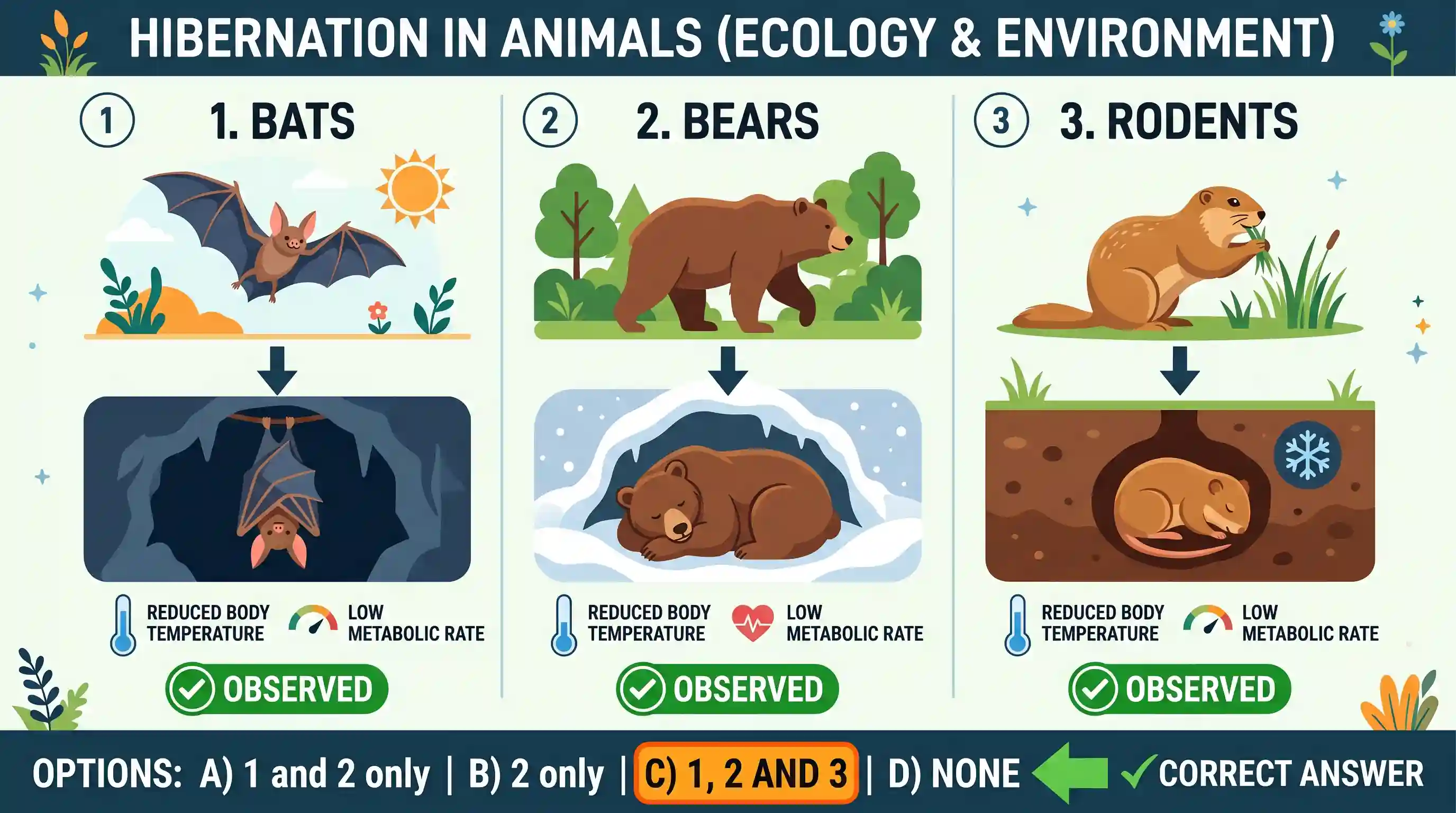
Consider the following: 1. Bats 2. Bears 3. Rodents The phenomenon of hibernation can be observed in which of the above kinds of animals?

- A1 and 2 only
- B2 only
- C1, 2 and 3Correct
- DHibernation cannot be observed in any of the above
Explanation
Hibernation is a state of minimal activity and metabolic depression in endothermic (warm-blooded) animals. It is characterized by lower body temperature, slower breathing, and a lower metabolic rate. Animals hibernate to conserve energy during periods of limited food availability or harsh environmental conditions (typically cold winters).
- Bats: Many bat species, especially those in temperate regions, are true hibernators. They seek out caves, mines, or other sheltered places to spend the winter in a state of torpor.
- Bears: While bears are often said to hibernate, their state of torpor is not as deep as that of true hibernators (like rodents or bats). Their body temperature doesn't drop as dramatically, and they can be roused more easily. However, it is still considered a form of hibernation or winter lethargy to conserve energy during food scarcity.
- Rodents: Many rodent species, such as groundhogs, hamsters, dormice, and marmots, are classic examples of true hibernators, undergoing profound physiological changes during their dormant period. Therefore, the phenomenon of hibernation can be observed in all three kinds of animals listed.
Related questions
More UPSC Prelims practice from the same subject and topic.
- Prelims 2014GS1geography
If a wetland of international importance is brought under the 'Montreux Record', what does it imply?
- Prelims 2014GS1geography
With reference to Bombay Natural History Society (BNHS), consider the following statements: 1. It is an autonomous organization under the Ministry of Environment and Forests. 2. It strives to conserve…
- Prelims 2014GS1geography
With reference to 'Global Environment Facility', which of the following statements is/are correct?
- Prelims 2014GS1geography
With reference to a conservation organization called 'Wetlands International', which of the following statements is/are correct? 1. It is an intergovernmental organization formed by the countries whic…
- Prelims 2014GS1geography
Which of the following phenomena might have influenced the evolution of organisms? 1. Continental drift 2. Glacial cycles Select the correct answer using the code given below.
- Prelims 2014GS1geography
Other than poaching, what are the possible reasons for the decline in the population of Ganges River Dolphins? 1. Construction of dams and barrages on rivers 2. Increase in the population of crocodile…