Lichens, which are capable of initiating ecological succession even on a bare rock, are actually a symbiotic association of

- Aalgae and bacteria
- Balgae and fungiCorrect
- Cbacteria and fungi
- Dfungi and mosses
Explanation
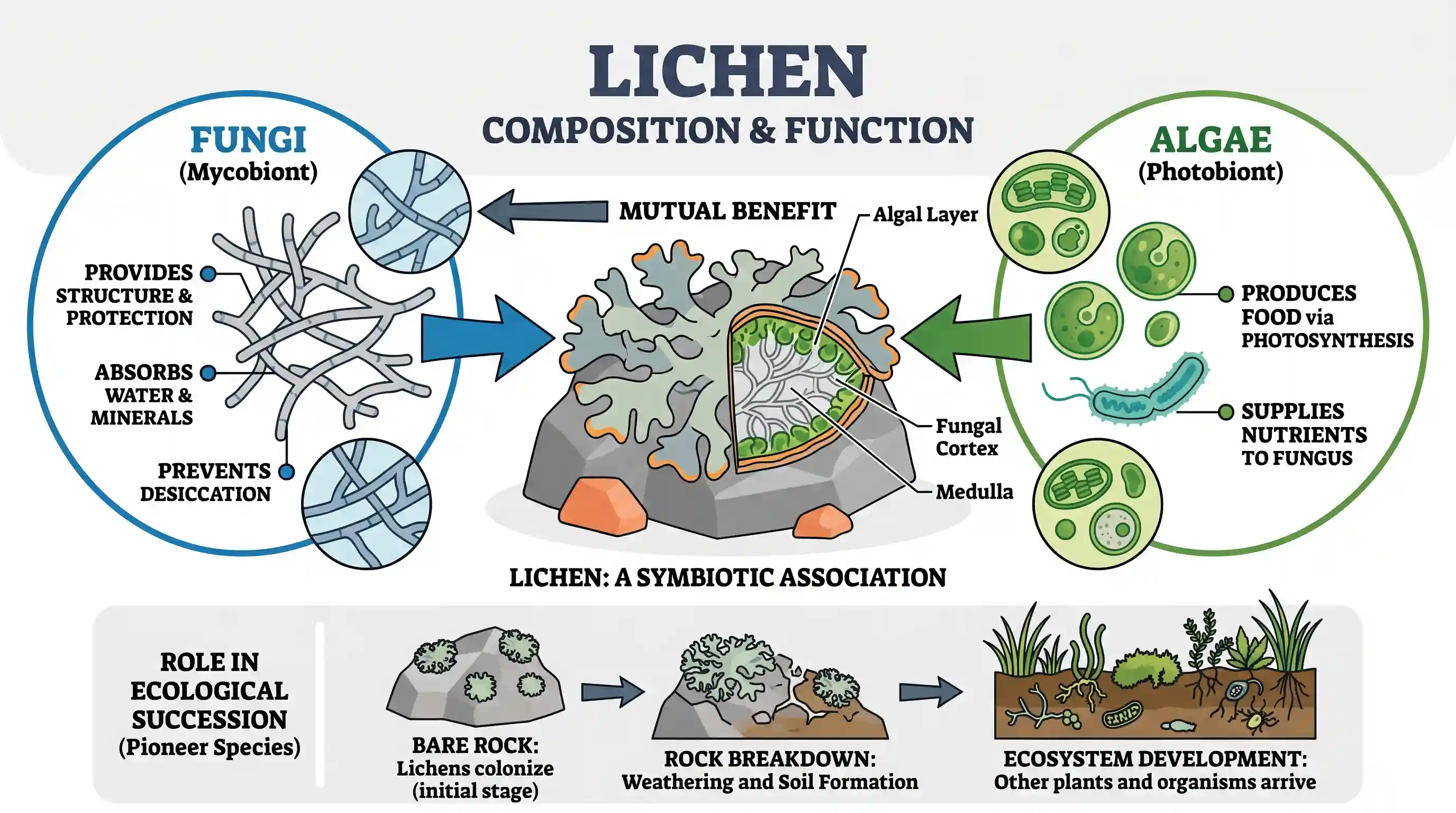
Lichens are remarkable organisms known for their ability to colonize harsh environments, including bare rock, where they play a crucial role in initiating ecological succession (primary succession).
A lichen is a symbiotic association (a close and often long-term interaction between two different biological organisms) primarily between:
A fungus (mycobiont): This component typically provides the structural body of the lichen, protects the photosynthetic partner from desiccation, and absorbs water and minerals from the environment. A photosynthetic partner (photobiont): This is usually a green alga (chlorophyta) or a cyanobacterium (formerly known as blue-green algae). The photobiont produces food (sugars) through photosynthesis, providing nutrients to the fungus. This mutualistic relationship allows lichens to survive in extreme conditions where neither partner could thrive alone. The fungus benefits from the food produced by the alga/cyanobacterium, while the alga/cyanobacterium benefits from the protection and access to water/minerals provided by the fungus.
Options A, C, and D describe other combinations that do not accurately represent the symbiotic nature of lichens.
Related questions
More UPSC Prelims practice from the same subject and topic.
- Prelims 2014GS1geography
If a wetland of international importance is brought under the 'Montreux Record', what does it imply?
- Prelims 2014GS1geography
With reference to Bombay Natural History Society (BNHS), consider the following statements: 1. It is an autonomous organization under the Ministry of Environment and Forests. 2. It strives to conserve…
- Prelims 2014GS1geography
With reference to 'Global Environment Facility', which of the following statements is/are correct?
- Prelims 2014GS1geography
With reference to a conservation organization called 'Wetlands International', which of the following statements is/are correct? 1. It is an intergovernmental organization formed by the countries whic…
- Prelims 2014GS1geography
Which of the following phenomena might have influenced the evolution of organisms? 1. Continental drift 2. Glacial cycles Select the correct answer using the code given below.
- Prelims 2014GS1geography
Other than poaching, what are the possible reasons for the decline in the population of Ganges River Dolphins? 1. Construction of dams and barrages on rivers 2. Increase in the population of crocodile…