If you travel through the Himalayas, you are likely to see which of the following plants naturally growing there? 1. Oak 2. Rhododendron 3. Sandalwood Select the correct answer using the code given below.

- A1 and 2 onlyCorrect
- B3 only
- C1 and 3 only
- D1, 2 and 3
Explanation
Let's consider the natural distribution of these plants in the Himalayan region:
-
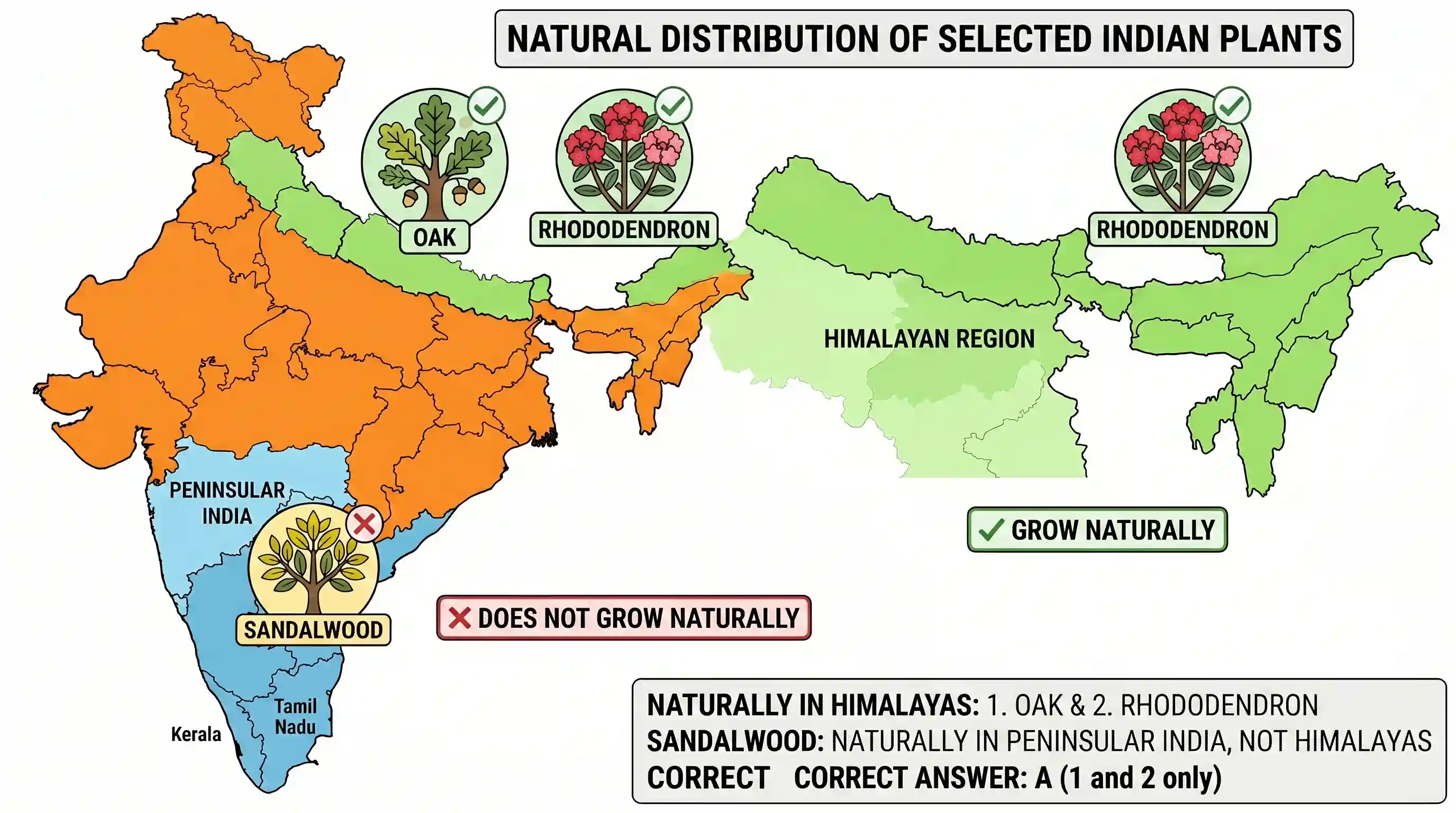
Oak: Various species of Oak (genus Quercus) are very common and widespread in the temperate and subtropical forest zones of the Himalayas. They form a significant part of the broadleaf forests across different altitudes, particularly in the mid-Himalayan ranges. This statement is correct.
-
Rhododendron: Rhododendrons are characteristic and iconic flowering plants of the Himalayan ecosystem. Numerous species of Rhododendron are found naturally growing at various altitudes in the Himalayas, from temperate forests to alpine regions, often forming dense undergrowth or even dominant tree species at higher elevations. This statement is correct.
-
Sandalwood: Sandalwood (Santalum album) is primarily found in the dry deciduous forests of Peninsular India, especially in the states of Karnataka, Tamil Nadu, and Kerala. It is not naturally found growing in the Himalayan region, which has a distinct climatic and ecological profile.
Therefore, Oak and Rhododendron are plants naturally growing in the Himalayas.
Related questions
More UPSC Prelims practice from the same subject and topic.
- Prelims 2014GS1geography
What are the significances of a practical approach to sugarcane production known as 'Sustainable Sugarcane Initiative'? 1. Seed cost is very low in this compared to the conventional method of cultivat…
- Prelims 2014GS1geography
Which one of the following pairs of islands is separated from each other by the "Ten Degree Channel?"
- Prelims 2014GS1geography
Consider the following pairs: Programme/Project Ministry 1. Drought-Prone Area Programme : Ministry of Agriculture 2. Desert Development Programme : Ministry of Environment and Forests 3. National Wat…
- Prelims 2014GS1geography
Consider the following pairs: 1. Dampa Tiger Reserve : Mizoram 2. Gumti Wildlife Sanctuary : Sikkim 3. Saramati Peak : Nagaland Which of the above pairs is/are correctly matched?
- Prelims 2014GS1geography
With reference to two non-conventional energy sources called 'coalbed methane' and 'shale gas', consider the following statements: 1. Coalbed methane is the pure methane gas extracted from coal seams,…
- Prelims 2014GS1geography
Consider the following rivers: 1. Barak 2. Lohit 3. Subansiri Which of the above flows/flow through Arunachal Pradesh?