Consider the following statements regarding a No-Confidence Motion in India: 1. There is no mention of a No-Confidence Motion in the Constitution of India. 2. A Motion of No-Confidence can be introduced in the Lok Sabha only. Which of the statements given above is/are correct?

- A1 only
- B2 only
- CBoth 1 and 2Correct
- DNeither 1 nor 2
Explanation
Let's analyze the statements regarding a No-Confidence Motion in India:
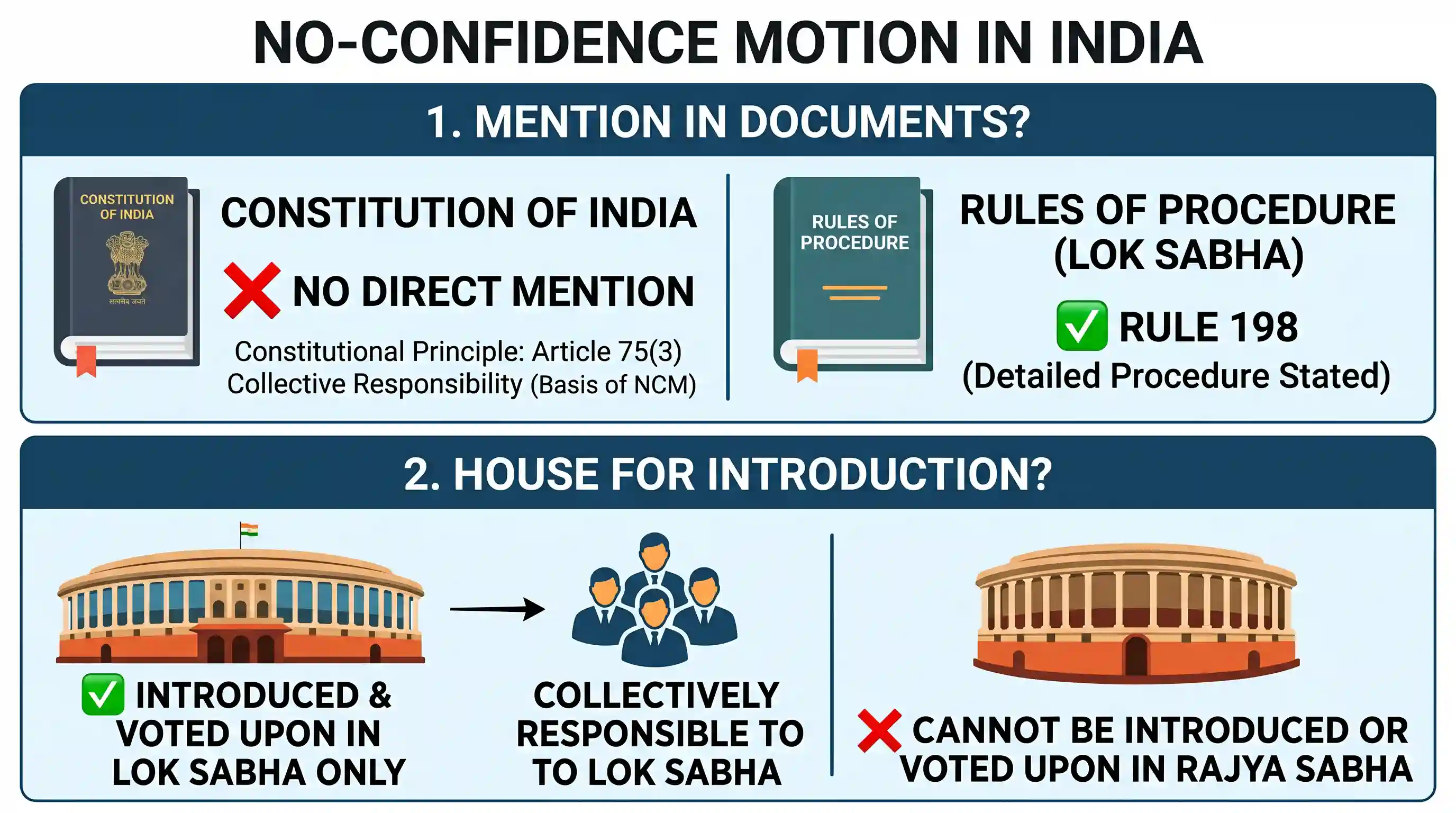
There is no mention of a No-Confidence Motion in the Constitution of India: This statement is correct. The term 'No-Confidence Motion' is not explicitly defined or mentioned in the text of the Constitution. However, the constitutional principle of 'collective responsibility' of the Council of Ministers to the Lok Sabha (Article 75(3)) forms the basis for such a motion. The actual procedure for moving a No-Confidence Motion is laid down in the Rules of Procedure and Conduct of Business in Lok Sabha (Rule 198). A Motion of No-Confidence can be introduced in the Lok Sabha only: This statement is correct. Since the Council of Ministers is collectively responsible only to the House of the People (Lok Sabha), a motion to express a lack of confidence in the government can only be introduced and voted upon in the Lok Sabha. The Rajya Sabha (Council of States) does not have the power to pass a No-Confidence Motion against the Council of Ministers. Therefore, both statements are correct.
Related questions
More UPSC Prelims practice from the same subject and topic.
- Prelims 2014GS1polity-and-governance
Which one of the following is the largest Committee of the Parliament?
- Prelims 2014GS1polity-and-governance
Which of the following is/are the function/functions of the Cabinet Secretariat? 1. Preparation of agenda for Cabinet Meetings 2. Secretarial assistance to Cabinet Committees 3. Allocation of financia…
- Prelims 2014GS1polity-and-governance
Consider the following statements : 1. The President shall make rules for the more convenient transaction of the business of the Government of India, and for the allocation among Ministers of the said…
- Prelims 2014GS1polity-and-governance
The power to increase the number of judges in the Supreme Court of India is vested in
- Prelims 2014GS1polity-and-governance
With reference to a grouping of countries known as BRICS, consider the following statements: 1. The First Summit of BRICS was held in Rio de Janeiro in 2009. 2. South Africa was the last to join the B…
- Prelims 2014GS1polity-and-governance
Recently, a series of uprisings of people referred to as 'Arab Spring' originally started from