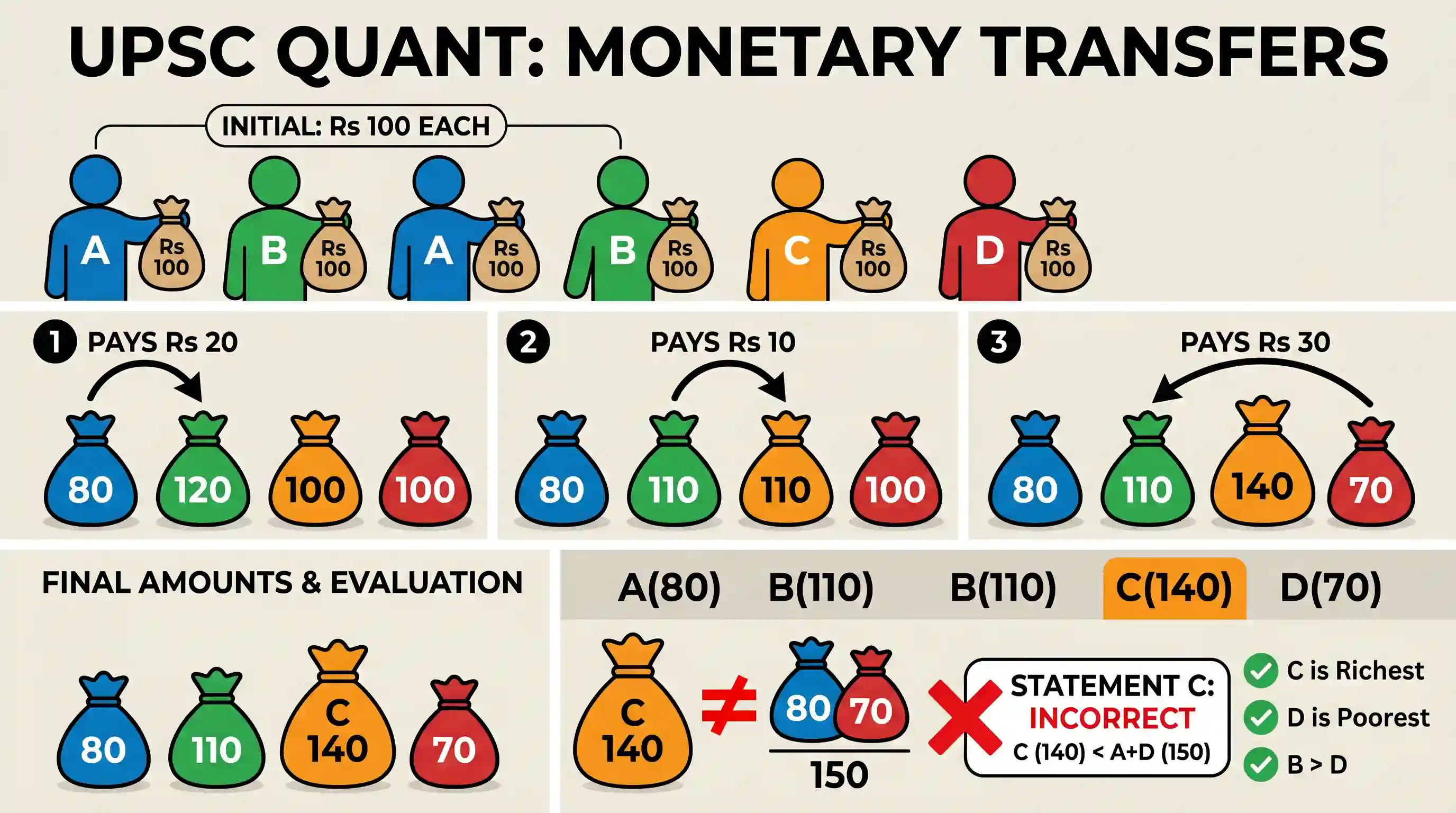
Each of A, B, C and D has Rs 100. A pays Rs 20 to B, who pays Rs 10 to C, who gets Rs 30 from D. In this context, which one of the following statements is not correct?

- AC is the richest
- BD is the poorest
- CC has more than what A and D have togetherCorrect
- DB is richer than D
Explanation
Let's track the money each person has after the transactions:
Initial amounts: A = 100 B = 100 C = 100 D = 100
-
A pays Rs 20 to B: A = 100 - 20 = 80 B = 100 + 20 = 120 C = 100 D = 100
-
B pays Rs 10 to C: A = 80 B = 120 - 10 = 110 C = 100 + 10 = 110 D = 100
-
C gets Rs 30 from D: A = 80 B = 110 C = 110 + 30 = 140 D = 100 - 30 = 70
Final amounts: A = 80 B = 110 C = 140 D = 70
Now let's analyze each statement:
A) C is the richest: C has 140, which is the highest amount. This statement is CORRECT. B) D is the poorest: D has 70, which is the lowest amount. This statement is CORRECT. C) C has more than what A and D have together: C has 140. A and D together have 80 + 70 = 150. 140 is NOT more than 150. This statement is NOT CORRECT. D) B is richer than D: B has 110, D has 70. 110 is greater than 70. This statement is CORRECT.
The question asks for the statement that is NOT correct. Therefore, option C is the answer.
The final answer is C
Related questions
More UPSC Prelims practice from the same subject and topic.
- Prelims 2015CSATQuantitative Aptitude
In a test, a candidate attempted only 8 questions and secured 50% marks in each of the questions. If he obtained a total of 40% in the test and all questions in the test carried equal marks, how many …
- Prelims 2015CSATQuantitative Aptitude
A father is nine times as old as his son and the mother is eight times as old as the son. The sum of the father's and the mother's age is 51 years. What is the age of the son?
- Prelims 2015CSATQuantitative Aptitude
Two equal glasses of same type are respectively 1/3 and 1/4 full of milk. They are then filled up with water and the contents are mixed in a pot. What is the ratio of milk and water in the pot?
- Prelims 2015CSATQuantitative Aptitude
In a parking area, the total number of wheels of all the cars (four- wheelers) and scooters/motorbikes (two-wheelers) is 100 more than twice the number of parked vehicles. The number of cars parked is
- Prelims 2015CSATQuantitative Aptitude
A person ordered 5 pairs of black socks and some pairs of brown socks. The price of a black pair was thrice that of a brown pair. While preparing the bill, the bill clerk interchanged the number of bl…
- Prelims 2015CSATQuantitative Aptitude
The monthly incomes of Peter and Paul are in the ratio of 4:3. Their expenses are in the ratio of 3:2. If each saves Rs. 6,000 at the end of the month, their monthly incomes respectively are (in Rs.)