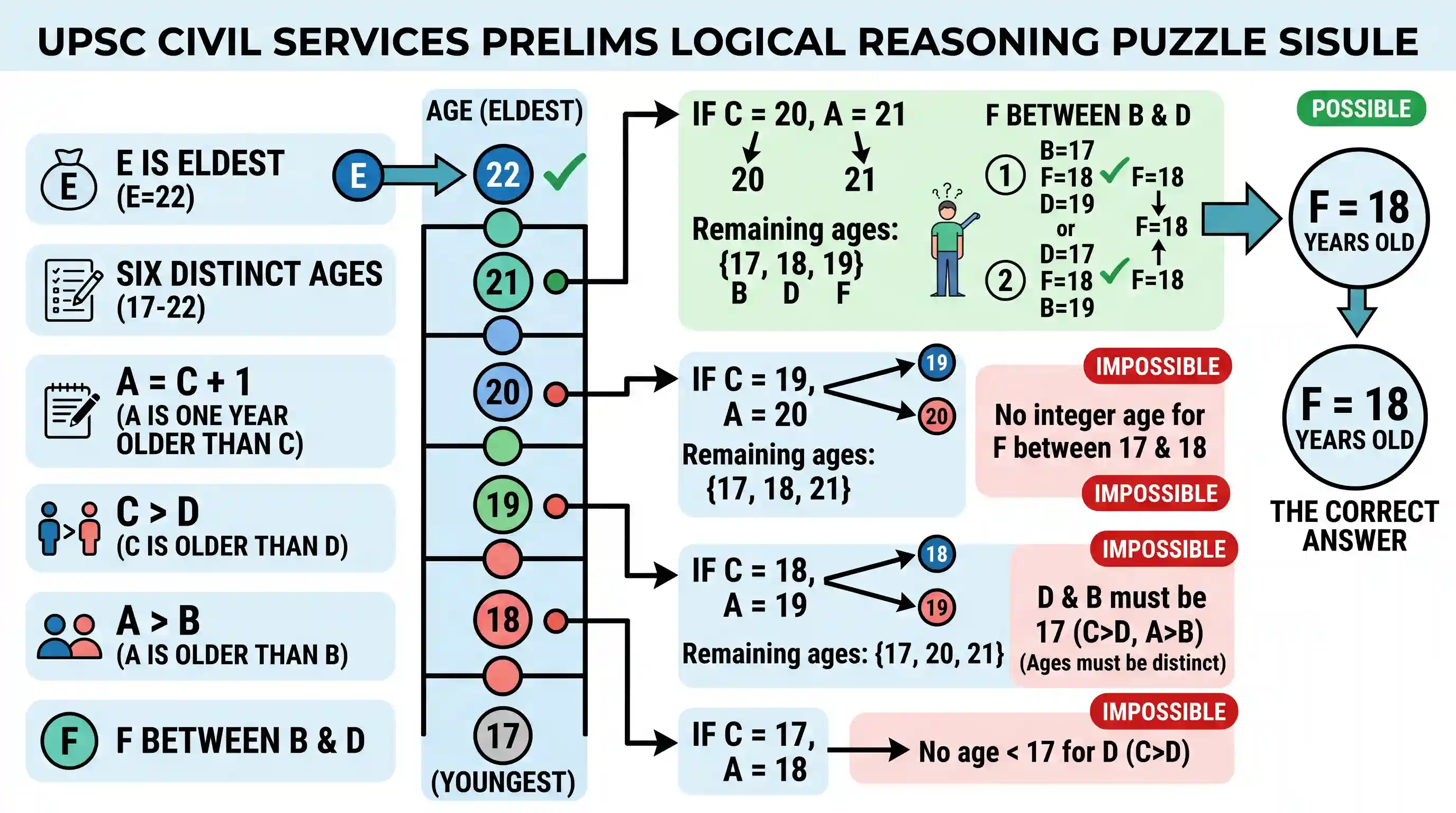
A, B, C, D, E and F are cousins. No two cousins are of the same age, but everyone's birthday falls on the same date of the same month. The youngest is 17 years old and the eldest E is 22 years old. F is somewhere between B and D in age. A is older than B. C is older than D. A is one year older than C. Which one of the following is possible?

- AD is 20 years old
- BF is 18 years oldCorrect
- CF is 19 years old
- DF is 20 years old
Explanation
The problem requires us to determine a possible age based on a set of logical conditions.
Let's list the given information:
- There are 6 cousins: A, B, C, D, E, F.
- No two cousins are of the same age.
- Ages range from 17 to 22. So the ages are 17, 18, 19, 20, 21, 22.
- E is the eldest, so E = 22.
- The youngest is 17.
- F is somewhere between B and D in age. This means B, F, and D are three distinct ages, and F is strictly between B and D (e.g., B = 2.
- A is older than B (A > B).
- C is older than D (C > D).
- A is one year older than C (A = C + 1).
Let's deduce the possibilities:
- We know E = 22.
- The remaining ages for A, B, C, D, F are {17, 18, 19, 20, 21}.
Now, let's use the condition A = C + 1 to find possible pairs for (C, A) from the remaining ages:
-
Case 1: C = 20, A = 21.
- Ages used: E=22, A=21, C=20.
- Ages remaining for B, D, F: {17, 18, 19}.
- From C > D (20 > D), D must be from {17, 18, 19}.
- From A > B (21 > B), B must be from {17, 18, 19}.
- From "F is somewhere between B and D", B, F, and D must be three distinct ages from {17, 18, 19}. The only way this is possible is if {B, D} = {17, 19} (in any order) and F = 18.
- Let's check if this is consistent:
- If D=17, B=19: E=22, A=21, C=20, B=19, F=18, D=17.
- E=22 (eldest) - Yes.
- 17 (D) is youngest - Yes.
- A=C+1 (21=20+1) - Yes.
- A>B (21>19) - Yes.
- C>D (20>17) - Yes.
- F is between B and D (19 > 18 > 17) - Yes.
- This arrangement is possible. In this scenario, F is 18 years old.
- If D=17, B=19: E=22, A=21, C=20, B=19, F=18, D=17.
-
Case 2: C = 19, A = 20.
- Ages used: E=22, A=20, C=19.
- Ages remaining for B, D, F: {17, 18, 21}.
- From C > D (19 > D), D must be from {17, 18}.
- From A > B (20 > B), B must be from {17, 18}.
- For F to be strictly between B and D, B and D must be distinct and have at least one integer age between them. If B and D are 17 and 18 (in any order), there is no integer age strictly between them. Thus, F cannot be placed. This case is impossible.
-
Case 3: C = 18, A = 19.
- Ages used: E=22, A=19, C=18.
- Ages remaining for B, D, F: {17, 20, 21}.
- From C > D (18 > D), D must be 17.
- From A > B (19 > B), B must be 17.
- However, all cousins must have distinct ages. B and D cannot both be 17. This case is impossible.
-
Case 4: C = 17, A = 18.
- Ages used: E=22, A=18, C=17.
- Ages remaining for B, D, F: {19, 20, 21}.
- From C > D (17 > D), there is no possible age for D, as 17 is the youngest and already assigned to C. This case is impossible.
Since only Case 1 is possible, F must be 18 years old.
Let's check the options: A) D is 20 years old - Not possible, as D must be 17 or 19 in the only valid scenario. B) F is 18 years old - This is possible, as shown in Case 1. C) F is 19 years old - Not possible. D) F is 20 years old - Not possible.
The final answer is B
Related questions
More UPSC Prelims practice from the same subject and topic.
- Prelims 2015CSATLogical Reasoning
Shahid and Rohit start from the same point in opposite directions. After each 1 km, Shahid always turns left and Rohit always turns right. Which of the following statements is correct?
- Prelims 2015CSATLogical Reasoning
Each of the six different faces of a cube has been coated with a different colour i.e., V, I, B, G, Y and O. Following information is given: 1) Colours Y, O and B are on adjacent faces. 2) Colours I, …
- Prelims 2015CSATLogical Reasoning
A, B, C, D, E and F are cousins. No two cousins are of the same age, but everyone's birthday falls on the same date of the same month. The youngest is 17 years old and the eldest E is 22 years old. F …
- Prelims 2015CSATLogical Reasoning
Two men, Anil and David, and two women, Shabnam and Rekha are in a sales group. Only two speak Tamil. The other two speak Marathi. Only one man and one woman can drive a car. Shabnam speaks Marathi. A…
- Prelims 2015CSATLogical Reasoning
Between 6 PM and 7 PM the minute hand of a clock will be ahead of the hour hand by 3 minutes at
- Prelims 2015CSATLogical Reasoning
Consider the following matrix: 3 8 10 2 ? 1 6 56 90 2 20 0 What is the missing number at '?' in the matrix?