When three friends A, B and C met, it was found that each of them wore an outer garment of a different colour. In random order, the garments are: jacket, sweater and tie; and the colours are: blue, white and black. Their surnames in random order Kumar and Singh. Further, we know that: 1. neither B nor Ribeiro wore a white sweater 2. C wore a tie 3. Singh's garment was not white 4. Kumar does not wear a jacket 5. Ribeiro does not like to wear the black colour 6. Each of the friends wore only one outer garment of only one colour What is C's surname?

- ARibeiroCorrect
- BKumar
- CSingh
- DCannot be determined
Explanation
The problem involves three friends (A, B, C), three garments (jacket, sweater, tie), three colors (blue, white, black), and three surnames (Kumar, Singh, Ribeiro). Each friend wears one garment of one color.
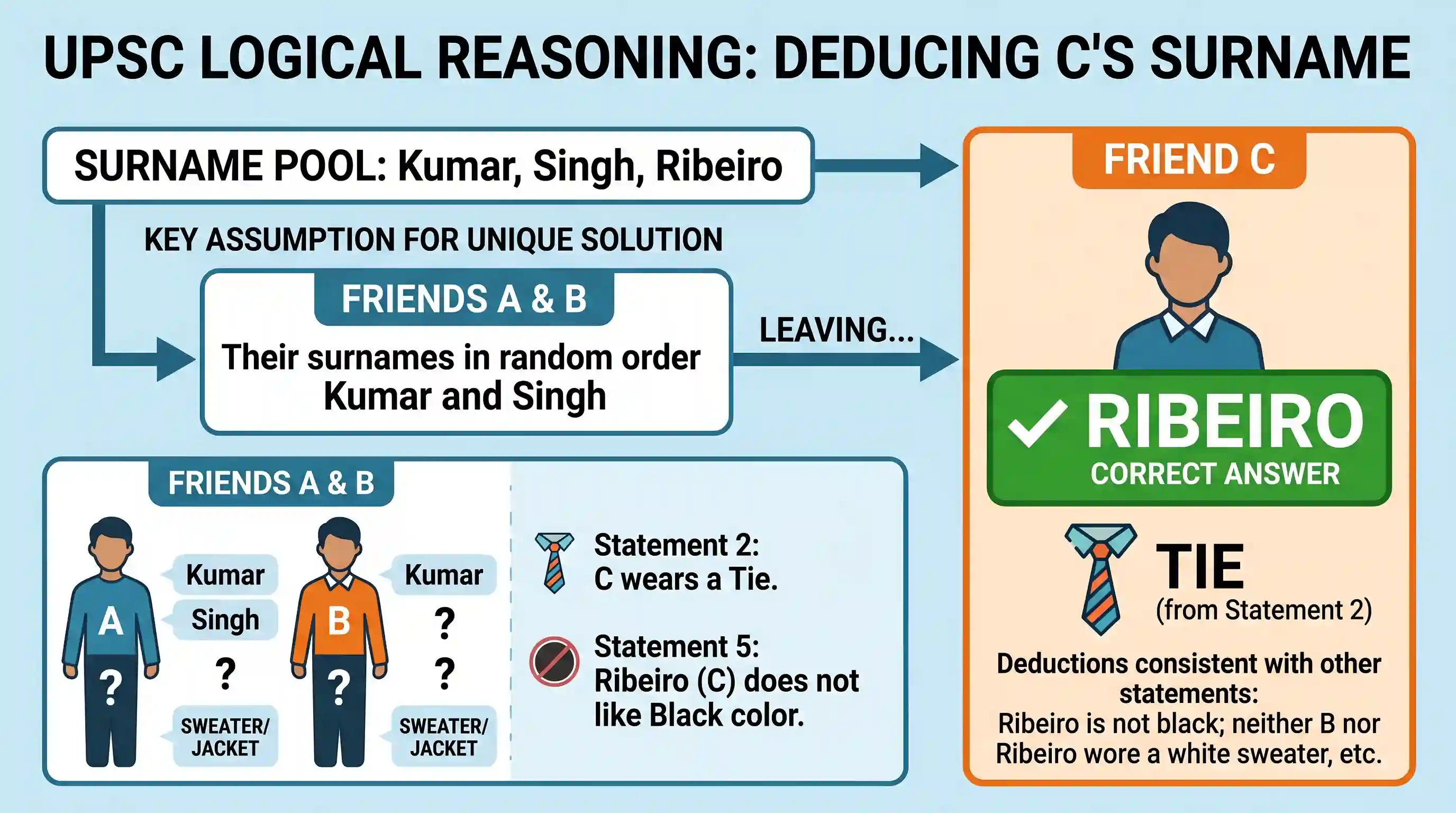
The crucial phrase "Their surnames in random order Kumar and Singh" is best interpreted as meaning that friends A and B have the surnames Kumar and Singh (in some order), and thus friend C must have the remaining surname, Ribeiro. This assumption is necessary to arrive at a unique answer, as is typical in such puzzles.
Let's proceed with the assumption that C's surname is Ribeiro.
-
From statement 2, C wore a tie. So, C = Ribeiro, Tie.
-
From statement 5, Ribeiro does not like to wear the black colour. Since C is Ribeiro, C's tie cannot be black. So, C's tie is either Blue or White.
-
From statement 1, neither B nor Ribeiro wore a white sweater. Since C is Ribeiro and C wore a tie (not a sweater), this condition is satisfied for Ribeiro.
Now we consider the two possibilities for C's tie color:
Case 1: C wore a Blue Tie.
-
C = Ribeiro, Tie, Blue.
Remaining friends: A, B. Remaining surnames: Kumar, Singh. Remaining garments: Jacket, Sweater. Remaining colors: White, Black.
- From statement 4, Kumar does not wear a jacket. Therefore, Kumar must wear the Sweater.
- From statement 3, Singh's garment was not white. Since Singh cannot wear white, and Kumar wears the sweater, Kumar must wear the White Sweater. So, Kumar = Sweater, White.
- This leaves Singh to wear the Black Jacket. So, Singh = Jacket, Black.
Now, we assign these to friends A and B:
- From statement 1, "neither B nor Ribeiro wore a white sweater". Ribeiro (C) wore a blue tie, which is not a white sweater, so this part is fine. B cannot wear a white sweater. Since Kumar wears the white sweater, B cannot be Kumar. Therefore, B must be Singh. So, B = Singh, Jacket, Black. This means A must be Kumar. So, A = Kumar, Sweater, White.
This gives the complete assignment: A = Kumar, Sweater, White B = Singh, Jacket, Black C = Ribeiro, Tie, Blue This solution is consistent with all given statements.
Case 2: C wore a White Tie.
-
C = Ribeiro, Tie, White.
Remaining friends: A, B. Remaining surnames: Kumar, Singh. Remaining garments: Jacket, Sweater. Remaining colors: Blue, Black.
- From statement 4, Kumar does not wear a jacket. Therefore, Kumar must wear the Sweater.
- From statement 5, Ribeiro does not like to wear the black colour. Since C is Ribeiro, C is wearing white, which is consistent. The black color must be worn by either Kumar or Singh. Since Kumar wears the sweater, Singh must wear the Black Jacket. So, Singh = Jacket, Black.
- This leaves Kumar to wear the Blue Sweater. So, Kumar = Sweater, Blue.
Now, we assign these to friends A and B:
- From statement 1, "neither B nor Ribeiro wore a white sweater". Ribeiro (C) wore a white tie, which is not a white sweater, so this part is fine. B cannot wear a white sweater. Kumar wears a blue sweater (not white), and Singh wears a black jacket (not a white sweater). So, B can be either Kumar or Singh. Both assignments are valid.
For example, one valid assignment is: A = Kumar, Sweater, Blue B = Singh, Jacket, Black C = Ribeiro, Tie, White This solution is also consistent with all given statements.
In both consistent scenarios (C wore a blue tie or C wore a white tie), C's surname is Ribeiro.
The final answer is A) Ribeiro.
Related questions
More UPSC Prelims practice from the same subject and topic.
- Prelims 2016CSATLogical Reasoning
A person X was driving in a place where all roads ran either north-south or east-west, forming a grid. Roads are at a distance of 1 km from each other in a parallel. He started at the intersection of …
- Prelims 2016CSATLogical Reasoning
Five people A, B, C, D and E are seated about a round table. Every chair is spaced equidistant from adjacent chairs. (i) C is seated next to A (ii) A is seated two seats from D (iii) B is not seated n…
- Prelims 2016CSATLogical Reasoning
There are five persons in a group - P, Q, R, S and T. The group has one doctor, one lawyer and one artist. P and S are unmarried students. T is a man married to one of the group members. Q is the brot…
- Prelims 2016CSATLogical Reasoning
There are five persons in a group - P, Q, R, S and T. The group has one doctor, one lawyer and one artist. P and S are unmarried students. T is a man married to one of the group members. Q is the brot…
- Prelims 2016CSATLogical Reasoning
There are five persons in a group - P, Q, R, S and T. The group has one doctor, one lawyer and one artist. P and S are unmarried students. T is a man married to one of the group members. Q is the brot…
- Prelims 2016CSATLogical Reasoning
There are five persons in a group - P, Q, R, S and T. The group has one doctor, one lawyer and one artist. P and S are unmarried students. T is a man married to one of the group members. Q is the brot…