Five people A, B, C, D and E are seated about a round table. Every chair is spaced equidistant from adjacent chairs. (i) C is seated next to A (ii) A is seated two seats from D (iii) B is not seated next to A On the basis of above information, which of the following must be true? 1. D is seated next to B 2. E is seated next to A 3. D and C are separated by two seats Select the correct answer using the code given below:

- A1 only
- B1 and 2 onlyCorrect
- C3 only
- DNeither 1 nor 2 nor 3
Explanation
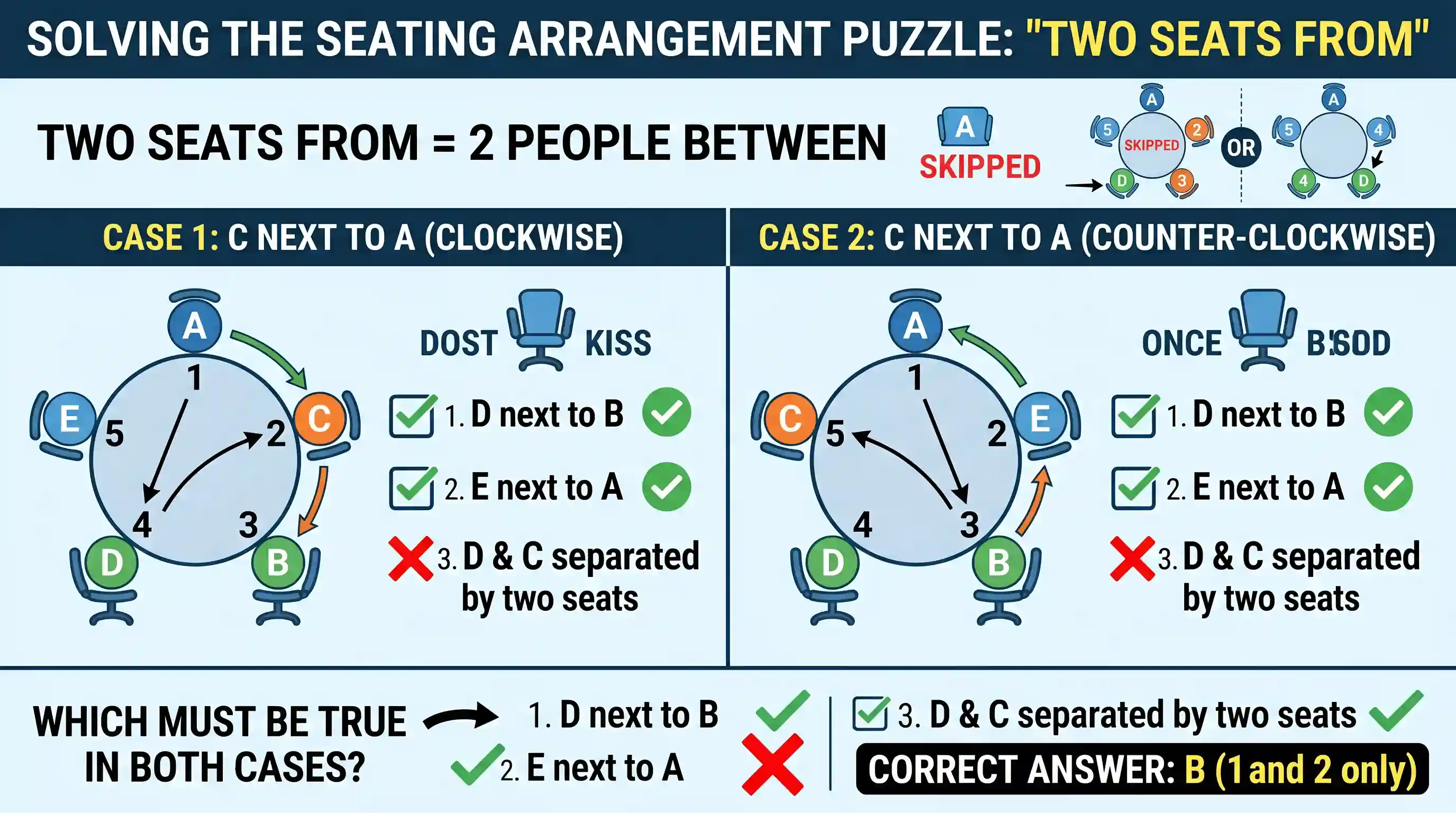
The key to solving this problem lies in interpreting the phrase "A is seated two seats from D". In the context of a circular table with equidistant chairs, "two seats from" typically means there are two people between them.
Let's place A at a fixed position (e.g., position 1). There are 5 chairs: 1-2-3-4-5 (clockwise).
From condition (ii) "A is seated two seats from D": This means there are two people between A and D. If A is at position 1, D must be at position 4 (with positions 2 and 3 between them). Arrangement so far: A _ _ D _ (1 _ _ 4 _)
From condition (i) "C is seated next to A": C can be at position 2 or position 5.
Case 1: C is at position 2. Arrangement: A C _ D _ (1 2 _ 4 _) Remaining seats: 3, 5. Remaining people: B, E. From condition (iii) "B is not seated next to A": A is at 1, so B cannot be at 2 or 5. Since C is at 2, B cannot be at 2. So B cannot be at 5. Therefore, B must be at position 3. This leaves E for position 5. Arrangement 1: A C B D E (clockwise: A-C-B-D-E) Let's verify this arrangement: (i) C next to A (A-C): Yes (ii) A two seats from D (A-C-B-D): Yes, C and B are between A and D. (iii) B not next to A (A-C-B): Yes, C is between A and B.
Case 2: C is at position 5. Arrangement: A _ _ D C (1 _ _ 4 5) Remaining seats: 2, 3. Remaining people: B, E. From condition (iii) "B is not seated next to A": A is at 1, so B cannot be at 2 or 5. Since C is at 5, B cannot be at 5. So B cannot be at 2. Therefore, B must be at position 3. This leaves E for position 2. Arrangement 2: A E B D C (clockwise: A-E-B-D-C) Let's verify this arrangement: (i) C next to A (C-A): Yes (ii) A two seats from D (A-E-B-D): Yes, E and B are between A and D. (iii) B not next to A (A-E-B): Yes, E is between A and B.
Both Arrangement 1 (A C B D E) and Arrangement 2 (A E B D C) are valid. Now let's check the given statements:
-
D is seated next to B
- In Arrangement 1 (A C B D E): B is at 3, D is at 4. Yes, they are next to each other.
- In Arrangement 2 (A E B D C): B is at 3, D is at 4. Yes, they are next to each other. Since this is true in both valid arrangements, statement 1 MUST be true.
-
E is seated next to A
- In Arrangement 1 (A C B D E): E is at 5, A is at 1. Yes, they are next to each other.
- In Arrangement 2 (A E B D C): E is at 2, A is at 1. Yes, they are next to each other. Since this is true in both valid arrangements, statement 2 MUST be true.
-
D and C are separated by two seats
- In Arrangement 1 (A C B D E): C is at 2, D is at 4. B is between them (1 person). So they are separated by one seat, not two. This statement is false for Arrangement 1.
- In Arrangement 2 (A E B D C): C is at 5, D is at 4. They are next to each other (0 people). This statement is false for Arrangement 2. Since this is false in both valid arrangements, statement 3 is NOT necessarily true.
Therefore, only statements 1 and 2 must be true.
The final answer is B) 1 and 2 only.
Related questions
More UPSC Prelims practice from the same subject and topic.
- Prelims 2016CSATLogical Reasoning
A person X was driving in a place where all roads ran either north-south or east-west, forming a grid. Roads are at a distance of 1 km from each other in a parallel. He started at the intersection of …
- Prelims 2016CSATLogical Reasoning
There are five persons in a group - P, Q, R, S and T. The group has one doctor, one lawyer and one artist. P and S are unmarried students. T is a man married to one of the group members. Q is the brot…
- Prelims 2016CSATLogical Reasoning
There are five persons in a group - P, Q, R, S and T. The group has one doctor, one lawyer and one artist. P and S are unmarried students. T is a man married to one of the group members. Q is the brot…
- Prelims 2016CSATLogical Reasoning
There are five persons in a group - P, Q, R, S and T. The group has one doctor, one lawyer and one artist. P and S are unmarried students. T is a man married to one of the group members. Q is the brot…
- Prelims 2016CSATLogical Reasoning
There are five persons in a group - P, Q, R, S and T. The group has one doctor, one lawyer and one artist. P and S are unmarried students. T is a man married to one of the group members. Q is the brot…
- Prelims 2016CSATLogical Reasoning
Four friends A, B, C and D need to cross a bridge. A maximum of two persons can cross it at a time. It is night and they just have one lamp. Persons that cross the bridge must carry the lamp to find t…