Four friends A, B, C and D need to cross a bridge. A maximum of two persons can cross it at a time. It is night and they just have one lamp. Persons that cross the bridge must carry the lamp to find the way. A pair must walk together at the speed of slower person. After crossing the bridge, the person having faster speed in the pair will return with the lamp each time to accompany another person in the group. Finally, the lamp has to be returned at the original place and the person who returns the lamp has to cross the bridge again without lamp. To cross the bridge, the time taken by them is as follows: A: 1 minute, B: 2 minutes, C: 7 minutes and D: 10 minutes. What is the total minimum time required by all the friends to cross the bridge?

- A23 minutesCorrect
- B22 minutes
- C21 minutes
- D20 minutes
Explanation
The problem is a variant of the classic bridge crossing puzzle, with a crucial additional rule regarding who can return the lamp, and a specific final state requirement.
Let the friends' crossing times be A=1, B=2, C=7, D=10. The goal is for all friends to cross the bridge (end on Side 2), and the lamp must be returned to the original place (Side 1), with the person who returned the lamp also ending on Side 2.
Key rules:
- Maximum two persons can cross at a time.
- They must carry the lamp.
- A pair walks at the speed of the slower person.
- Crucial rule: "After crossing the bridge, the person having faster speed in the pair will return with the lamp each time to accompany another person in the group." This means the faster person of the just-crossed pair must return, and this return is to pick up remaining people.
- Final condition: "Finally, the lamp has to be returned at the original place and the person who returns the lamp has to cross the bridge again without lamp."
Let's trace the optimal path satisfying all conditions:
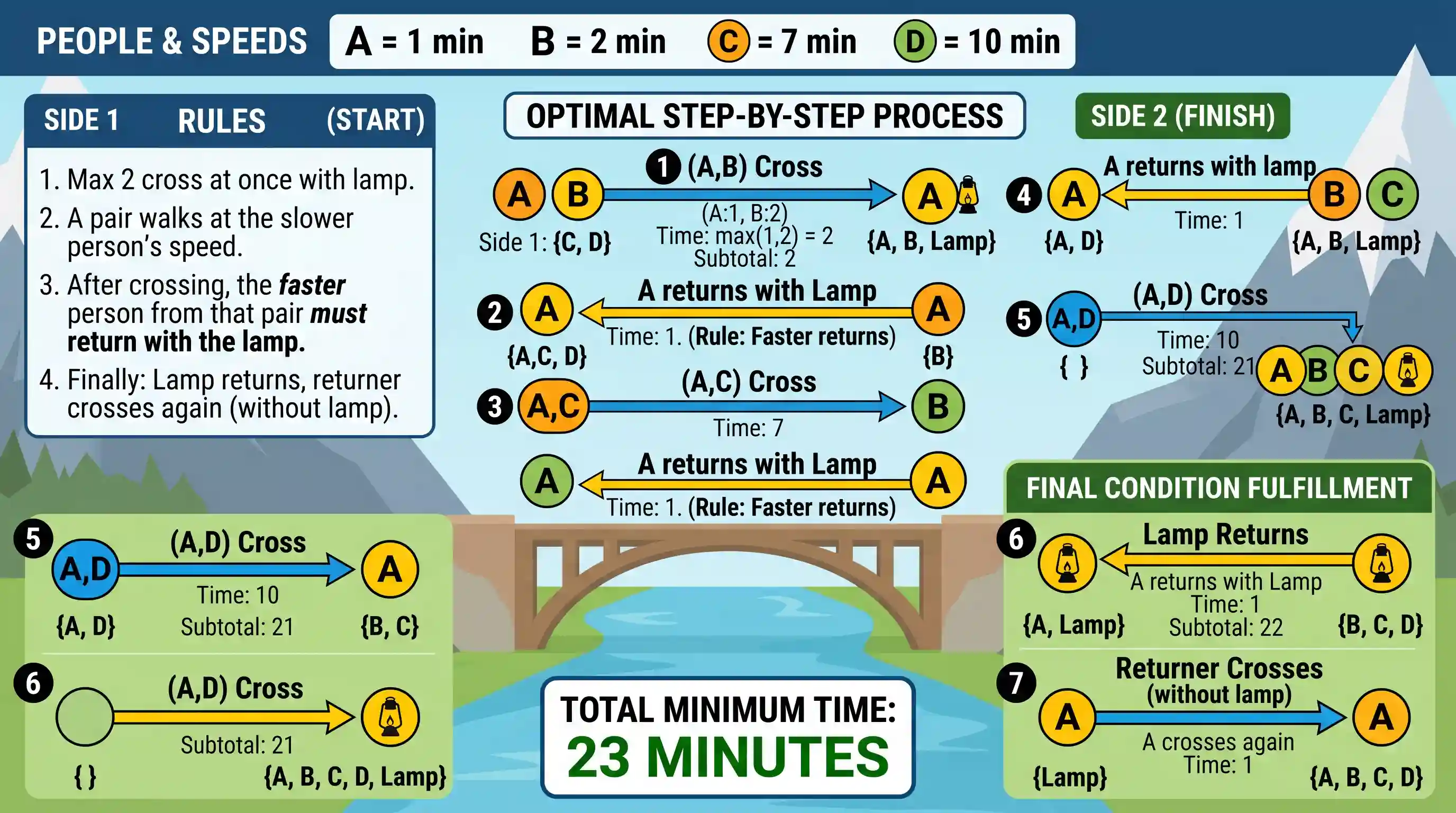
Step-by-step process:
- A and B cross from Side 1 to Side 2. Time taken = max(A, B) = max(1, 2) = 2 minutes. (Side 1: C, D; Side 2: A, B, Lamp)
- According to rule 4, A (the faster person in the A,B pair) returns with the lamp to Side 1. Time taken = 1 minute. (Side 1: A, C, D, Lamp; Side 2: B)
- A and C cross from Side 1 to Side 2. Time taken = max(A, C) = max(1, 7) = 7 minutes. (Side 1: D; Side 2: A, B, C, Lamp)
- According to rule 4, A (the faster person in the A,C pair) returns with the lamp to Side 1. Time taken = 1 minute. (Side 1: A, D, Lamp; Side 2: B, C)
- A and D cross from Side 1 to Side 2. Time taken = max(A, D) = max(1, 10) = 10 minutes. (Side 1: ; Side 2: A, B, C, D, Lamp)
At this point, all four friends are on Side 2, and the lamp is also on Side 2. Total time so far = 2 + 1 + 7 + 1 + 10 = 21 minutes.
Now, we must satisfy the final condition (rule 5): 6. The lamp has to be returned to the original place (Side 1). The fastest person to do this is A. A returns with the lamp. Time taken = 1 minute. (Side 1: A, Lamp; Side 2: B, C, D) 7. The person who returned the lamp (A) has to cross the bridge again without the lamp to join the other friends. Time taken = 1 minute. (Side 1: Lamp; Side 2: A, B, C, D)
All friends are now on Side 2, and the lamp is on Side 1. Total minimum time = 21 (for initial crossing) + 1 (lamp return) + 1 (final crossing) = 23 minutes.
Why other options are incorrect (or why other strategies are not optimal):
- A common strategy for the basic bridge problem (where the lamp can stay on Side 2) is to send the two fastest (A,B), A returns, then send the two slowest (C,D), B returns, then A,B cross again. This takes 2+1+10+2+2 = 17 minutes. However, this strategy is invalid here because of rule 4. After C and D cross, C is the faster person in the (C,D) pair, so C (not B) would have to return. If C returns, it adds 7 minutes instead of 2, making it longer.
- If we tried to force the 17-minute strategy and then add the final steps:
- (A,B) cross (2). A returns (1).
- (C,D) cross (10).
- According to rule 4, C (faster in C,D) must return. C returns (7).
- (A,C) cross (7) to get everyone across. Total = 2+1+10+7+7 = 27 minutes (before final steps), which is much longer.
- The strategy leading to 23 minutes is the most efficient one that strictly adheres to rule 4.
- If we tried to force the 17-minute strategy and then add the final steps:
The final answer is 23 minutes.
The final answer is A) 23 minutes
Related questions
More UPSC Prelims practice from the same subject and topic.
- Prelims 2016CSATLogical Reasoning
A person X was driving in a place where all roads ran either north-south or east-west, forming a grid. Roads are at a distance of 1 km from each other in a parallel. He started at the intersection of …
- Prelims 2016CSATLogical Reasoning
Five people A, B, C, D and E are seated about a round table. Every chair is spaced equidistant from adjacent chairs. (i) C is seated next to A (ii) A is seated two seats from D (iii) B is not seated n…
- Prelims 2016CSATLogical Reasoning
There are five persons in a group - P, Q, R, S and T. The group has one doctor, one lawyer and one artist. P and S are unmarried students. T is a man married to one of the group members. Q is the brot…
- Prelims 2016CSATLogical Reasoning
There are five persons in a group - P, Q, R, S and T. The group has one doctor, one lawyer and one artist. P and S are unmarried students. T is a man married to one of the group members. Q is the brot…
- Prelims 2016CSATLogical Reasoning
There are five persons in a group - P, Q, R, S and T. The group has one doctor, one lawyer and one artist. P and S are unmarried students. T is a man married to one of the group members. Q is the brot…
- Prelims 2016CSATLogical Reasoning
There are five persons in a group - P, Q, R, S and T. The group has one doctor, one lawyer and one artist. P and S are unmarried students. T is a man married to one of the group members. Q is the brot…